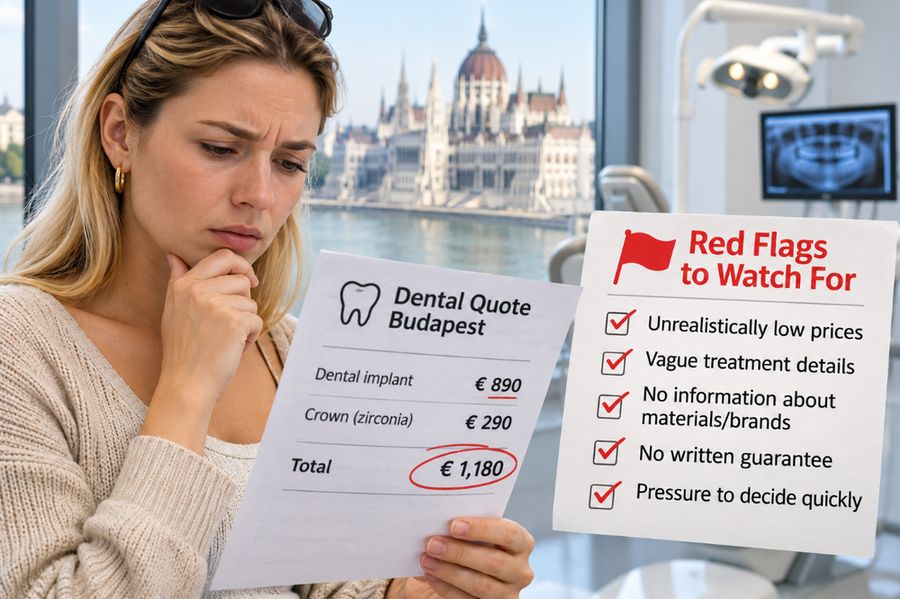
Key Takeaways
A €4,500 Budapest dental package can cost more than a €6,000 quote if it excludes necessary treatment stages. Compare the complete written plans – not just their advertised prices.
- Compare the same endpoint: one jaw or both, fixed or removable teeth, and temporary or definitive restorations.
- Check every inclusion: extractions, imaging, temporary teeth, implant components, the final bridge and adjustment appointments.
- Clarify “teeth in a day”: this may mean a temporary fixed bridge, and immediate loading depends on clinical suitability.
- Add the full travel budget: include all expected trips, accommodation, time off work and potential return visits.
- Read aftercare and warranty conditions: establish who handles complications, which costs are covered and who pays for additional travel.
- Resolve unknowns before paying: request written exclusions, conditional charges and a process for approving treatment changes.
Choose a clinically appropriate, clearly specified plan – not simply the lowest starting price.
Cheap Budapest Dental Quotes: How to Spot Hidden Costs and Compare Treatment Plans
A €4,500 dental implant package can cost more than a €6,000 package once both include the same treatment. The difference may be temporary teeth, extractions, imaging, implant components or the final bridge – not necessarily the quality of the dentistry.
That does not make every low-priced quote misleading. A clinic may offer excellent value through efficient workflows and straightforward pricing. Equally, a higher price does not automatically buy better care.
The problem begins when two treatment plans appear comparable but describe different endpoints.
One clinic may quote surgery and implants. Another may include surgery, temporary teeth and the definitive restoration. Both advertisements might use “All-on-4”, yet the patient is purchasing substantially different things.
For patients travelling from the United Kingdom, Ireland or the United States, this uncertainty matters twice: unexpected treatment costs can also create unexpected flights, accommodation and time away from work.
This guide provides a practical method for comparing Budapest dental quotes line-by-line. It includes an illustrative price comparison, a reusable checklist and questions that reveal missing costs before you commit.
Start with the Endpoint, Not the Headline Price
Before comparing individual charges, establish what each quote promises to deliver.
Ask:
“Does this total cover my treatment from assessment through delivery and adjustment of the agreed final teeth, or does it cover only one stage?”
Then establish whether the price applies to:
-
One tooth, one jaw or both jaws.
-
Implant placement alone or a complete restoration.
-
Fixed teeth or a removable overdenture.
-
Temporary teeth, definitive teeth or both.
-
A standard case or your assessed clinical needs.
An arch means the teeth in one jaw. A “full-arch” price does not necessarily cover the whole mouth.
Likewise, four implants do not mean four individual replacement teeth. In a full-arch restoration, several implants support a larger prosthesis.
Write a shared comparison sentence above both quotations:
“I am comparing treatment for one lower arch, including the agreed extractions, implant surgery, healing-stage teeth, necessary components and a specified definitive fixed bridge.”
If the plans do not fit the same sentence, resolve that difference first.
A Worked Example: When €6,000 Is Cheaper Than €4,500
Consider two fictional Budapest quotations for the same clinically agreed treatment scope.
The figures below are illustrative arithmetic, not current clinic prices, market averages or an assessment of what any patient needs.
For this example, both plans ultimately provide the same implant system, the same temporary fixed bridge and an equivalent definitive bridge.
| Treatment item | Quote A: €4,500 headline | Quote B: €6,000 package |
|---|---|---|
| Initial advertised package | €4,500 | €6,000 |
| Required assessment and imaging | €150 extra | Included |
| Agreed extractions | €400 extra | Included |
| Temporary fixed bridge | €650 extra | Included |
| Necessary restorative components | €400 extra | Included |
| Definitive bridge | Included | Included |
| Defined fitting and adjustment appointments | €150 extra | Included |
| Comparable clinical total | €6,250 | €6,000 |
Quote A initially appears €1,500 cheaper. Once the specified exclusions are added, it becomes €250 more expensive.
The lesson is not that packages are always better. It is that comparable scope matters more than the advertised starting figure.
This example also avoids a common comparison error: charging separately for every conceivable implant component. Different workflows use different parts. Include only the components required for the proposed treatment, and confirm whether they are already bundled.
Neither total above includes travel, accommodation, optional sedation, unexpected treatment changes or long-term maintenance.
Comparison rule: An unexplained blank is “unknown”, not “included” and not automatically “extra”. Ask the clinic to classify it.
Line 1: Assessment, Imaging and Treatment Planning
A photograph-based estimate can help you explore affordability. It cannot establish every clinical detail.
Ask whether the quote follows an examination by a dentist and what remains provisional.
Check the following:
-
Consultation and medical-history review.
-
Relevant dental examination.
-
Necessary radiographs or other imaging.
-
CBCT scanning, if clinically indicated.
-
Digital scans or impressions.
-
Treatment planning and any surgical guide.
A CBCT scan provides three-dimensional imaging, but it should be justified for the case – not treated as a mandatory shopping-list item for every patient.
Ask whether an existing suitable scan can be reviewed and whether further imaging might still be needed.
The red flag is not “final price subject to examination”. That can be an honest limitation.
The red flag is presenting an unassessed estimate as a guaranteed final price, then introducing foreseeable costs only after the patient arrives.
Request a written explanation of which findings could change the plan and how those changes would be priced.
Line 2: Extractions and Preparatory Treatment
“Implant package” does not necessarily include removing existing teeth.
Compare the number and type of extractions proposed. Ask whether the amount covers straightforward extractions, surgical extractions or both.
Also check whether either plan includes:
-
Treatment of existing gum disease.
-
Removal of failed implants.
-
Removal or sectioning of old bridges.
-
Treatment of infection.
-
Bone reshaping or other preparation.
These are not interchangeable procedures.
More importantly, a cheaper extraction-based plan may not be clinically equivalent to a plan preserving suitable teeth. Do not allow price comparison to bypass the question of whether irreversible treatment is justified.
If one clinic recommends removing an entire arch and another proposes retaining several teeth, pause the financial comparison. Request the diagnosis, prognosis and alternatives, and consider an independent opinion.
A written price cannot make an unnecessary procedure good value.
Line 3: Implant System, Number and Surgical Scope
“Four premium implants” is not a complete specification.
Ask for the manufacturer, system and planned number of implants in each jaw. Confirm whether the clinic may substitute another system and whether your approval would be sought.
The quote should distinguish straightforward implant placement from additional procedures such as grafting or advanced surgery.
For branded All-on-4 treatment, ask what the clinic means by the term. Patients sometimes encounter it used loosely for different four-implant full-arch solutions.
Do not assume that every four-implant package uses Nobel Biocare implants or follows an identical restorative protocol.
Useful questions include:
-
Who will perform the surgery?
-
What relevant training and experience do they have?
-
What happens if the planned number of implants cannot be placed?
-
How would a change affect the restoration, timetable and price?
A named brand supports traceability. It does not replace diagnosis, surgical competence or a maintainable restoration.
Line 4: Temporary Teeth During Healing
Temporary teeth are one of the most important differences between apparently similar quotes.
Ask exactly what you will wear between surgery and the final restoration:
-
A fixed provisional bridge.
-
A removable temporary denture.
-
An adapted existing denture.
-
No prosthesis for a defined period.
“Temporary dentures included” does not necessarily mean fixed teeth.
Likewise, “teeth in a day” commonly refers to a provisional restoration rather than the definitive bridge. Immediate loading depends on clinical findings, including implant stability; it should not be promised regardless of the surgical result.
Ask what happens if a fixed provisional cannot safely be fitted.
Will an alternative be provided? Is it included? Could the healing period or number of visits change?
Also clarify charges for temporary repairs, relining and adjustments.
A temporary bridge needs to function during a changing healing period, but it is not permission for unrestricted chewing. Written diet and cleaning instructions should accompany it.
The cheapest temporary option may be reasonable. An undisclosed temporary arrangement is the problem.
Line 5: Abutments and Other Implant Components
An implant fixture is the part placed in bone. Additional components connect it to a restoration or support particular stages of healing.
Depending on the treatment, a plan may refer to:
-
Healing abutments.
-
Temporary abutments or cylinders.
-
Definitive abutments.
-
Multi-unit abutments.
-
Prosthetic screws.
These terms do not describe the same item.
A healing abutment supports soft-tissue healing. It is not interchangeable with a definitive restorative abutment. Some full-arch workflows use multi-unit abutments without requiring a separately charged conventional healing-abutment stage.
Therefore, do not insist that every quote include four healing abutments simply because a checklist mentions them.
Instead ask:
“Are all components necessary for the planned temporary and definitive restorations included? Please identify any component charges that remain outside the total.”
If a clinic quotes “implant plus crown”, confirm whether the connecting component is included.
If a full-arch quote already bundles these parts, adding separate allowances would incorrectly inflate its price.
Line 6: The Definitive Bridge or Crowns
The final restoration can account for a major difference between two treatment totals.
“Permanent teeth” is too vague for a meaningful comparison. Definitive restorations still need maintenance and may eventually require repair or replacement.
Ask the clinic to specify:
-
Whether the restoration is fixed or removable.
-
The proposed material and supporting framework.
-
The number of teeth or units.
-
Whether it is one connected bridge or another design.
-
The fitting, try-in and adjustment appointments included.
-
The process if changes are needed before acceptance.
Acrylic, composite and zirconia descriptions alone may not explain the full construction. Ask whether “zirconia” means a particular full-arch design, individual crowns on a framework or another arrangement.
Do not assume the most expensive material is automatically best. Suitability depends on the bite, available space, opposing teeth, repair needs, cleaning access and clinical design.
If Quote A ends with temporary teeth while Quote B includes a definitive bridge, there is no valid price comparison until the missing final stage is added.
Line 7: Anaesthesia, Sedation and Medicines
Check what pain control is included.
Local anaesthesia, sedation and general anaesthesia are different services. A reassuring phrase such as “comfortable treatment” does not tell you which is planned.
Ask:
-
Is local anaesthesia included?
-
Is sedation optional or recommended?
-
Who administers and monitors it?
-
What additional assessment is required?
-
Are relevant prescriptions or take-home medicines included?
Do not add sedation to the budget automatically if it is neither wanted nor clinically indicated.
However, if you need it to undergo treatment, compare both plans on that basis before booking.
Also ask whether sedation affects escort requirements or your practical arrangements after the appointment.
Line 8: Visits, Travel and the Second Trip
Compare the full treatment journey, not just the first Budapest visit.
Request the expected number of trips, appointment days and nights needed for each stage. These are planning estimates, not guarantees that healing will follow a flight itinerary.
Check whether the quote includes:
-
Airport transfers.
-
Accommodation or a defined allowance.
-
Companion accommodation.
-
Transfers between appointments.
-
Additional nights if treatment is delayed.
“Free hotel” needs a duration, room category and conditions. “Transfers included” needs a defined route.
UK and Irish patients should calculate each return journey separately. US patients should allow for transatlantic travel, potentially longer stays and greater disruption if another trip becomes necessary.
Compare clinical totals in the quoted currency first. Then calculate your own travel budget using a consistent exchange-rate assumption.
Include card charges, currency-conversion costs and unpaid leave where relevant.
Do not assume ordinary travel insurance covers planned dental treatment or related complications. Check the actual policy wording.
Line 9: Aftercare, Maintenance and Warranties
Aftercare should describe responsibilities, not simply provide a telephone number.
Ask who reviews healing, who manages urgent problems and whether any home-country appointments are included.
A “UK partner” or “local aftercare service” may provide only selected assessments. Confirm its identity, location, scope and charges.
Separate three categories:
-
Included postoperative reviews and adjustments.
-
Chargeable long-term maintenance.
-
Remedial care following a complication or failure.
Then read the warranty conditions.
Does it cover an implant fixture, laboratory work or the entire replacement procedure? Are professional cleaning, review appointments or protective appliances required? Who pays for travel?
A manufacturer’s replacement component is not necessarily free surgery or a new bridge.
Never delay urgent local assessment while waiting for an overseas clinic to approve a warranty claim.
Five Red Flags That Deserve a Pause
1. The quote has no defined endpoint
You cannot tell whether the final teeth, temporary restoration or second treatment stage are included.
2. “All-inclusive” has no written schedule
The clinic repeats the phrase but will not identify exclusions, visit limits or optional upgrades.
3. Major changes need immediate approval after arrival
A legitimate new finding can change treatment. Pressure to approve irreversible work without explanation or reasonable consideration is different.
4. A guarantee replaces discussion of risks
No responsible treatment plan should depend on a promise that implants cannot fail or complications cannot occur.
5. Payment terms are clearer than clinical terms
You receive repeated deposit requests but no named clinician, itemised scope, change process or aftercare responsibilities.
A separate charge is not inherently suspicious. A charge that remains unexplained until you have little practical choice deserves scrutiny.
Your Free Line-by-Line Comparison Template
Copy this table into a document or spreadsheet. Use “included”, “extra”, “not needed” or “unknown” for each line.
| Comparison item | Clinic A | Clinic B |
|---|---|---|
| Same jaw, diagnosis and treatment endpoint? | ||
| Treating clinicians identified? | ||
| Examination and necessary imaging | ||
| Extractions and preparatory treatment | ||
| Implant manufacturer, system and quantity | ||
| Additional surgery, if indicated | ||
| Temporary teeth: fixed or removable | ||
| Alternative if immediate loading is unsuitable | ||
| Necessary implant components | ||
| Definitive restoration and construction | ||
| Fitting, try-ins and adjustments | ||
| Anaesthesia and any required sedation | ||
| Expected trips and appointment days | ||
| Included aftercare and exclusions | ||
| Maintenance and warranty conditions | ||
| Payment, cancellation and change terms | ||
| Comparable clinical total | ||
| Travel and accommodation allowance | ||
| Remaining unpriced items |
For each extra, request a price or range. For each unknown, request clarification. Do not turn “not needed” into a charge unless the clinician identifies a reason.
Keep confirmed costs separate from conditional allowances. A total with several unresolved items should not be labelled final.
A Message to Send Both Clinics
Thank you for my treatment proposal. I am comparing plans on the same clinical scope rather than headline price. Please confirm the total through delivery of the specified definitive restoration, including the planned temporary teeth, necessary components, preparatory treatment and adjustment appointments.
Please identify exclusions, conditional procedures and their prices or ranges. Please also confirm the expected visits, the alternative if immediate fixed teeth are unsuitable, aftercare responsibilities, warranty conditions and how treatment changes require my approval.
Clear, specific answers are useful evidence of transparent communication.
Choose the Clearest Complete Plan, Not the Lowest Starting Number
A €4,500 quotation may be genuine value. A €6,000 package may be more economical. Neither conclusion is possible until you establish that both describe the same treatment.
First compare clinical suitability. Then compare the complete scope, required travel, remaining uncertainty and aftercare responsibilities.
The strongest quotation is not necessarily the longest document. It is the one that explains what you are buying, what could change and who takes responsibility at each stage.
Before committing to Budapest dental treatment, request a written plan that survives this comparison. A clinic confident in its proposal should help you understand the differences – not ask you to ignore them.
Frequently Asked Questions
Why can a €4,500 All-on-4 quote cost more than a €6,000 package?
The lower quote may cover only part of the treatment, such as implant placement, while excluding extractions, temporary teeth, necessary components or the definitive bridge. A higher quote may include those stages. Compare both plans through the same endpoint before deciding which offers better value. These figures are illustrative, not verified Budapest prices.
What should I check in a Budapest dental treatment quote?
Check which jaw and procedures the quote covers, the implant system and quantity, the temporary teeth, the definitive restoration and all necessary components. Ask whether imaging, extractions, anaesthesia and adjustments are included. The plan should also explain expected visits, exclusions, conditional charges, aftercare and payment terms.
Does “teeth in a day” include the final implant bridge?
Not necessarily. The phrase may describe a temporary fixed bridge provided around the time of implant surgery, with the definitive restoration fitted later. Ask which restoration the advertised price includes and what the final stage will cost. Also request the alternative arrangement if immediate fixed teeth are not clinically suitable.
Are separate charges for extractions or implant abutments a red flag?
Not automatically. Itemised charges can make a quote more transparent, and the components required depend on the treatment design. The concern is an essential charge that remains undisclosed or unexplained. Ask the clinic to confirm that the total includes every component and procedure necessary to deliver the agreed treatment.
How can I compare aftercare and warranties between two clinics?
Ask both clinics to identify included reviews, adjustment appointments, emergency arrangements and maintenance requirements. Check whether warranty coverage applies to components, laboratory work, corrective treatment or a combination. Confirm who pays for additional flights and accommodation. A longer warranty is not necessarily more useful if its exclusions make it difficult to access.
Sources
- General Dental Council: Going abroad for dental treatment – Patient questions about assessment, clinician qualifications, insurance, complications, aftercare and additional travel costs.
- General Dental Council: Written treatment plans and communication – A UK reference point for explaining proposed treatment and realistic costs, not a statement that GDC rules govern Hungarian clinics.
- Nobel Biocare: All-on-4 treatment concept procedures manual – Provisional and definitive restorations, implant stability and restorative components.
- Nobel Biocare: Healing abutments instructions for use – The function of healing abutments within implant treatment.
- General Dental Council: Prosthodontics specialty curriculum – Treatment planning, provisional and definitive restorations, maintenance and cost considerations.