Key Takeaways
- When a tooth is missing for a long time, the nearby teeth can drift, tip, or move into the empty space, while the opposing tooth may over-erupt into the gap.
- This movement can leave a space that looks open but is no longer large enough—or correctly shaped—for a dental implant and a natural-looking implant crown.
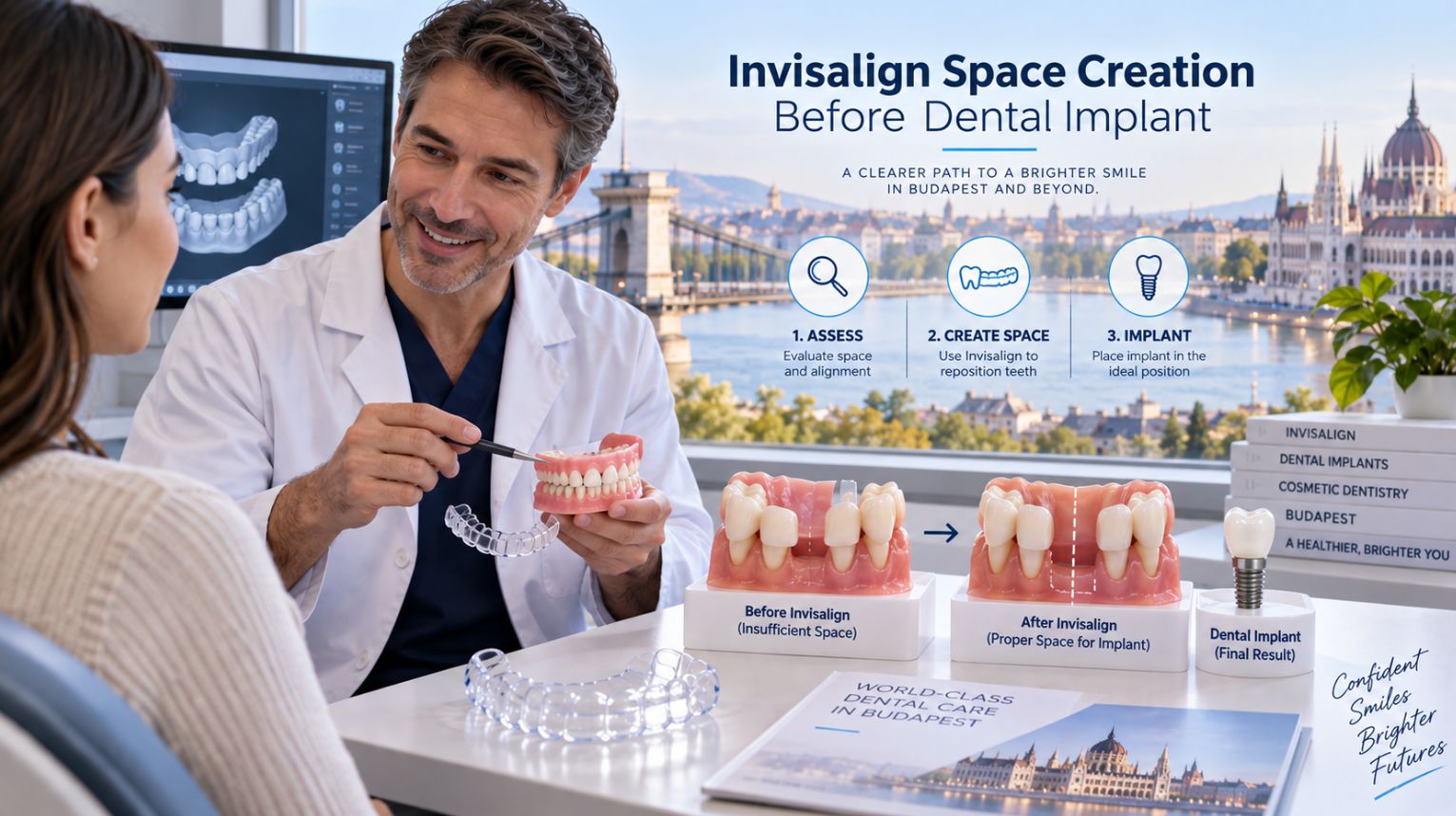
- Invisalign can act as a space-creation treatment, not just a cosmetic tooth-straightening option.
- Clear aligners may help upright tipped molars, reposition neighbouring teeth, reopen a collapsed gap, improve root spacing, and prepare the area for future implant placement.
- The objective is not simply to make the visible gap wider. The dental team must create the correct horizontal space, root clearance, vertical bite space, and appropriate gum-and-bone conditions for an implant.
- In many cases, the ideal order is: diagnosis → gum and tooth stabilisation → final implant-crown planning → Invisalign space creation → reassessment → implant placement → healing → final crown → retention and maintenance.
- The final implant crown should be planned before Invisalign begins. This lets the orthodontic treatment create enough space for a crown with natural width, shape, gum contours, bite contacts, and cleaning access.
- Invisalign may be particularly helpful after an old extraction when a neighbouring molar has tipped into the gap, reducing room for an implant.
- A clinician may use attachments, elastics, bite ramps, or refinement aligners to achieve controlled tooth movements. More difficult cases may require fixed braces, temporary anchorage devices, or a combination approach.
- A visible gap does not guarantee that an implant will fit safely. X-rays and, where clinically appropriate, CBCT imaging may be needed to evaluate root positions, bone volume, nerves, sinus anatomy, and available space.
- Active gum disease, untreated decay, infection, poor oral hygiene, and unstable teeth or restorations should be treated before Invisalign or implant surgery.
- After Invisalign creates the space, the gap must be protected with a retainer, temporary tooth, bonded provisional restoration, or another space-maintaining option so teeth do not drift back before implant treatment.
- Invisalign is not suitable for every implant-preparation case. Severe tipping, advanced bone loss, complex bite problems, multiple missing teeth, or inconsistent aligner wear may make fixed braces or another treatment strategy more predictable.
- Dental implants replace missing teeth, but they do not move like natural teeth. Careful orthodontic planning before implant placement can improve the final result’s appearance, function, cleanability, and long-term stability.
- UK and US patients considering treatment in Budapest should request a written treatment timeline with Invisalign reviews, potential refinements, implant surgery, healing, temporary tooth options, final crown timing, retention, costs, travel visits, and aftercare arrangements.
Invisalign Before Dental Implants: Fixing Tipped Teeth and Collapsed Gaps
When a tooth has been missing for months or years, the surrounding teeth often drift, tip, or over-erupt into the gap. Invisalign can sometimes act as a carefully planned space-creation treatment, moving natural teeth into more favourable positions so a dental implant and crown can fit properly, look natural, and function comfortably.
For patients in the US, UK, or considering treatment in Budapest, this matters because replacing a missing tooth is not always as simple as inserting an implant into an old extraction site. The existing space may be too narrow, the neighbouring tooth roots may be too close, the bite may have changed, or the opposing tooth may have moved into the gap. In these situations, orthodontic alignment can be the bridge between an old missing-tooth space and a high-quality implant restoration.
Why Teeth Shift After Tooth Loss
Teeth are not fixed in place as isolated structures. They work as part of a connected chewing system. Each tooth is influenced by its neighbours, the tooth it bites against, the surrounding bone and gum tissues, and everyday chewing forces.
When a tooth is removed or lost, the balance changes. The adjacent teeth may gradually lean or drift toward the empty space. The opposing tooth—the tooth in the other jaw that previously met the missing tooth—may slowly move downward or upward into the space. This process is often called over-eruption.
The result can be a gap that looks open from the front but is no longer suitable for a standard implant crown.
A British Dental Journal review explains that, after tooth loss, adjacent and opposing teeth commonly tip, drift, or over-erupt into the space, creating relationships that may not be optimal for replacement. It also notes that orthodontic correction can improve prosthetic replacement, function, hygiene, and aesthetics.
What commonly happens after an extraction
A long-standing missing tooth can lead to several changes:
- The tooth in front of the gap may tip backward into the space.
- The tooth behind the gap may tip forward into the space.
- Roots may move closer together beneath the gum line.
- The opposing tooth may over-erupt because it has lost its bite contact.
- The gap may become too narrow for a normal-sized implant crown.
- The bite may become uneven.
- Food may pack into the area.
- Cleaning may become harder.
- The gums and bone in the extraction area may change over time.
- The teeth can look acceptable in photographs while the implant site remains unsuitable clinically.
These changes are particularly common after the loss of a back tooth, such as a first molar. The second molar often tilts forward into the empty space, while the premolar in front may drift backward. This can reduce both the width and vertical height needed for an implant-supported crown.
Invisalign as a Space-Creator
Invisalign is widely associated with correcting crowded front teeth, but its restorative role can be just as valuable. In selected cases, clear aligners can be used to create, reopen, redistribute, or preserve space for a future implant restoration.
The treatment goal is not simply to make the gap wider. A quality plan must create appropriate three-dimensional space:
-
Mesiodistal space: the horizontal width between neighbouring teeth.
-
Root space: sufficient room between the roots of adjacent natural teeth.
-
Vertical space: enough height between upper and lower teeth for an implant crown and its components.
-
Buccolingual space: enough width in the jawbone from cheek side to tongue or palate side.
-
Soft-tissue space: adequate gum thickness and contour for an aesthetic, cleanable result.
A 2026 prospective cohort study of 97 patients needing orthodontic space opening for future single-tooth implant restorations found that both clear aligners and fixed appliances were effective in opening potential implant-prosthetic space. The study reported that longer-standing tooth loss and larger space requirements tended to be associated with longer treatment.
This does not mean Invisalign is appropriate for every space-creation case. It means clear aligners can be part of a restorative strategy when the clinician has sufficient control of the required tooth movements and the patient wears the aligners reliably.
The Main Goal: Create the Right Implant Site
An implant crown should not be treated as a generic artificial tooth placed wherever a gap appears. It needs to be designed around the future smile, bite, gum tissue, and functional demands of the patient.
The dental team should consider:
- The correct width and shape of the replacement tooth.
- The location and angle of the implant.
- The position of neighbouring roots.
- The thickness and level of surrounding gum tissue.
- Bone availability.
- The location of nearby nerves or sinus anatomy.
- The patient’s bite, grinding risk, and chewing pattern.
- The shade, texture, and translucency of the final crown.
- How easily the crown and gum margin can be cleaned.
The British Dental Journal describes this as restorative-driven treatment planning: the proposed final restoration is visualised first, and the treatment sequence is then designed backwards from that endpoint.
For patients considering Invisalign before an implant, this means the implant surgeon and orthodontic provider should communicate early. The aligner plan should not simply straighten visible teeth; it should create the precise conditions needed for the implant restoration.
How Invisalign Can Correct Tipped Teeth
Tipped teeth are one of the main reasons an old extraction site becomes difficult to restore with an implant.
Why molars tip into a gap
When a lower first molar is lost, the second molar behind it often gradually tilts forward. Instead of remaining upright, the crown leans into the gap while the root position becomes unfavourable.
This can cause several problems:
- The implant space becomes narrower at the chewing surface.
- Root spacing may be inadequate below the gum line.
- The tooth may create a deep gum pocket that is difficult to clean.
- The opposing upper molar can over-erupt.
- The final implant crown may have insufficient height.
- Bite forces may become uneven.
- The future implant may need to be smaller than ideal or may require a more complex restoration.
Orthodontic uprighting moves the tilted natural tooth into a more vertical orientation. This can restore a healthier relationship between the tooth, gum, bone, and future implant site.
A clinical report on molar uprighting notes that treatment to upright a molar inclined toward an edentulous space is often necessary before implant placement. Similarly, restorative-orthodontic literature describes uprighting mechanics as a way to correct tilted or drifted teeth and regain space for implant replacement.pubmed.ncbi.nlm.nih+1
Can Invisalign upright a molar?
In selected cases, yes. Invisalign can be planned to move a tipped molar or premolar, but the predictability depends on the amount of tipping, root position, bone support, bite interference, aligner wear, attachments, elastics, and clinician experience.
Some cases may be treated successfully with clear aligners. Others may need fixed braces, temporary anchorage devices, sectional orthodontics, or a combination of methods to achieve the required root movement and anchorage.
The correct appliance is the one that can deliver the necessary movement safely and predictably—not automatically the least visible one.
Invisalign for Implant Space: Step-by-Step Process
Step 1: Investigate the missing-tooth site
The first appointment should be comprehensive. A clinician needs to understand why the tooth was lost, how long it has been missing, what has changed since extraction, and whether the surrounding teeth and gums are healthy.
Assessment may include:
- Dental and medical history.
- Gum and periodontal examination.
- Bite and jaw-function assessment.
- Digital scans.
- Clinical photographs.
- X-rays.
- CBCT imaging where clinically justified for implant planning.
- Review of existing crowns, bridges, root-treated teeth, and implants.
- Evaluation of grinding, clenching, smoking, and oral hygiene habits.
A missing tooth caused by untreated gum disease or recurrent infection requires more than space creation. The underlying cause must be controlled first, or future implant treatment may carry increased risk.
Step 2: Decide whether the tooth space should be opened, closed, or maintained
An implant is not always the only solution. Depending on the tooth involved, the bite, tooth proportions, age, facial aesthetics, and available bone, the team may consider:
- Orthodontically opening the space for an implant.
- Maintaining an existing suitable space.
- Closing the space with natural teeth.
- Replacing the tooth with a conventional bridge.
- Considering a resin-bonded bridge in suitable front-tooth cases.
- Using a removable partial denture.
- Planning a broader full-mouth restorative treatment.
The ideal choice should be made only after reviewing the final smile and bite.
Step 3: Plan the final implant crown before Invisalign begins
The implant crown should be planned before the teeth move. This may involve a digital wax-up or mock-up showing the intended shape, width, and position of the replacement tooth.
The orthodontic plan can then create the right amount of room around that crown.
The restorative team should communicate key information to the Invisalign provider, including:
- The ideal width of the future implant crown.
- The desired position of adjacent tooth roots.
- The intended implant location.
- Vertical clearance needed for the crown.
- Aesthetic requirements in the visible smile zone.
- Whether the patient may need grafting or gum treatment.
The implant site requires more than a visible gap. Literature on orthodontic-restorative planning notes that adequate mesiodistal, vertical, and buccolingual dimensions should be planned for both the implant and the final implant-supported restoration.
Step 4: Begin Invisalign space creation
The Invisalign plan may include attachments, interproximal reduction in other parts of the arch, elastics, bite ramps, or carefully sequenced aligners to create space without compromising the rest of the bite.
The provider may aim to:
- Upright a molar or premolar.
- Move a tooth backward or forward.
- Open the space gradually.
- Correct rotations.
- Align the roots beside the future implant.
- Improve a crossbite or overbite that affects the implant site.
- Stop an opposing tooth from over-erupting.
- Improve the overall smile while creating restorative space.
For successful movement, patients generally need to wear aligners close to full time, commonly around 20–22 hours daily, following the schedule set by their clinician. Clear aligners must be actively monitored, whether reviews take place in person or through an appropriately managed remote system.
Step 5: Reassess space and roots
At the end of the first Invisalign phase, the dental team should not automatically proceed to implant surgery. They should confirm that the site is truly ready.
This reassessment may include:
- Measuring the final gap.
- Checking root positions radiographically.
- Assessing vertical and horizontal bone dimensions.
- Reviewing gum thickness and gum levels.
- Checking bite contacts.
- Confirming that the opposing tooth has not over-erupted.
- Considering refinement aligners if necessary.
- Taking new digital scans.
- Reviewing the final implant crown design.
In some cases, Invisalign refinement aligners are needed to perfect root position, spacing, or bite before the implant is placed.
Step 6: Preserve the newly created space
Once space has been created, it must be maintained. Teeth can drift back into a new gap if orthodontic retention is ignored.
A retainer, temporary tooth, bonded provisional restoration, or another space-maintaining solution may be needed while the implant site is prepared and the implant heals.
Orthodontic-restorative research stresses that the final planned position of teeth should be maintained after site development; failure to maintain the space can compromise implant placement and lead to the need for further orthodontic treatment.
Step 7: Implant placement and final crown
Once the site is stable and suitable, the implant can be placed in the planned position. Depending on the patient’s bone, gums, medical history, implant stability, and aesthetic requirements, the clinician may recommend bone grafting, soft-tissue grafting, delayed loading, or temporary restoration during healing.
The final implant crown should be made only after the implant, gum tissues, and bite are stable. Its colour, shape, contour, and bite contacts should complement the newly aligned natural teeth.
Case Study Example: Reopening a Lower Molar Space
Consider an illustrative example.
A 49-year-old patient lost a lower first molar more than a decade ago. They delayed replacement because they could chew reasonably well on the other side. Over time, the second molar behind the gap tipped forward, the premolar in front drifted backward, and the upper molar moved slightly downward into the space.
At first glance, there appears to be a gap. However, imaging shows that:
- The visible space is too narrow for a natural-sized molar crown.
- The neighbouring roots lean into the implant site.
- Vertical space has reduced because the upper tooth has over-erupted.
- The tipped second molar is difficult to clean around.
- A direct implant would require compromise in crown width, implant position, or both.
A restorative-led plan may involve:
- Gum-health assessment and professional hygiene.
- Digital smile and bite planning.
- Invisalign with attachments to upright the lower second molar.
- Controlled repositioning of the premolar and second molar to create correct space.
- Possible management of the over-erupted upper molar.
- Refinement aligners to perfect root positions.
- Retention or a temporary tooth to preserve the space.
- CBCT-guided implant planning.
- Implant placement and healing.
- A final implant crown designed for proper bite contacts and easy cleaning.
The outcome is not simply “a bigger gap.” It is a better-positioned, healthier, more functional implant site.
Invisalign Versus Fixed Braces for Space Creation
Clear aligners can be very effective, but they are not automatically the best tool for every tipped-tooth case.
A recent cohort study found that both clear aligners and fixed orthodontic appliances could open potential implant-restorative spaces. In that study, clear aligners were used in short-to-medium duration cases, while fixed appliances were used more often in very long treatments.
The point is not that one treatment is universally superior. The point is that the clinician must choose the appliance that gives the required control for the individual anatomy and implant plan.
Signs You May Need Space Creation Before an Implant
You may benefit from Invisalign or other orthodontics before an implant if:
- A tooth has been missing for years.
- The gap looks narrower than the neighbouring tooth on the other side.
- A molar has tipped forward or backward into the space.
- You have food trapping beside the missing-tooth area.
- The opposing tooth has moved down or up into the gap.
- You have crowding as well as a missing tooth.
- Your dentist says the roots beside the gap are too close.
- The implant crown would need to be unusually narrow or wide.
- You have an old bridge and teeth have shifted around it.
- You want Invisalign for cosmetic reasons and also need an implant.
- You are planning crowns, veneers, or a larger smile reconstruction.
- You have relapse after previous braces and a missing tooth.
A visible gap is not a clinical diagnosis. Only examination and imaging can confirm whether an implant can be placed safely and whether orthodontic site development would improve the result.
Important Limits and Risks
Invisalign space creation is a clinical treatment, not a simple cosmetic adjustment.
Healthy gums are essential
Active gum disease, untreated decay, infection, and poor plaque control need treatment before orthodontics or implant surgery. Moving teeth through unhealthy supporting tissues can worsen instability and compromise future treatment.
Bone cannot be assumed from the gap
A large-looking gap does not guarantee adequate bone for an implant. Bone loss after extraction may require grafting even if orthodontics has created enough tooth space.
Not every case is suited to Invisalign
Severe molar tipping, complex root movement, extensive bone loss, multiple missing teeth, significant bite collapse, or poor aligner compliance may make braces, temporary anchorage devices, or another strategy more appropriate.
Space must be retained
Newly created implant space can be lost if retainers or temporary restorations are not worn as instructed.
Implants still need lifelong care
An implant does not decay, but the surrounding gums and bone can develop inflammation and disease. Daily cleaning, professional maintenance, and prompt attention to bleeding, swelling, looseness, pain, or bite changes are essential.
Treatment Timing for UK and US Patients Visiting Budapest
International patients should plan restorative alignment carefully. Invisalign can involve months of active treatment and potential refinement stages; implant treatment may require a separate surgical appointment, healing period, and later restorative visit.
Before beginning treatment in Budapest, request a written treatment roadmap covering:
- Consultation and diagnostic records.
- Invisalign scan, treatment plan, and expected duration.
- Number of aligner review appointments.
- Remote-monitoring options and clinical safeguards.
- What happens if aligners are lost or attachments detach.
- Whether refinements are included.
- How the new implant space will be retained.
- Implant surgery timing and healing expectations.
- Whether grafting may be necessary.
- Temporary-tooth options.
- Final crown appointment timing.
- Retainer and night-guard arrangements.
- Itemised cost, warranty, and exclusions.
- Transferable records for your dentist at home.
- Emergency and long-term maintenance arrangements in the UK or US.
Dental tourism may offer value, but only when the staged plan remains clinically safe and practical after travel is included.
Final Verdict
For patients whose teeth have shifted after tooth loss, Invisalign can be much more than a cosmetic straightening treatment. It can act as a restorative alignment tool that uprights tipped teeth, reopens collapsed spaces, improves root positions, and helps create a site where a dental implant can be placed properly.
The most successful outcome comes from collaboration: the orthodontic plan must be designed around the future implant crown, not simply around a straighter-looking smile. In many cases, clear aligners can create a more natural implant space, improve bite balance, and reduce the compromises that arise when an implant is placed into a poorly positioned old extraction gap.
However, Invisalign is not right for every implant-preparation case. The decision should be based on imaging, gum health, tooth-root position, bone volume, bite mechanics, aligner compliance, and the ability of the dental team to deliver the final implant restoration safely.
For a long-standing missing tooth, the most important question is not, “Can an implant fit in the gap today?” It is, “What needs to change so the final implant crown looks natural, functions well, and remains healthy for years?”
FAQs: Invisalign for Implant Space Creation
Can Invisalign create space for a dental implant?
Yes. Invisalign can create or reopen space for a future dental implant by moving natural teeth that have drifted, tipped, or rotated into an old extraction gap. It may help widen the visible space, improve root separation below the gum line, and support a more natural position for the final implant crown.
A recent clinical study found that both clear aligners and fixed appliances can successfully open potential implant-restorative spaces when adjacent teeth have shifted after tooth loss.
Why do teeth shift after a tooth is lost?
After a tooth is extracted or lost, nearby teeth can gradually lean into the empty space. The tooth in the opposite jaw may also move into the gap because it no longer meets an opposing tooth.
This can make the site narrower, reduce room for the final crown, change bite contacts, and make cleaning more difficult. Orthodontic literature describes tooth drifting and over-eruption as common problems in long-standing missing-tooth spaces.
Can Invisalign upright a tipped molar before an implant?
In selected cases, yes. Invisalign can be used to upright a tipped molar or premolar, particularly where a tooth has leaned into a missing-tooth space. The aim is to regain room for an implant crown, improve root orientation, and establish more balanced bite contacts.
Whether clear aligners are appropriate depends on the severity of tipping, gum and bone support, root position, bite interference, treatment goals, and the patient’s ability to wear aligners consistently. More complex cases may be better treated with fixed braces, temporary anchorage devices, or a combined orthodontic approach.
Why does a tipped tooth make implant treatment difficult?
A tipped tooth can take up the room needed for an implant and its crown. Even if the top of the gap looks wide enough, the roots under the gum may be angled into the implant site.
Implant planning requires room in several directions: between adjacent teeth, between their roots, vertically against the opposing tooth, and within the jawbone. Orthodontic planning can help create adequate space before irreversible implant surgery.
How much space is needed for a dental implant?
The precise space requirement depends on the tooth being replaced, implant system, implant diameter, crown design, root positions, bone volume, gum tissues, and bite. It cannot be safely assessed with a mirror or photograph alone.
As a general technical reference, orthodontic-implant literature has described approximately 8 mm of mesiodistal space as a minimum for a conventional 4 mm implant in some situations, although narrower implants and site-specific factors can change the requirement. Your implant clinician should confirm the required space using clinical records and imaging.
Can Invisalign create root space, not just a visible gap?
Yes. This is one of the most important benefits of restorative orthodontics. Invisalign can be planned to improve the angle and position of the roots of neighbouring teeth, helping create safer room for implant placement.
A visible gap is not enough. The implant clinician needs appropriate clearance around roots beneath the gum line, alongside suitable bone and gum conditions.
Is it better to get Invisalign before a dental implant?
Often, yes. Natural teeth can be moved with Invisalign, while a fully integrated dental implant stays fixed in the jawbone. If the surrounding teeth are crowded, tipped, or poorly positioned, Invisalign is commonly completed before placing the final implant.
This order lets the dental team position teeth and roots first, then place the implant in the most favourable position for appearance, function, and long-term cleaning.
Can I get Invisalign if I already have an implant?
Sometimes. Invisalign can move your natural teeth around an existing implant, but it cannot move the implant or implant crown itself.
This can work well when the implant is outside the main area of tooth movement. If the implant is beside teeth that need extensive repositioning, the plan becomes more complex and the implant crown may need to be remade after orthodontics.
Can Invisalign fix a gap that is too small for an implant?
Yes, potentially. Invisalign can move neighbouring teeth apart to reopen a narrow extraction space and create a more suitable area for an implant crown.
The treatment plan should be based on the final crown design, not simply on making the gap look larger. The dental team needs to assess crown width, root clearance, bone volume, gum contours, and bite contacts.
Can Invisalign fix a gap that is too large for an implant?
Yes, in some cases. If a missing-tooth space is too wide, Invisalign can redistribute the space by moving neighbouring teeth, closing part of the gap, or balancing spacing across the dental arch.
This can help prevent an implant crown from looking unnaturally broad or out of proportion with the tooth on the opposite side of the smile.
Can Invisalign correct an over-erupted tooth before an implant?
In some cases, yes. When a tooth has no opposing contact after tooth loss, it may gradually over-erupt into the gap. This can reduce the vertical space available for an implant crown.
Invisalign may be able to improve selected over-eruption cases, but the feasibility depends on the amount of movement needed, root position, bone support, bite forces, and whether additional orthodontic tools are required. Severe cases may require fixed orthodontics, enamel reshaping, restorative adjustment, or another treatment plan.
Will I need attachments for Invisalign space creation?
Often, yes. Attachments are small tooth-coloured composite shapes placed on selected natural teeth. They help clear aligners grip teeth more effectively and improve control of movements such as molar uprighting, rotations, root positioning, and tooth translation.
Attachments are a normal part of many Invisalign plans and do not mean treatment has failed.
Will I need braces instead of Invisalign?
Possibly. Invisalign can be highly effective for selected restorative alignment cases, but fixed braces may provide more predictable control for severe molar tipping, complex root movements, difficult bite correction, large spaces, or situations requiring temporary anchorage devices.
Your orthodontic provider should recommend the appliance that can achieve the required result safely and predictably—not simply the least visible one.
How long does Invisalign space creation take?
Treatment time depends on how much the teeth have shifted, how long the tooth has been missing, whether roots need to move, whether an opposing tooth has over-erupted, and how consistently you wear aligners.
Minor space adjustment may take several months. More complex molar uprighting, bite correction, and implant-site development can take longer. In the available clinical evidence, longer-standing tooth loss and larger space-opening needs were associated with longer orthodontic treatment.
How often must I wear Invisalign aligners?
Most patients are instructed to wear aligners for approximately 20–22 hours each day. You normally remove them for meals, brushing, flossing, and drinks other than water.
Space creation depends on reliable tooth movement, so inconsistent wear can cause delays, poor tracking, additional refinement aligners, or a less predictable implant-preparation result.
Is Invisalign space creation painful?
You may feel pressure or mild tenderness when beginning a new aligner or when a tooth is actively moving. This is usually temporary and often settles within a few days.
Persistent severe pain, swelling, a tray that does not fit, a loose attachment, or signs of infection should be reported promptly to your dentist or orthodontist.
Will I need a temporary tooth during Invisalign treatment?
Possibly. If the missing tooth is visible when you smile or speak, a temporary replacement may be included in a clear retainer, a removable appliance, a bonded temporary tooth, or another provisional solution.
The best option depends on the position of the gap, planned orthodontic movements, bite forces, appearance requirements, and future implant plan.
What happens after Invisalign creates the implant space?
Once the orthodontic phase is complete, the implant team reassesses the space, tooth roots, bite, gums, and bone. This may involve a new scan, X-rays, or CBCT imaging where clinically appropriate.
If the site is ready, the next stages may include implant placement, healing, a temporary restoration, and a final implant crown. If spacing or root positions are not yet ideal, additional refinement aligners may be needed first.
Do I need a retainer before the implant is placed?
Usually, yes. After Invisalign creates space, teeth can drift back if the space is not retained. Your clinician may provide a retainer, a temporary tooth within a retainer, a bonded provisional restoration, or another appliance to preserve the space during implant planning and healing.
Retention is especially important because even small tooth movements can affect implant spacing and the fit of the future crown.
Do I need bone grafting after Invisalign?
Possibly. Invisalign can create suitable space between teeth, but it cannot guarantee sufficient jawbone for an implant. Bone may reduce after extraction, particularly if the tooth has been missing for a long time.
Your implant clinician may recommend grafting if the bone volume or contour is inadequate for a stable, aesthetic implant position. This decision should be made using clinical examination and appropriate imaging.
Can gum disease affect Invisalign or implant treatment?
Yes. Active gum disease, untreated tooth decay, infection, and poor oral hygiene should be treated before Invisalign or implant surgery.
Healthy gums and stable bone are essential for controlled orthodontic movement and implant longevity. Patients with a history of periodontal disease may need closer maintenance appointments before, during, and after treatment.
Can a dental implant be placed as soon as Invisalign ends?
Sometimes, but not automatically. Your dentist needs to confirm that the space, root clearance, gum health, bone volume, and bite are suitable. Some patients require refinement aligners, a retainer phase, bone grafting, or further healing before implant surgery.
The correct timing is based on the final implant plan, not simply the date you finish wearing your last Invisalign tray.
How long after implant surgery is the final crown fitted?
This varies. The timing depends on implant stability, healing, bone quality, grafting, the location of the implant, gum healing, and the clinician’s loading protocol.
Some patients may receive a temporary tooth soon after surgery, while the final crown is fitted only after the implant and surrounding tissues are stable enough for a predictable long-term result.
Can I use Invisalign if I am considering dental treatment in Budapest?
Yes, but treatment abroad needs detailed coordination. Invisalign may take months and can require progress reviews, refinements, and retainers; implant treatment may require separate surgery, healing, and final-crown visits.
Before starting, ask for a written timetable covering aligner reviews, remote-monitoring arrangements, temporary-tooth options, implant surgery, likely healing stages, final crown timing, total costs, warranty conditions, digital records, and follow-up options after you return to the UK or US. The British Orthodontic Society advises that orthodontic treatment, including clear aligner treatment, should be actively monitored by the treating clinician either remotely or face to face.
What should I ask at a consultation for Invisalign and an implant?
Ask these key questions:
- Is my existing gap suitable for an implant, or do I need space creation first?
- Are my neighbouring roots too close or angled into the implant site?
- Can Invisalign upright the teeth that have tipped into the gap?
- Will Invisalign create enough horizontal and vertical space?
- Do I need treatment for an over-erupted opposing tooth?
- Do I need bone or gum grafting?
- Who will coordinate my orthodontic and implant treatment?
- Will I need attachments, elastics, braces, or temporary anchorage?
- How will the newly created space be retained?
- Are refinement aligners included?
- What is included in the full cost?
- How will treatment and aftercare work if I live in the UK or US?
What is the most important goal of Invisalign space creation?
The goal is not simply a larger gap. It is a properly planned implant site with enough room for a natural-looking, cleanable, stable, and functional implant crown.
That requires correct tooth positions, root clearance, bite space, gum support, bone volume, and long-term retention. Invisalign can be an excellent space-creation tool when it is coordinated with implant and restorative planning from the beginning.
Sources
- British Dental Journal – The Role of Orthodontics in Implant Dentistry
- British Dental Journal – Surgical Guidelines for Dental Implant Placement
- PubMed – Adjunctive Orthodontic Applications in Dental Implantology
- PubMed – Molar Uprighting Before Implant Placement
- Medicina – Orthodontic Preparation of Implant Prosthetic Space for Single-Tooth Restorations
- Journal of Oral Implantology – Orthodontic Considerations for Implant-Supported Restorations
- British Orthodontic Society – Monitoring Clear Aligner Treatment
This article is for general educational information only. Invisalign, implant treatment, and space creation require an in-person assessment, diagnostic imaging where appropriate, and an individual treatment plan from qualified orthodontic, restorative, and implant professionals.