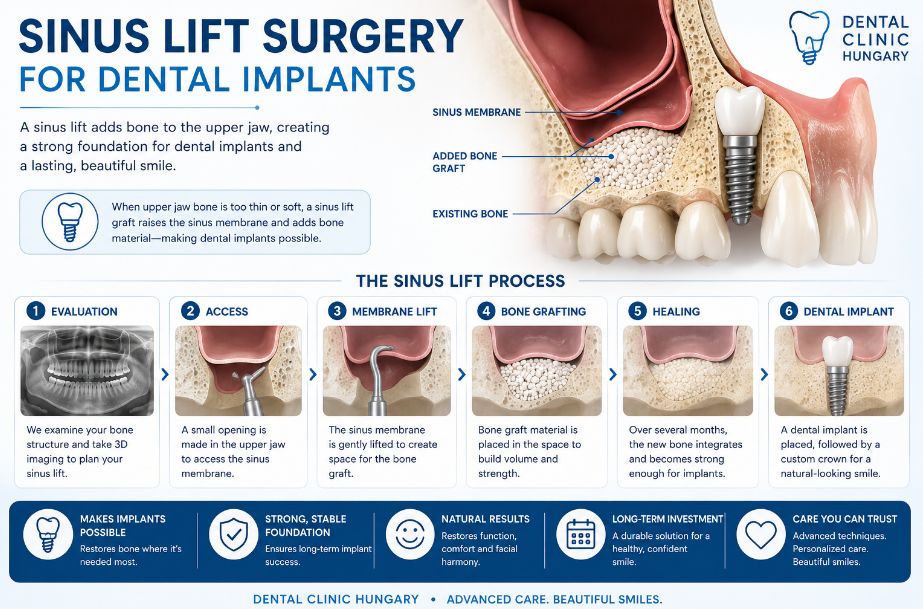
In a Nutshell
A sinus lift is a pre-implant procedure that creates more bone height in the upper back jaw when tooth loss and sinus expansion have left too little support for dental implants.
- Why it is needed: upper molars and premolars can leave behind limited bone after extraction, making standard implant placement unsafe or unstable.
- Direct sinus lift: uses a small side opening in the jaw and is typically chosen for more significant bone loss or larger grafting needs.
- Indirect sinus lift: is performed through the implant site and may suit patients who need a smaller lift and still have enough natural bone for implant stability.
- Benefits: can make implants possible, improve implant position and support a single crown, bridge or full-arch restoration.
- Recovery: expect temporary swelling, bruising, tenderness and sinus pressure. Follow sinus precautions, including avoiding nose blowing, smoking and strenuous activity during early healing.
- Risks: include sinus membrane perforation, infection, sinusitis, graft healing problems and the need to delay implant placement in some cases.
- Treatment timing: implants may be placed at the same appointment or after graft healing, depending on the amount and quality of your remaining bone.
- For UK patients travelling to Budapest: request a CBCT-based diagnosis, a written treatment plan, details of the graft material and clear guidance on recovery, review appointments and when it is safe to fly home.
Sinus Lift Surgery: Procedure, Types, Benefits, Risks, Dental Implants and Recovery
A sinus lift is a well-established pre-implant procedure used when the upper back jaw does not have enough bone height to support dental implants safely. For many UK patients who have lost upper molars or premolars, it can make implant treatment possible without compromising the final result.
The procedure involves carefully raising the floor of the maxillary sinus and, when appropriate, placing bone-graft material beneath the sinus membrane. It may sound complex, but it is a routine part of advanced implant dentistry when performed after proper 3D planning. The key is selecting the right technique, protecting the sinus membrane and allowing sufficient healing time before the final crown, bridge or full-arch restoration is fitted.
Why a Sinus Lift May Be Needed
The maxillary sinuses are air-filled spaces located above the upper back teeth. Their lower lining sits close to the roots of the premolars and molars. When these teeth are removed or lost, two changes can reduce available bone for implants:
-
The jawbone remodels and gradually loses height after tooth loss.
-
The sinus may expand downwards into the space previously occupied by tooth roots.
As a result, the remaining bone may be too shallow for a conventional implant. An implant placed without enough support can be unstable, poorly positioned or more difficult to restore and clean over the long term.
A sinus lift increases vertical bone volume in this area. It can help create a safer foundation for a single implant, multiple posterior implants or a full upper-arch bridge.
Not every patient missing upper back teeth needs sinus augmentation. Short implants, tilted implants, pterygoid implants or a different bridge design may be suitable in selected cases. A CBCT scan is normally needed to determine which option is safest and most predictable.
What Happens During Sinus Lift Surgery?
A sinus lift is usually completed under local anaesthetic. Some patients may also choose conscious sedation, particularly if they are anxious or having more extensive implant treatment.
The surgeon accesses the upper-jaw bone and gently separates the Schneiderian membrane—the thin membrane lining the sinus—from the bony floor below it. This creates a space that can be filled with graft material or, in selected transcrestal cases, allowed to heal around a stable implant without additional graft material.
The graft acts as a scaffold for the patient’s own bone formation. Depending on the anatomy, the implant may be placed at the same appointment or after the augmented area has healed.
A typical process includes:
- Clinical examination, medical review and CBCT scan.
- Assessment of sinus health, residual bone height and implant position.
- Local anaesthetic and access to the surgical site.
- Gentle elevation of the sinus membrane.
- Placement of graft material where indicated.
- Implant placement at the same visit or during a later phase.
- Wound closure, written aftercare instructions and review appointments.
- Healing before the final crown, bridge or full-arch restoration.
The procedure is not a cosmetic add-on. It is a biological and structural preparation step designed to improve the conditions for long-term implant stability.
Types of Sinus Lift
The two main approaches are direct sinus lift surgery and indirect sinus lift surgery. Both aim to increase usable bone height beneath the sinus, but they differ in access, scale and typical indication.
Direct Sinus Lift: Lateral-Window Technique
A direct sinus lift is also known as a lateral-window sinus lift. The surgeon creates a small opening in the side wall of the upper jaw, allowing broad visibility of the sinus membrane. The membrane is carefully lifted, and bone-graft material is placed beneath it.
This approach is usually considered when:
- There is substantial loss of bone height below the sinus.
- A larger amount of augmentation is needed.
- More than one implant is planned in the upper back jaw.
- A patient requires extensive posterior support for a full-arch restoration.
- The surgeon needs direct access to manage complex sinus anatomy.
Implants can sometimes be placed during the same operation, but only if enough native bone remains to provide reliable initial implant stability. If bone is very limited, the graft may need to heal first before implant placement.
The lateral-window method is more invasive than the indirect approach, but it can provide a controlled and predictable way to manage larger deficiencies.
Indirect Sinus Lift: Transcrestal Technique
An indirect sinus lift is also called a transcrestal, crestal or osteotome sinus lift. Rather than entering through the side of the jaw, the surgeon approaches through the planned implant site at the top of the ridge.
The sinus floor is elevated carefully through the implant preparation site. This technique is often used where a smaller lift is required and enough natural bone remains to secure an implant at the same appointment.
Indirect sinus lift surgery may be recommended when:
- The amount of missing bone height is limited.
- The implant can obtain dependable primary stability in the remaining bone.
- A smaller augmentation is sufficient.
- The patient is suitable for a less invasive surgical approach.
In suitable cases, this method can reduce the size of the surgical area and may lead to less post-operative swelling. It cannot replace the lateral-window technique where a larger lift or more extensive grafting is required.
Direct vs Indirect Sinus Lift
A systematic review of sinus-floor elevation complications found different risk patterns between the two techniques. Lateral sinus lifts were associated with more membrane perforations and sinusitis cases, while transcrestal procedures were associated in some reports with benign positional vertigo, a temporary dizziness related to the surgical technique.
Benefits of Sinus Lift Surgery
The main benefit is that sinus augmentation can allow implants to be placed in an upper-jaw area that would otherwise have insufficient bone support.
Potential advantages include:
- Makes implants possible after long-term loss of upper back teeth.
- Creates more vertical bone height for an implant of suitable length and position.
- May support a fixed bridge rather than a removable denture.
- Can be part of a full-mouth or full-arch rehabilitation plan.
- May be combined with implant placement in suitable cases.
- Helps the clinician place implants in a position that supports bite, appearance and cleanability.
- Can avoid placing implants at an unfavourable angle solely to avoid the sinus.
Dental implants placed after sinus-floor augmentation generally show high survival in published studies. A systematic review and meta-analysis reported a pooled implant survival rate of 97.7% after three to six years of follow-up, although results vary between patients, surgical protocols and studies. Smoking was associated with significantly poorer implant survival in the available evidence.
These figures should be viewed as population-level research findings, not a personal guarantee. Individual results depend on bone quality, sinus anatomy, gum health, smoking or nicotine use, medical factors, healing, implant design, bite forces and long-term cleaning.
Bone Graft Materials Used in Sinus Lifts
The graft material selected for a sinus lift depends on the defect, surgical approach, planned implant timing and clinician preference. Possible materials include:
-
Autogenous bone: bone collected from the patient, often from inside the mouth for smaller grafts.
-
Synthetic grafts: laboratory-made materials, often calcium phosphate-based, designed as a scaffold for new bone.
-
Xenografts: processed animal-derived mineral materials used as long-lasting scaffolds.
-
Allografts: processed human donor bone from regulated tissue banks.
-
Composite grafts: combinations designed to balance biological activity, handling and volume stability.
No graft is universally best. Autogenous bone has important biological properties but requires a donor site. Synthetic materials avoid that additional surgical area and can be effective for suitable sinus-lift procedures. Slow-resorbing materials can help maintain volume, while other materials may be replaced by new bone at a different rate.
Your clinician should explain exactly what graft material is proposed, why it is appropriate for your case and whether an implant can be placed at the same appointment.
Is a Sinus Lift Safe?
Sinus lift surgery is widely used and can be safe and predictable when it is carefully planned and performed by an experienced clinician. Like every surgical procedure, however, it carries risks.
The most frequent intra-operative complication is perforation of the Schneiderian membrane. A systematic review reported a weighted membrane-perforation incidence of 23.5% across 1,652 sinus-lift surgeries, with rates varying widely among studies. Thin sinus membranes and bony septa—internal bony partitions within the sinus—were identified as risk factors.
A perforation does not automatically mean the procedure has failed. Small tears can often be repaired during surgery with membranes or other techniques. A systematic review reported implant survival of 97.68% under repaired perforated membranes compared with 98.88% under intact membranes, with no statistically significant difference in implant survival.
The evidence is not entirely uniform. Another systematic review found an association between membrane perforation and increased implant loss, highlighting why avoidance, detection and proper repair are important.
The practical message for patients is clear: membrane perforation is a recognised complication, not necessarily a disaster, but it should be managed by a clinician with appropriate surgical skill and a clear follow-up protocol.
Possible Complications
Most sinus-lift patients heal without serious complications. Nevertheless, informed consent should include the following possibilities:
- Sinus membrane perforation during surgery.
- Bleeding, swelling, bruising and temporary pain.
- Wound opening or delayed healing.
- Infection of the grafted area.
- Graft exposure, movement, partial loss or failure to integrate.
- Acute or chronic sinusitis.
- Nasal congestion, pressure or abnormal discharge.
- Communication between the mouth and sinus, known as an oroantral communication.
- Implant failure or inability to place the implant as originally planned.
- Temporary dizziness after a transcrestal technique.
- Need for further treatment, a staged implant plan or referral to an ear, nose and throat specialist.
Patients with pre-existing sinus disease, chronic sinus symptoms, blocked sinus drainage, significant allergies or previous sinus surgery should tell the implant team before treatment. In some cases, an ENT assessment may be advisable before sinus augmentation.
A review of sinonasal complications found that rhinosinusitis after sinus lift is more often seen in patients with existing sinus disease, anatomical obstruction or membrane perforation.
Recovery After a Sinus Lift
Recovery varies depending on whether the procedure was direct or indirect, whether grafting was extensive and whether implants were placed at the same appointment.
Most people experience swelling and tenderness for several days. The swelling may peak around the second or third day before gradually improving. Bruising around the cheek or under the eye can occur after a lateral-window procedure.
Common temporary symptoms include:
- Tenderness or aching in the upper back jaw.
- Mild facial swelling.
- Bruising.
- A sensation of pressure around the cheek or sinus.
- Minor nasal spotting.
- Slight difficulty chewing on the surgical side.
- Temporary restriction in wearing a denture over the area.
Your dentist or oral surgeon will provide individual instructions, but common early aftercare measures include resting, taking prescribed medication as directed, using cold compresses during the first day and choosing softer foods for the first few days.
Sinus precautions
Because the surgical site is close to the sinus, patients are normally advised to avoid activities that raise pressure inside the nose and sinus while early healing occurs. These may include:
- Do not blow your nose.
- Sneeze with your mouth open if possible.
- Avoid drinking through straws unless your clinician says otherwise.
- Avoid smoking, vaping and nicotine use.
- Avoid scuba diving and air travel until your clinician confirms it is safe.
- Avoid heavy lifting, intense exercise and forceful spitting during the early recovery period.
- Use prescribed nasal sprays or decongestants only as directed.
Instructions differ between procedures and patients, so follow the written advice from your own surgical team rather than relying solely on general information online.
How Long Before Dental Implants or Final Teeth?
There is no single timeline for every sinus lift.
If enough natural bone remains, an implant may be placed at the same time as the sinus lift. The implant then requires a healing period before it is restored with a crown or bridge.
If bone height is very limited, the graft may need to heal before the implant is inserted. After the implant is placed, a further healing phase is usually required before the definitive teeth are fitted.
In a full-arch treatment plan, temporary teeth may be used during healing. The final bridge should not be rushed before the implants are stable, the gums have matured and the bite has been checked.
A clinic should provide a written staged plan outlining:
- Whether your sinus lift and implants will happen together or separately.
- The anticipated healing intervals.
- Whether a temporary crown, bridge or denture is included.
- The type of final restoration planned.
- How many visits are likely to be required.
- What happens if healing takes longer than expected.
For patients travelling from the UK to Budapest, treatment planning should allow enough time for post-operative review and the possibility that clinical findings may alter the original timetable. Dental tourism should never force biology into an unrealistic schedule.
Sinus Lift and Full-Arch Dental Implants
Sinus augmentation is often considered when the upper back jaw needs support for multiple implants. However, it is not always necessary for full-arch treatment.
Some full-arch designs use angled posterior implants to avoid the sinus and reduce the need for grafting. In more severe upper-jaw atrophy, pterygoid implants or zygomatic implants may be considered in specialist settings. Short implants can also be a less invasive alternative in selected cases.
A responsible implant clinic should discuss why sinus lifting is recommended rather than presenting it as the only route. The key questions are:
- Is there enough bone for short or tilted implants?
- Is a direct or indirect sinus lift clinically appropriate?
- Would a graft-free full-arch design be safer or more efficient?
- Is extensive augmentation necessary to support the desired final bridge?
- What are the risks, costs, travel requirements and maintenance needs of each option?
Choosing a Sinus Lift Clinic in Budapest
Budapest can offer UK patients access to advanced implant treatment at lower private costs than many UK clinics. However, a sinus lift should be assessed on clinical quality, not just price.
Before booking, ask:
- Will I receive a CBCT scan and written explanation of my sinus anatomy?
- Who will perform the procedure, and what is their implant and sinus-surgery experience?
- Which sinus-lift technique do you recommend and why?
- Will implants be placed during the same visit or after healing?
- What graft material and membrane will be used?
- What happens if the sinus membrane is perforated?
- Is temporary treatment included while the area heals?
- What complications are covered or managed during my stay?
- How long should I remain in Budapest after surgery before flying home?
- Will I receive my scan, implant passport, graft details and treatment records?
- What maintenance and emergency-care advice will I receive after returning to the UK?
Transparent answers are a positive sign. Be cautious of a clinic that confirms a same-day implant and final-bridge schedule before reviewing a three-dimensional scan.
Frequently Asked Questions
Does a sinus lift hurt?
The procedure is carried out under local anaesthetic, so you should not feel pain during surgery. Mild-to-moderate soreness, swelling and pressure afterwards are common and usually manageable with the medication and instructions provided by your clinician.
Can I have implants on the same day as a sinus lift?
Sometimes. It depends on whether enough natural bone remains to hold the implant firmly at the time of surgery. If there is insufficient stability, graft healing may be completed first and implants placed later.
How long does a sinus lift take to heal?
The healing time depends on the technique, amount of grafting, your bone biology and whether an implant was placed at the same time. Your clinician should provide a personalised timeline after reviewing your scan and surgical findings.
Is a direct sinus lift better than an indirect sinus lift?
Neither approach is universally better. A direct lateral-window sinus lift is usually used when more bone augmentation is needed. An indirect transcrestal technique may be appropriate for smaller lifts where enough natural bone remains.
What happens if the sinus membrane tears?
A membrane tear is a known complication. Small perforations can often be repaired during surgery. Depending on the size and location, the surgeon may continue, modify the procedure or stage the implant treatment. Proper management is important for reducing complications.
Can smokers have sinus-lift surgery?
Smoking and nicotine use can negatively affect healing and implant outcomes. Research has linked smoking with lower implant survival after sinus augmentation. Your clinician may recommend stopping before and after surgery.
Can I fly after a sinus lift?
You should follow the specific advice of your surgical team. Air travel may be delayed after sinus surgery because pressure changes can affect healing. Discuss your travel dates before treatment, particularly if you are travelling from the UK to Budapest.
The Bottom Line
A sinus lift can be a safe, routine and highly useful part of implant dentistry when upper back-jaw bone loss prevents conventional implant placement. The direct lateral-window technique is commonly used for larger augmentation needs, while the indirect transcrestal approach can be a less invasive option for selected patients with enough remaining bone.
Success relies on thorough CBCT-based planning, control of gum disease, appropriate graft selection, gentle membrane management, realistic healing time and long-term implant maintenance. If you are considering sinus lift treatment in Budapest, look for an implant team that explains your options clearly, provides a written staged plan and prioritises predictable healing over a rushed treatment timetable.
Sources
- Systematic Review: Incidence, Risk Factors and Complications of Schneiderian Membrane Perforation During Sinus Lift Surgery
- Systematic Review and Meta-Analysis: Management of Schneiderian Membrane Perforations and Subsequent Implant Survival
- Systematic Review and Meta-Regression: Effect of Sinus Membrane Perforation on Dental Implant Failure
- Systematic Review: Complications of Sinus Floor Elevation and Management Strategies
- Systematic Review and Meta-Analysis: Clinical Performance of Dental Implants After Sinus Floor Augmentation
- Systematic Review: Outcomes of Implants Placed After Osteotome Sinus Floor Elevation
- Review: Sinonasal Complications Following the Sinus Lift Procedure