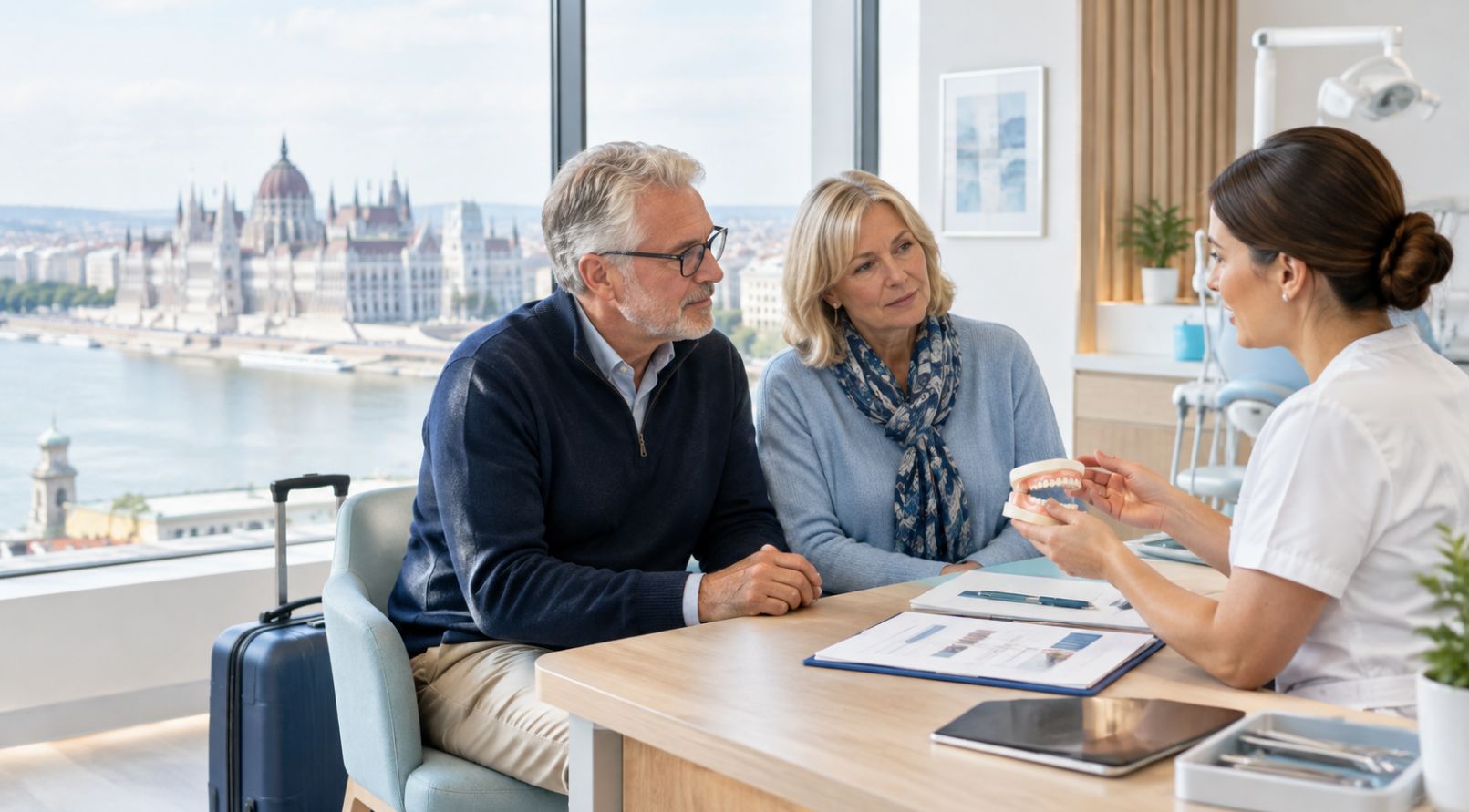
Key Points: Icelandic Patients in Budapest: Dental Care and Costs
- Budapest can offer Icelandic patients a more affordable option for extensive dental treatment, particularly crowns, bridges, dentures and implants.
- Most working-age adults in Iceland pay privately for routine dental care. Exceptions exist for certain conditions, accidents and other qualifying circumstances.
- Cross-border healthcare rules preserve existing reimbursement rights; they do not create new ones. Treatment in Hungary does not automatically qualify for Iceland Health support.
- Eligible pensioners may receive a 75% contribution towards qualifying general dentistry, assessed under Iceland Health’s rules and fee schedule – not necessarily 75% of the Budapest invoice.
- Implant reimbursement has separate conditions. Certain procedures require prior approval, and implant-number limits can affect support for All-on-4 or All-on-6 treatment.
- Advertised savings of “up to 80%” are not guaranteed. Compare equivalent, itemised treatment plans and include flights, accommodation, insurance, companion costs and possible return visits.
- Concentrated appointment schedules can reduce repeated travel, but they cannot shorten biological healing. Implant treatment may require staged visits over several months.
- Digital imaging, modern equipment and long warranties are useful considerations – not proof of superior care. Qualifications, appropriate treatment planning and written guarantee terms matter more.
- Patients should confirm reimbursement before treatment, obtain the required English or Icelandic documentation and arrange clear aftercare in Iceland.
- The best decision balances price with clinical suitability, travel requirements and long-term maintenance – not simply the lowest advertised fee.
Why Icelandic Patients Choose Budapest for Dental Treatment
An Icelandic patient boarding a flight to Budapest may have more than a suitcase and a hotel reservation. They may also carry dental X-rays, an itemised treatment estimate and questions about how to eat comfortably again.
For someone facing extensive dental work, the journey is not necessarily a holiday with a dental appointment attached. It can be a carefully calculated response to a bill that feels difficult to manage at home.
Budapest offers a compelling proposition: internationally oriented clinics, published treatment prices and appointments organised around patients travelling from abroad. For Icelandic residents, another important consideration is whether Iceland Health, known as Sjúkratryggingar Íslands, will contribute towards eligible treatment.
However, the story needs more precision than advertisements promising “80% savings” or “75% reimbursement” usually provide.
Working-age adults generally pay for routine dentistry themselves, but exceptions exist. Pensioners may qualify for substantial support, but not every implant, crown or full-mouth reconstruction receives the same reimbursement. Travelling within the European Economic Area does not create an entitlement to treatment that Iceland would not otherwise cover.
Understanding those distinctions is essential to understanding why patients consider Budapest – and whether the journey makes financial and clinical sense.
The Reykjavik-to-Budapest Flight Path
Dental treatment abroad becomes attractive when the difference between two treatment estimates is large enough to outweigh the inconvenience of travelling.
For an Icelandic patient needing several restorations, the calculation may include lost working time, flights, accommodation, temporary teeth and a second visit. For a pensioner with unstable dentures, it may also include whether suitable treatment qualifies for Iceland Health support.
Budapest clinics advertise directly to Icelandic patients, and dental tourism businesses report substantial interest from Iceland. Nevertheless, promotional estimates of annual patient numbers should not be mistaken for independently verified national statistics.
There is a visible market for Iceland-to-Hungary dental travel. The evidence reviewed does not establish a reliable national count of Icelandic patients visiting Budapest or a measured annual growth rate.
The more useful question is therefore not how many people are “fleeing” Iceland. It is why an individual patient might find treatment abroad more accessible – and what they must check before leaving.
The System at Home: Why Working-Age Adults Look Abroad
Iceland’s dental funding arrangements differ from the expectation that national health insurance covers most necessary healthcare.
Routine dental care for most adults aged 18–67 is generally paid privately. This can leave patients responsible for substantial costs when several teeth need treatment.
However, saying that every person in this age group receives absolutely no support would be inaccurate. Iceland Health also participates in certain treatment costs associated with congenital defects, accidents and illnesses. Eligibility depends on the circumstances and applicable rules, rather than age alone.
Pensioners and qualifying disability-benefit recipients have different arrangements. These distinctions matter because two people receiving similar treatment in Budapest may have very different reimbursement outcomes.
Why a large treatment plan changes the calculation
A single filling rarely provides the strongest financial case for travelling abroad. The travel budget may exceed any treatment saving.
The calculation changes when a patient needs multiple crowns, extensive bridgework, dentures or implant-supported replacement teeth. Treatment fees become a much larger share of the total budget.
For a working-age adult without applicable reimbursement, the comparison is usually straightforward in principle: the complete Icelandic private quotation versus the complete overseas cost.
For an eligible pensioner, the calculation has another layer: how much Iceland Health will contribute to each proposed treatment item.
Neither patient should compare only a headline package price.
Cross-border healthcare preserves eligibility; it does not create it
Directive 2011/24/EU provides a framework for cross-border healthcare within the EEA. Iceland Health explains that eligible patients seeking comparable dental care in another EEA country can apply for the same payment participation available domestically.
Hungary is an EU member state and part of the EEA framework. Iceland participates through its EEA membership.
The important principle is continuity of entitlement.
An ordinary working-age adult who has no entitlement to reimbursement for routine cosmetic dentistry in Iceland does not obtain one simply by having veneers fitted in Budapest.
Likewise, a pensioner cannot assume that every component of a foreign implant package qualifies for a flat 75% refund.
What Iceland Health Actually Reimburses
Iceland Health’s published guidance is more detailed than the broad statements commonly used in dental tourism marketing.
For pensioners, it generally contributes 75% towards eligible general dentistry abroad, assessed under the relevant Icelandic fee schedule and applicable conditions.
This is not a promise to refund 75% of any foreign clinic’s invoice.
The main distinctions include:
-
General dentistry: eligible pensioner treatment can receive the applicable 75% contribution.
-
Removable dentures: support is available under specified replacement intervals and conditions.
-
Crowns and implants where natural teeth remain: separate grant rules and limits apply.
-
Implants in completely toothless jaws: prior approval is required, with limits on supported implant numbers.
-
Travel and accommodation: Iceland Health does not contribute to these expenses.
Implant reimbursement requires particular care
For approved implant treatment in a completely toothless jaw, Iceland Health states that it subsidises the first two implants in the lower jaw and the first four implants in the upper jaw.
This has direct implications for All-on-4 and All-on-6 treatment.
A package containing four or six implants does not mean that all those implants automatically qualify for reimbursement. The proposed jaw, existing teeth, restoration design and prior approval all matter.
For eligible fixed restorations and implants in a jaw where natural teeth remain, Iceland Health currently publishes a separate maximum grant of ISK 153,108 within a 12-month period, subject to its conditions.
Patients should confirm the current limit and their individual eligibility directly before committing to treatment.
Approval and reimbursement take time
Certain procedures require approval before treatment begins. Iceland Health lists examples including implants in toothless jaws and regional CT imaging.
Its published average processing time for prior approval is four to six weeks after receiving complete documentation.
Reimbursement applications submitted after treatment can take considerably longer. The published average is 16–24 weeks from receipt of all necessary information.
Patients therefore need sufficient funds to pay the clinic first. Expected reimbursement should not be treated as money available immediately after returning home.
The Budapest Proposition: Price, Organisation and Practical Support
Budapest’s appeal is not solely a low treatment fee. International clinics also sell organisation.
For someone who does not speak Hungarian, help with airport transfers, accommodation and appointment scheduling can reduce the uncertainty of travelling for healthcare.
Some providers offer Icelandic-language coordination or assistance through local representatives. Others communicate primarily in English. Patients should confirm who will explain the clinical plan, not simply who will collect them at the airport.
Travel assistance can include:
- Help choosing accommodation near the clinic
- Airport transfer arrangements
- Appointment coordination
- Treatment estimates before departure
- Translation or interpretation support
- Assistance preparing reimbursement documents
These services are not universally included. Flights, hotels and transfers may be optional extras, independently booked services or benefits subject to a minimum treatment spend.
A “turnkey package” should always be broken down into its clinical and travel components.
Is dental treatment really 80% cheaper?
Some businesses advertise savings of up to 80%. That should be treated as a possible comparison for selected cases, not a standard discount available to every Icelandic patient.
A defensible comparison requires two equivalent, written treatment plans.
Both should specify the same number of teeth, restoration type, implant components and supporting procedures. A premium implant with a final ceramic crown cannot fairly be compared with an advertised implant fixture alone.
There is also no single verified Reykjavik price against which every Budapest clinic can be measured.
The most reliable evidence is a patient’s actual domestic quotation compared with a personalised Budapest quotation.
Published Budapest Prices: What the Figures Include
La Porta Dental publishes euro-denominated examples that help illustrate Budapest’s price structure. These are provider prices, not a citywide average or a guaranteed quotation.
The provider’s page contains both summary ranges and a detailed itemised list. Patients should obtain a fresh quotation that resolves any differences between those sections.
The published page also states that prices can change.
For Icelandic residents, budgeting in euros can make the clinic quotation easier to understand, but payment ultimately introduces an exchange-rate consideration. The Icelandic krona value may change between booking, treatment and reimbursement.
Technology: A Useful Tool, Not Proof of Superiority
Dental tourism advertising frequently highlights 3D imaging, digital scanners and computer-designed restorations.
These technologies can be useful. Their presence does not establish that Hungarian dentistry is superior to Icelandic dentistry.
A cone beam CT scan, commonly called CBCT, provides three-dimensional imaging that may assist implant planning. It should be requested when clinically justified rather than used automatically as a marketing feature.
CAD/CAM systems support computer-aided design and manufacture of restorations. Depending on the clinic, material and case, they may shorten production time.
However, “same-day dentistry” does not mean that every patient can receive a definitive full-mouth restoration immediately.
The relevant questions are:
- Why is this scan necessary?
- Who interprets the images?
- Which restoration material is proposed?
- Is the advertised rapid restoration temporary or definitive?
- What happens if the treatment requires additional healing?
The strongest sign of quality is a clear clinical explanation, not a list of equipment brands.
Warranties need careful reading
A multi-year warranty can provide reassurance, but it is only as useful as its written terms.
A “lifetime implant warranty” may concern the replacement implant component rather than surgical fees, crowns, travel or treatment after biological failure.
Patients should ask whether the guarantee depends on regular reviews, professional cleaning, smoking status or use of a protective night guard.
They should also establish who pays for flights and accommodation if returning to Budapest becomes necessary.
Express Treatment: Convenient Scheduling Has Biological Limits
An intensive treatment block can appeal to someone who would otherwise need repeated appointments around work or family responsibilities.
Crowns and bridges may sometimes be organised within a concentrated visit after examination and preparation. However, no fixed two-week schedule is suitable for every case.
There is also no basis for assuming that Icelandic treatment routinely takes months while identical Budapest treatment always takes days.
The advantage is often coordinated scheduling – not a different healing process.
Extractions, implant placement, bone grafting and gum treatment may require staged care. Some patients receive temporary teeth during an initial visit and return later for definitive restorations.
A responsible clinic allows the clinical findings to determine the timetable.
A Tale of Two Demographics
The following profiles are illustrative, not accounts of identified patients.
They show why different Icelandic patients may consider Budapest for very different reasons.
Profile A: A pensioner seeking reliable chewing
A 72-year-old pensioner struggles with an unstable lower denture. Meals take longer, harder foods are avoided and eating socially has become uncomfortable.
The objective is function rather than a cosmetic transformation.
An assessment might consider a replacement conventional denture, an implant-retained removable denture or a fixed full-arch restoration.
All-on-4 and All-on-6 describe approaches using four or six implants to support a full arch of replacement teeth. They are not automatically the best choice for every toothless patient.
This pensioner should first establish:
- Which treatment offers an appropriate balance of function and maintenance.
- Whether medical conditions or medicines affect treatment.
- Which items require prior Iceland Health approval.
- How the implant-number limits affect reimbursement.
- Whether a simpler treatment could meet the same needs.
The financial objective is not to “maximise 75% reimbursement” at any clinical cost. It is to obtain suitable care while using legitimate entitlement correctly.
A treatment plan containing unnecessary implants or a restoration the patient cannot maintain may be poor value, even if part of it is subsidised.
Profile B: A working-age adult comparing private costs
A 43-year-old patient has several heavily restored teeth and is also unhappy with their appearance.
They receive an extensive domestic quotation and investigate Budapest as an alternative.
Without an applicable reimbursement exception, they should expect to fund the treatment themselves. The cross-border framework does not make elective cosmetic dentistry subsidised.
Their priorities may include avoiding excessive borrowing, retaining natural teeth and obtaining durable restorations.
Veneers and crowns are not interchangeable. A veneer covers mainly the front surface of a tooth, while a crown covers more of the tooth and usually requires greater preparation.
The patient should ask which teeth genuinely need crowns and whether whitening, limited restorations or other less invasive options could meet their goals.
A lower price does not justify removing healthy tooth structure unnecessarily.
Calculating Savings Without Misleading Yourself
The essential calculation is:
Total overseas cost minus confirmed reimbursement, compared with the equivalent domestic cost after any applicable reimbursement.
The overseas budget should include:
- All treatment stages
- Flights and baggage
- Accommodation and meals
- Transfers and local transport
- Insurance suitable for planned treatment
- Companion costs where needed
- Time away from work
- Possible adjustments or return visits
Consider an illustrative – not quoted – case.
A patient receives a €15,000 domestic treatment estimate and an equivalent €7,000 Budapest estimate. Two trips cost another €2,000, producing a €9,000 overseas total before any reimbursement.
The saving is €6,000, or 40%, not 80%.
If the plans differ in materials or procedures, even that comparison may be invalid.
Eligible reimbursement must then be assessed separately for both options. Patients should not compare a gross Icelandic price with a Budapest price that already assumes an unconfirmed refund.
Documentation, Aftercare and Patient Protection
For Iceland Health reimbursement, administrative detail matters.
Its guidance requires an application, an itemised invoice, matching payment evidence and supporting clinical documents appropriate to the treatment.
Invoices may need treatment dates, tooth numbers and procedure details. Documents must be in Icelandic or English.
Before booking, confirm that the clinic can provide this information in an acceptable format.
Aftercare deserves equal attention. Patients should obtain treatment records, implant identification details and a written maintenance plan.
They should know who handles an urgent concern after returning to Iceland and whether a local dentist is willing to provide maintenance.
Iceland Health also warns that incidents occurring during treatment abroad are not covered under Iceland’s Patient Insurance Act. Reimbursement approval is therefore not a guarantee of compensation or clinical protection.
Ask the clinic about professional liability insurance, complaints procedures and the practical route for resolving a dispute.
The Future of Cross-Border Dental Healthcare
Icelandic patients considering Budapest illustrate both the possibilities and the limits of healthcare mobility.
Cross-border rules can help eligible patients retain financial support when choosing treatment elsewhere. International clinics can organise appointments and publish prices that make comparison easier.
But neither mechanism removes the need for careful diagnosis, realistic budgeting or long-term maintenance.
The most trustworthy Budapest clinic will explain what it can provide, what remains uncertain and which questions only Iceland Health can answer.
Before travelling, patients should obtain equivalent quotations, confirm reimbursement directly and request a personalised plan covering treatment, recovery and aftercare.
For some Icelanders, a plane ticket to Hungary has become part of a practical dental solution – but the most valuable prescription remains the right treatment, supported by clear information.
Frequently Asked Questions
Why do Icelandic patients choose Budapest for dental treatment?
Budapest appeals to Icelandic patients because treatment fees can be lower for extensive work such as crowns, bridges, dentures and dental implants. International clinics may also help organise appointments, accommodation and airport transfers. Whether the trip offers good value depends on the complete treatment plan, travel expenses and aftercare requirements.
Is dental treatment in Budapest always cheaper than in Iceland?
No. A lower clinic fee does not automatically mean a lower overall cost. Flights, accommodation, insurance, time away from work and possible return visits can reduce the saving. Travelling may be more financially worthwhile for several restorations than for a single filling or routine check-up.
Can Iceland Health reimburse dental treatment received in Hungary?
Eligible patients can apply for Iceland Health payment participation for qualifying dental treatment in Hungary. The entitlement generally follows the same rules as treatment in Iceland. Travelling abroad does not create reimbursement rights for procedures that would not qualify domestically. Patients should confirm their eligibility before booking.
Do Icelandic pensioners receive 75% reimbursement for all dental treatment abroad?
No. Eligible pensioners may receive a 75% contribution towards qualifying general dentistry, assessed under Iceland Health’s applicable rules and fee schedule. This is not necessarily 75% of the foreign clinic’s invoice. Crowns, implants and certain other treatments have separate conditions, limits or approval requirements.
Can working-age Icelandic adults receive reimbursement for crowns or veneers in Budapest?
Most working-age adults pay privately for routine dental care, and elective cosmetic treatment does not become reimbursable simply because it takes place in Hungary. Exceptions may apply to qualifying treatment connected with accidents, illnesses or congenital conditions. Anyone who believes an exception applies should obtain confirmation from Iceland Health before proceeding.island+1
Do dental implants in Budapest require prior approval from Iceland Health?
Certain treatments require prior approval, including implants in completely toothless jaws. Iceland Health also applies limits to the number of implants it supports in these cases. Patients considering All-on-4 or All-on-6 should submit the proposed treatment plan before treatment and confirm which components qualify for reimbursement.
Can crowns and dental implants be completed during one visit to Budapest?
Some crown and bridge treatments may be completed during a concentrated visit, depending on the examination findings and laboratory schedule. Implant treatment often requires staged visits, with healing between implant placement and the final restoration. Temporary teeth provided during the first visit should not be confused with the definitive replacement teeth.
What should Icelandic patients check before choosing a Budapest dental clinic?
Request an itemised treatment plan and ask about the treating dentist’s qualifications, proposed materials, implant system, treatment stages and aftercare. Check whether temporary restorations, scans and additional procedures are included. Confirm the language used for clinical explanations and obtain written warranty terms, including who pays for return travel if further treatment is needed.
What documents are needed to claim dental reimbursement from Iceland Health?
Requirements depend on the treatment, but generally include a reimbursement application, an itemised invoice, proof of payment and relevant clinical documentation. Certain procedures also require evidence of prior approval. Documents must be supplied in Icelandic or English. Confirm the current requirements and ensure the clinic can provide them before travelling.
How should patients arrange aftercare after returning to Iceland?
Before travelling, agree on how the Budapest clinic handles concerns after treatment and establish whether an Icelandic dentist can provide local maintenance. Obtain copies of treatment records, relevant X-rays and implant identification details. Ask when a return visit might be necessary, what the warranty covers and who pays for additional treatment and travel.
Sources
- Iceland Health: Dental treatment abroad – eligibility, prior approval, reimbursement limits, documentation and patient protection
- Iceland Health: Payment participation for dental services abroad and the cross-border healthcare framework
- European Commission: Dental coverage arrangements in Iceland
- La Porta Dental Budapest: Published treatment prices and implant package examples
- Dental Clinic Hungary: Examples of dental tourism marketing directed at Icelandic patients