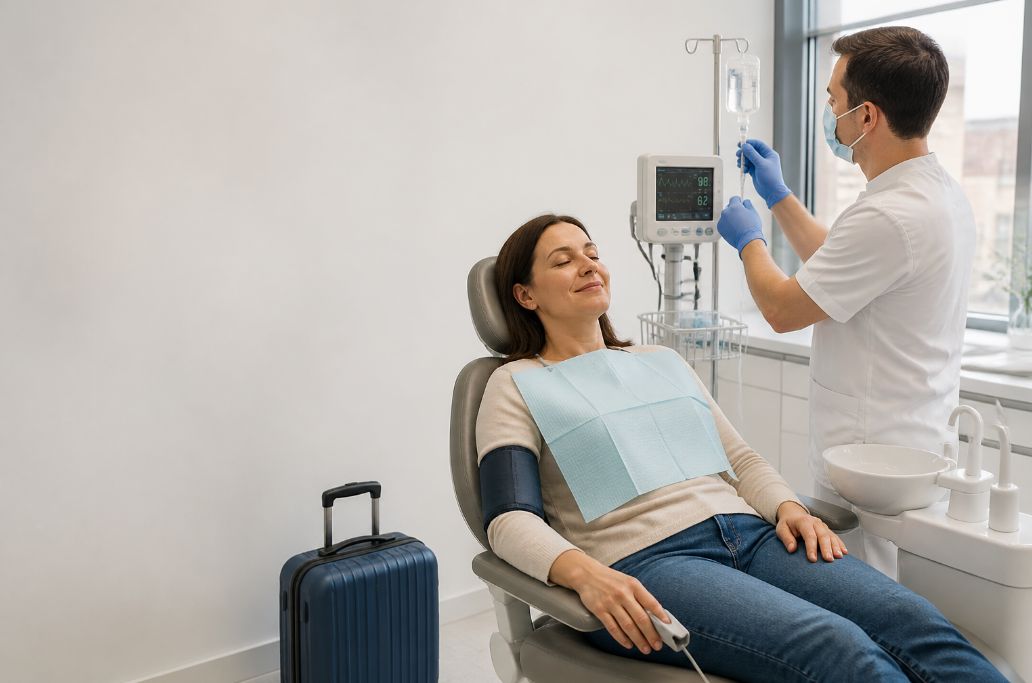
Conscious sedation can transform the experience of dental treatment for anxious UK patients and international dental tourists by making complex procedures feel shorter, calmer and virtually pain‑free while you remain responsive and breathing on your own. When properly delivered by trained teams, it is a safe, flexible tool that can open the door to treatment you may have delayed for years – both at home and in reputable clinics abroad.
What Is Conscious Sedation in Dentistry?
Conscious sedation is the use of sedative medications to put you into a deeply relaxed, anxiety‑free state while you stay conscious, able to respond to simple commands and maintain your own breathing. It is designed to work alongside, not instead of, local anaesthetic, which still numbs the teeth and gums for actual pain control.
In dentistry it is most often delivered as:
-
Inhalation sedation (nitrous oxide/oxygen “gas and air”).
-
Oral sedation with tablets.
-
Intravenous (IV) conscious sedation via a cannula in your arm.
Unlike a general anaesthetic, you do not need a breathing tube or hospital operating theatre, and recovery is usually much faster.
Why Conscious Sedation Matters for Dental Tourism
For dental tourists, especially those travelling for implant surgery, full‑mouth reconstructions or long multi‑procedure visits, conscious sedation can be the difference between tolerating treatment and avoiding it altogether. Overseas clinics that specialise in implantology and aesthetic dentistry increasingly promote conscious sedation as part of their dental tourism packages because it allows them to complete large amounts of work in fewer, longer sessions.
This is particularly relevant if:
-
You have dental phobia or severe anxiety.
-
You need multiple extractions, bone grafting or several implants in one visit.
-
You are flying in for “intensive” treatment over a short time window.
However, precisely because it’s powerful, conscious sedation should only be offered in clinics with robust safety protocols, experienced anaesthetists or suitably trained dentists, and proper recovery facilities.
How Conscious Sedation Works
Conscious sedation affects the central nervous system, reducing your awareness of your surroundings and dampening anxiety while preserving protective reflexes and the ability to cooperate. With IV sedation, drugs like midazolam are titrated slowly until you reach the desired level of relaxation; throughout, your breathing, oxygen saturation, heart rate and blood pressure are monitored.
Patients typically report:
-
Feeling “drifty” or sleepy but not completely “out.”
-
Little or no memory of the procedure afterwards (anterograde amnesia).
-
A sense that time passed very quickly.
Inhalation sedation using nitrous oxide works more gently and wears off rapidly once the gas is stopped, while oral sedation tends to have a slower onset and less precise titration compared with IV.
Types of Dental Sedation Used With Tourists
For both UK‑based and international patients, dentists can choose from several conscious sedation techniques depending on your needs and medical status.
Common options include:
-
Nitrous oxide/oxygen (“laughing gas”) – inhaled through a small mask; ideal for mild to moderate anxiety, especially for shorter or less invasive procedures.
-
Oral sedatives – tablets taken before the appointment; simpler to administer but less controllable in dose and timing.
-
Intravenous (IV) conscious sedation – given via a vein, offering precise titration and strong anxiolysis for lengthy or complex treatments such as implant placement or multiple extractions.
-
General anaesthesia – not considered conscious sedation and usually reserved for hospital‑based cases or particular medical indications.
Many dental tourism centres highlight IV conscious sedation because it lets them safely carry out longer sessions that fit within a typical 5–10 day travel window.
Who Is a Good Candidate?
Conscious sedation is particularly valuable for patients who might otherwise avoid essential care.
Typical indications include:
-
Severe dental anxiety or phobia that prevents routine treatment.
-
History of traumatic dental experiences or strong gag reflex.
-
Need for long or complex procedures (implants, sinus lifts, extensive restorations).
-
Difficulty keeping still or holding the mouth open (e.g. TMJ pain, movement disorders).
-
Certain developmental or cognitive conditions where cooperation is difficult, provided medical status is appropriate.
Many clinics restrict IV conscious sedation to ASA I or ASA II patients (those with no or only mild systemic disease), referring higher‑risk cases for specialist assessment or hospital‑based care.
Benefits for Anxious Patients
For nervous patients, conscious sedation can feel genuinely life‑changing.
Key benefits include:
-
Deep relaxation and reduced anxiety – you feel calm and detached from the dental environment.
-
Little or no memory – many patients recall very little of the procedure, which helps break the cycle of fear.
-
Perception of painless treatment – local anaesthetic handles pain; sedation removes fear and reduces awareness.
-
Ability to tolerate longer appointments – you are less likely to get exhausted or overwhelmed, so more can be done in a single session.
Over time, positive experiences under sedation can gradually rebuild trust and make routine dentistry without sedation more acceptable for some patients.
Benefits for Dentists and Treatment Quality
Conscious sedation also brings significant advantages from the dentist’s perspective, which indirectly benefit you as the patient.
These include:
-
Improved cooperation – reduced movement, less gagging and fewer interruptions mean the clinician can focus on precision.
-
More efficient sessions – complex or multiple treatments can be combined into fewer visits, saving time for both patient and clinic.
-
Potential cost savings overall – although sedation itself has a fee, consolidating treatment into fewer, longer appointments may reduce total visit costs and your time off work.
-
Better outcomes – stable working conditions allow for meticulous implant placement, high‑quality restorations and more predictable results.
For dental tourism, this efficiency is critical because travel schedules are tight; sedation enables a great deal of work to be done safely during each trip.
Conscious Sedation in UK Dentistry
Within the UK, dental sedation is widely used in both NHS and private settings for eligible patients, especially those with significant anxiety or complex treatment needs. Techniques such as inhalation sedation and IV sedation are delivered by clinicians who have undergone specific training and must follow strict guidance on patient selection, monitoring and recovery.
UK guidance emphasises that:
-
Sedation complements local anaesthesia, rather than replacing it.
-
A responsible adult escort is required after IV sedation, and activities such as driving, operating machinery or signing legal documents are restricted for a set period.
-
Clear pre‑ and post‑sedation instructions must be provided in writing and explained to both the patient and their escort.
If you are a UK patient considering dental tourism, it is worth experiencing local conscious sedation first to understand how your body responds before committing to major overseas treatment under sedation.
Conscious Sedation in Popular Dental Tourism Hubs
Many dental tourism destinations—such as Hungary, Spain, Turkey and Thailand—actively promote sedation dentistry as part of their offering for international patients.
For example:
-
Hungarian clinics focused on implantology advertise “conscious sedation for oral surgery and aesthetic work” for overseas visitors.
-
Thai hospital‑based dental centres provide multiple sedation options for everything from simple cleaning to complex surgical extractions and implants.
-
International “sedation dentistry” lists highlight clinics in the USA, Europe and Asia that attract patients globally with their sedation expertise.
When you research dental tourism providers, pay attention to who actually administers the sedation (dentist vs. anaesthesiologist), what monitoring equipment is used, and whether staff have experience dealing with international patients and language barriers.
Safety Considerations and Possible Risks
When provided correctly, conscious sedation in dentistry has an excellent safety record. However, as with any medical intervention, there are potential risks that must be respected—especially if you are travelling abroad where follow‑up may be more complicated.
Important safety aspects:
-
Comprehensive medical history, including medications, allergies, sleep apnoea and substance use, is essential before sedation.
-
Clinicians should be trained in sedation techniques and emergency management, with appropriate life‑support equipment on hand.
-
Continuous monitoring of oxygen saturation, heart rate and respiration is recommended during IV sedation.
-
Post‑sedation instructions (no driving, no alcohol, no major decisions for a specified time) must be followed strictly.
Side effects can include prolonged drowsiness, nausea, headache or (rarely) respiratory depression, which is why proper dosing and monitoring are so important. In countries where regulation may be less stringent, it is vital to check that your chosen clinic follows internationally recognised sedation protocols.
Conscious Sedation vs General Anaesthesia
Some patients confuse conscious sedation with general anaesthesia, but they differ in important ways.
Conscious sedation:
-
Keeps you responsive and breathing independently.
-
Can often be delivered safely in a dental clinic setting.
-
Has a quicker recovery time and fewer systemic risks.
General anaesthesia:
-
Renders you fully unconscious.
-
Requires airway support and is typically performed in a hospital or specialised facility.
-
Carries higher risk and is reserved for specific indications (e.g. complex surgery, certain medical or behavioural needs).
For most anxious dental tourists and UK patients seeking complex restorations, conscious sedation strikes a safer, more practical balance between comfort and risk.
Practical Tips for UK Patients Considering Sedation Abroad
If you are thinking about having conscious sedation as part of dental treatment overseas, planning is crucial.
Practical steps:
-
Ask for written information on the sedation protocol, drugs used and staff qualifications.
-
Share your full medical history and any past sedation experiences with the clinic in advance.
-
Clarify pre‑flight and post‑sedation guidelines, including how long you should wait before flying after major treatment.
-
Ensure you have someone to accompany you on treatment days, and avoid scheduling tourist activities immediately after sedation sessions.
-
Plan follow‑up with a UK dentist in case you need additional care or have questions once you return home.
Well‑organised dental tourism providers will factor sedation recovery time into your treatment itinerary and will advise against overly ambitious schedules that compromise healing and safety.
When Conscious Sedation Might Not Be Appropriate
Despite its benefits, conscious sedation is not suitable for every patient or every situation.
It may be contraindicated or require specialist input if:
-
You have serious cardiovascular or respiratory conditions, severe obesity or uncontrolled systemic disease.
-
You are pregnant, or have certain drug allergies or interactions.
-
You cannot arrange an escort and safe recovery environment after your appointment.
In such cases, your dentist may recommend alternative anxiety‑management strategies, low‑dose inhalation sedation only, or referral for hospital‑based care.
Final Thoughts for Your Smile Journey
For UK patients and dental tourists alike, conscious sedation can be a powerful ally in finally completing the treatment you have been postponing—especially if you struggle with fear, have a strong gag reflex, or face a long, complex plan. The key is to treat it as a medical procedure in its own right: choose clinics with proven sedation expertise, ask detailed questions, and follow pre‑ and post‑sedation instructions carefully so your experience is as safe and stress‑free as possible.
Sources and Further Reading
Conscious Sedation in Dentistry – NIH/PMC overview of techniques, safety and indications:
https://pmc.ncbi.nlm.nih.gov/articles/PMC6327823/
Conscious Sedation in Dentistry – StatPearls clinical review (techniques and patient selection):
https://www.ncbi.nlm.nih.gov/books/NBK592406/
Intravenous Conscious Sedation Benefits – Artedental (Spain) – patient‑friendly explanation of IV sedation:
https://www.artedentalclinic.com/benefits-consious-sedation/
Exploring the Benefits of Conscious Sedation – Together Dental (UK) – practical overview for anxious patients:
https://together.dental/blog/exploring-the-benefits-of-conscious-sedation/
Conscious Sedation in Dentistry – Odontoliuzzi – indications and benefits for fearful patients:
https://odontoliuzzi.com.br/en/blog/conscious-sedation-at-the-dentist-how-it-works-and-what-the-benefits/
Advantages of Conscious Sedation for Anxious Patients – Westgate Dental Centre:
https://westgatedentalcentre.com/the-life-changing-benefits-of-conscious-sedation/
Reasons/Benefits of Sedation Dentistry – Apple Tree Dental – general sedation benefits:
https://appletreedental.ca/reasons-benefits-of-sedation-dentistry/
Dental Sedation | Nervous Patients – Bupa Dental Care (UK) – sedation options and guidance:
https://www.bupa.co.uk/dental/dental-care/treatments/dental-sedation
Sedation Dentistry – Cleveland Clinic – patient‑focused FAQ on dental sedation:
https://my.clevelandclinic.org/health/treatments/22275-sedation-dentistry
Sedation Dentistry – BIDH Dental Hospital Thailand – sedation options for international patients:
https://dentalhospitalthailand.com/sedation-dentistry/
Dental Tourism – Budapest clinic focusing on implantology and conscious sedation:
https://subadental.com/en/szolgaltatasaink/dental-turizmus
Dental Sedation – Information for Patients (Kings) – UK video guidance on IV sedation:
https://www.youtube.com/watch?v=4KG2AlzceQU
Top 5 Sedation Dentistry Clinics Around the World – overview of global sedation providers:
https://crownpointdentists.com/top-5-sedation-dentistry-clinics-around-the-world/