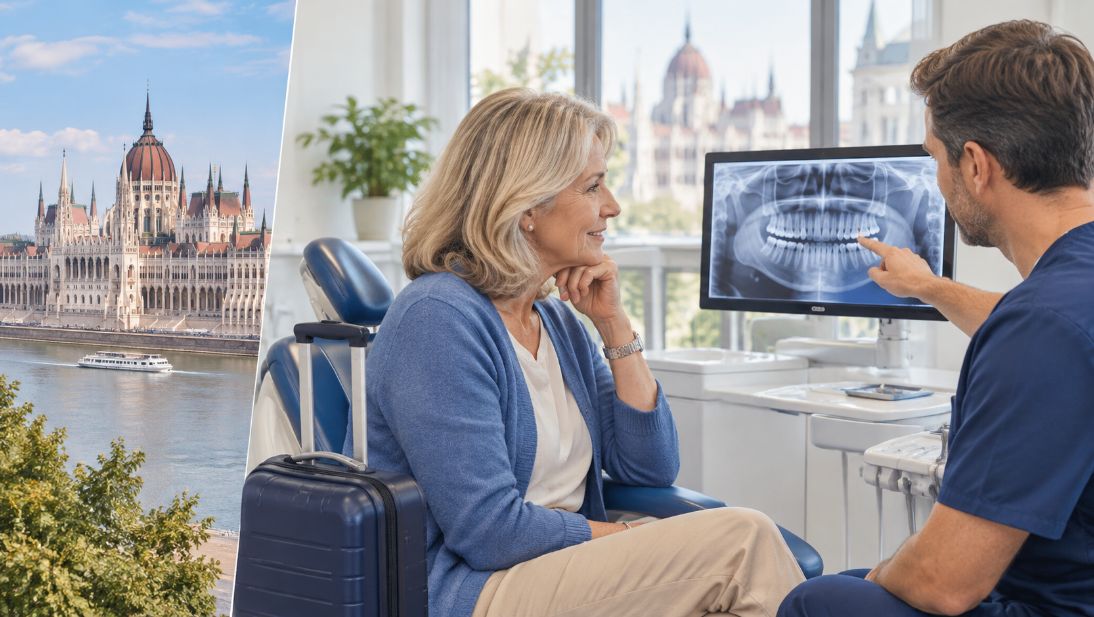
Summary
-
- Ryanair and Aer Lingus fly direct from Dublin to Budapest in about 2 hours 55 minutes. Budapest was not listed on Cork Airport’s published schedule when checked, so compare travelling via Dublin with a protected connection from Cork.
- Start with a dental consultation in Ireland. Send existing X-rays and relevant records securely to the Budapest clinic before paying for new scans. Ask for an itemised estimate and a clear explanation of what could change after an in-person examination.
- Plan flights around your appointments, especially the final fitting or review. Implant treatment often involves a surgery trip and a later visit for the final teeth, so budget for both before booking.
- Compare the full cost with an equivalent Irish treatment plan. Include flights, accommodation, transfers and local follow-up—not just the clinic fee.
- Confirm who will look after you when you return to Ireland, what your insurance covers and who pays if you need a repair or another trip.
- Ask the Budapest dentist to complete Form MED 2 for qualifying non-routine dental work. Irish tax relief is generally 20% on eligible expenses and is separate from HSE reimbursement. See our MED 2 guide for Budapest dental treatment.
Dental Treatment in Budapest from Ireland: A Travel Guide for Dublin and Cork Patients
Dublin is the simplest starting point for most Irish patients travelling to Budapest for dental treatment. Ryanair and Aer Lingus both publish direct Dublin–Budapest flights, with a scheduled flight time of about 2 hours 50 minutes to 2 hours 55 minutes. Cork previously had a direct Ryanair service, but Budapest is not listed on Cork Airport’s published schedule checked for this guide. If you live in Munster, compare travelling overland to Dublin with a protected connecting flight from Cork.
The most useful work happens before you buy a ticket. Start with an examination in Ireland, send relevant records securely to your Budapest dentist and get a written estimate that separates confirmed costs from decisions that need an in-person assessment. Then build your trip around the last appointment you need, not the cheapest flight home.
For implants, that means checking flights for the final restoration visit as well as the surgery trip. For crowns or veneers, it means leaving enough time for the laboratory, the fitting and any adjustments before you fly.
Direct flights from Dublin to Budapest: Ryanair vs Aer Lingus
Both airlines fly from Dublin Airport (DUB) to Budapest Ferenc Liszt International Airport (BUD). Compare actual outbound and return dates on the airline websites before committing to clinic appointments. A flight that works for a consultation may be unsuitable for a trip that ends with an essential fitting or surgical review.
| Route | Airline or routing | Published schedule snapshot, 18 November 2026 | What it means for dental patients |
|---|---|---|---|
| Dublin to Budapest, direct | Ryanair | The route page shows availability across all seven days of the week. Published examples include 15:50 on Thursday 31 December and 06:10 on Friday 1 January, both with a scheduled flight time of 2 hours 55 minutes. | Check the schedule for each visit. A departure time on one date does not establish the time on another, even on the same route. |
| Dublin to Budapest, direct | Aer Lingus | Aer Lingus advertises a regular direct service and a flight time of about 2 hours 50 minutes. Check the booking calendar for exact dates and times. | Compare the return time, baggage allowance and fare-change conditions against Ryanair, not just the outbound fare. |
| Cork to Budapest | Via Dublin overland, or a connecting itinerary from Cork | Budapest is not listed on Cork Airport’s published schedule checked for this guide. Cork Airport records a previous direct Ryanair route. | Do not plan around an old route announcement. Start with Dublin direct, then price a protected connection from Cork if travelling to Dublin is inconvenient. |
Flight times are shown in local time. Budapest is one hour ahead of Ireland, so a 15:50 Dublin departure with a scheduled flight time of 2 hours 55 minutes arrives at 19:45 Budapest time. Add time for getting off the aircraft, collecting bags if needed and reaching your accommodation.
Choose the return flight first
Work backwards from your final appointment. Ask the clinic when it expects to finish, whether it wants to check the work again before you leave and what happens if the laboratory needs more time. After surgery, ask your treating dentist when it is appropriate for you to travel; there is no single return-flight rule for every procedure.
When comparing Ryanair and Aer Lingus, price the itinerary you would actually buy: flights, bags, any seating you need and the cost of changing dates. If the final fitting date is uncertain, compare the cost of a flexible fare with the cost of staying an extra night. Neither helps if you book a return before the clinic has confirmed the appointment window.
Cork to Budapest: when Dublin is the better option
For patients in Cork city, County Cork, Kerry, Waterford or elsewhere in Munster, the decision is not simply which airport is closer. Compare the whole journey from home to your Budapest accommodation, then repeat the calculation for the return.
Travel overland to Dublin and fly direct
Price an airport coach, driving and parking, or rail to Dublin plus an airport transfer. If the direct flight leaves early, compare the cost of a Dublin Airport hotel with the inconvenience of travelling overnight or making a very early start.
For staged treatment, consider the journey home after the surgical visit separately. A long drive that is manageable on the way out may be a poor choice after treatment. If the clinic plans sedation, ask before booking whether you need an escort and what restrictions apply to travelling or driving afterwards.
Fly from Cork on one protected itinerary
If you prefer to start at Cork Airport, look for a connecting itinerary sold as one protected booking. Check what happens if the first flight is delayed, whether your bag is checked through and how late the itinerary lands in Budapest.
Avoid pairing a tight self-transfer with an appointment that cannot move. If you buy two separate tickets, do not assume the second airline will rebook you at no cost after a missed connection. A direct flight from Dublin can be the simpler choice even when the journey to Dublin takes longer than getting to Cork Airport.
Start with a dental consultation in Ireland
A local consultation gives you a useful point of comparison before you accept an overseas treatment plan. It can also help identify a problem that needs attention now rather than on a future trip. Tell your Irish dentist you are considering treatment abroad and ask what they can assess, what records already exist and whether they would be willing to provide any follow-up care.
What to ask your Irish dentist
-
Which teeth can reasonably be kept? If a Budapest proposal recommends extractions or extensive crowns, ask what alternatives are worth discussing.
-
Is there anything that should be treated before I travel? Ask about current pain, infection, gum problems or failing restorations rather than assuming they can wait.
-
Which X-rays and records already exist? Request the date, image type and a copy of any relevant report or clinical summary.
-
What follow-up could you provide? Distinguish routine maintenance from an urgent assessment or a repair to someone else’s implant or bridge. Ask what each visit would cost.
-
Can I get an itemised Irish estimate for a comparable result? One estimate for an implant fixture and another for a complete implant, connector and crown are not comparable.
An Irish consultation does not bind the Budapest dentist to the same diagnosis or treatment. If the two plans differ substantially, ask both dentists to explain why. A disagreement about whether a tooth can be saved matters more than a difference in price.
Send existing X-rays before paying for new ones
Ask the Budapest clinic what it needs for a preliminary review before arranging additional imaging in Ireland. A panoramic X-ray, often called an OPG, shows both jaws in one broad image. Smaller dental X-rays show individual teeth in more detail, while a cone beam CT scan, or CBCT, provides a three-dimensional view when clinically justified.
A 3D scan is not a requirement for every crown or veneer quote. If the clinic requests one for implant planning, ask why it is needed, whether an existing scan can be used and which files to send. For a CBCT, the clinic may ask for the original DICOM files rather than screenshots so it can review the scan properly.
Use the clinic’s secure upload channel for records. Include the date of each image, an up-to-date medication list, relevant medical conditions and allergies. Ask the clinic to confirm that the files open and are good enough for review before you pay for repeat imaging or book travel.
Get a written answer before booking
Ask the Budapest clinic to send you:
-
A preliminary plan showing which teeth or implant sites it proposes to treat and why.
-
An itemised estimate that separates diagnostics, preparation, surgery, temporary teeth and final restorations.
-
A list of decisions that cannot be made remotely, along with the likely price and scheduling impact if the plan changes.
-
The expected number of visits, the appointment window for each and the conditions for moving to the next stage.
-
The deposit and cancellation terms, including what you owe if you attend the examination but decide not to proceed.
A clinic can be transparent without promising an exact price from photographs. What matters is whether it explains the uncertainty before you fly and gives you time to consider a revised plan after you arrive.
How many Budapest trips will you need?
The number of trips depends on the treatment and what the dentist finds in person. Ask for the shortest realistic timetable and the fallback if your treatment takes longer. Do this for each stage, not just the first visit.
| Treatment | How to plan the trip | What could change it |
|---|---|---|
| Consultation and diagnostics | Book a consultation-only visit if you want an in-person opinion before committing. | You may need further imaging or a different treatment plan. Agree in advance whether any treatment is even up for discussion on that trip. |
| Crowns, veneers or a tooth-supported bridge | One treatment trip may be possible if the clinic can fit in assessment, preparation, temporary restorations, laboratory work and final placement. | A tooth may need other care first, or the laboratory may need more time to adjust or remake a restoration. |
| Dental implants | Many plans involve a surgery trip and a later restoration trip after healing. Ask when the clinic expects to confirm that you are ready for the final teeth. | Extractions, grafting or healing findings can change the number of visits or the timing. |
| Full-arch implant treatment | Ask whether the first trip ends with a fixed temporary bridge, a removable option or another arrangement, and what the second trip includes. | Immediate fixed temporary teeth may not be appropriate. Get the fallback plan and its cost in writing. |
Example: a two-trip implant plan from Ireland
For the first trip, a patient travels the day before the consultation rather than relying on a same-day flight. At the assessment, the dentist reviews the records, takes any clinically justified additional images and explains whether the proposed treatment still makes sense. If the patient proceeds, the clinic provides written instructions, identifies any temporary restoration and confirms whether a review in Budapest or Ireland is needed.
The patient keeps the second visit provisional until the clinic confirms the timing. Before booking that trip, they ask how many appointments are needed for impressions or scans, fitting and adjustments, and whether the final payment is due at fitting. This avoids a common budgeting mistake: pricing the surgery trip in detail and treating the trip for the final teeth as an afterthought.
Getting from Budapest Airport to your clinic
The 100E Airport Express runs around the clock from Budapest Airport to central Pest, including Kálvin tér and Deák Ferenc tér. Budapest’s transport operator lists a journey time of about 40 minutes to the centre and a standard single fare of 2,500 HUF. You can buy and validate the special ticket with a bank card on board.
Use the bus if it suits your arrival time, luggage and clinic location. For a late arrival, limited mobility or a return to your hotel after a procedure, compare a licensed taxi with any clinic-arranged transfer. If a transfer is advertised as included, confirm whether it covers both directions, every treatment trip and anyone travelling with you.
Choose accommodation by the clinic’s actual address, not simply by how central the hotel looks. Check travel time at appointment hours, lift access if needed and whether you can extend the booking. For a multi-appointment visit, a straightforward route back to the clinic is more useful than a hotel near the main sights.
Budget for both trips before comparing Budapest with Ireland
Compare the cost of the finished dental work and the whole journey. Put Irish consultation and imaging, flights, accommodation, local transport, insurance, planned aftercare and a contingency on separate lines. If you will lose earnings or need a companion, include those costs too.
Here is an illustrative two-trip budget. The amounts show how to compare costs; they are not current fares or clinic prices.
| Budget item | Example |
|---|---|
| Itemised Budapest treatment | €4,200 |
| Irish consultation and imaging | €180 |
| Two return flights, including bags | €360 |
| Accommodation across both trips | €480 |
| Ground transport in Ireland and Budapest | €120 |
| Insurance allowance and travel contingency | €300 |
| Planned follow-up in Ireland | €160 |
| Total before any tax relief | €5,800 |
If a comparable Irish plan is €7,000, the difference is €1,200 before any tax relief, not the €2,800 difference between the two clinic prices. If you model tax relief, assess the qualifying costs on both sides. Eligible dental work in Ireland may attract relief too, so deducting it only from the Budapest quote can overstate the saving.
MED 2 tax relief for Irish patients treated in Budapest
Irish Revenue allows tax relief on qualifying non-routine dental treatment performed abroad by a dentist qualified to practise under that country’s laws. Relief is generally at the standard rate of 20%. Crowns, veneers and qualifying implant treatment are examples, but an entire dental package does not become eligible simply because it includes one qualifying procedure.
Ask the treating dentist to complete Form MED 2 and give you an itemised invoice and payment receipts. If your treatment spans more than one tax year, Revenue says the dentist must complete a separate form for each year. Keep the form as evidence: you claim the qualifying amount under non-routine dental expenses, rather than submitting MED 2 as the claim itself.
Do not include flights and hotels in an ordinary dental tourism claim where the care was available in Ireland. Revenue distinguishes that situation from qualifying care available only abroad. Also exclude amounts already reimbursed or due to be reimbursed. Our guide to claiming MED 2 tax relief for Budapest dental treatment explains what to ask the clinic for and how to prepare your claim.
Tax relief is separate from HSE reimbursement. Under the HSE Cross Border Directive scheme, you generally need to be eligible for the equivalent care in Ireland’s public system, and the HSE specifies a local HSE dental clinic referral for eligible dental services. If you are counting on reimbursement, check the referral and eligibility rules before paying a deposit. Flying from Dublin or Cork does not itself establish Irish tax or HSE eligibility, including for travellers based in Northern Ireland or elsewhere in the UK.
Confirm aftercare before you leave Ireland
Get an urgent contact number, including instructions for evenings and weekends, and ask who handles problems once you are home. If a clinic advertises Irish or UK aftercare, ask for the provider’s name and location, whether an appointment is included and who pays for investigations, repairs or another trip to Budapest.
Ask your insurer in writing whether the policy covers travel for planned dental treatment and what it excludes, particularly complications, cancellation and extended stays. Do not rely on a European Health Insurance Card to pay for private dental treatment you travelled to receive.
Before leaving Budapest, collect your treatment summary, relevant images, implant details where applicable, written care instructions, receipts and any MED 2 paperwork due. Ask which symptoms warrant prompt local assessment and what maintenance is needed. If a problem arises at home, do not postpone urgent care while waiting for an overseas clinic to reply.
The final booking checklist
-
Book the local assessment and request existing records before arranging new scans.
-
Ask the Budapest dentist for a written plan, a cost breakdown and the findings that could change either.
-
Check direct Dublin flights for every likely visit. From Cork, compare door-to-door travel via Dublin with a protected connection.
-
Confirm the first and last appointments, including any review, before buying non-refundable flights.
-
Budget for the final teeth, return visits, time off and follow-up before counting any tax relief.
-
Agree who provides aftercare and collect the contact details before you travel.
-
Confirm who will complete MED 2 and how the clinic will document payments across tax years if relevant.
The best itinerary is the one that gives you time to make a decision after the examination and enough flexibility to finish treatment without rushing. If you already have an Irish treatment plan or recent X-rays, send them securely for a preliminary Budapest review before booking. Ask for two things back: a price for the finished treatment and a realistic schedule for getting there.