Key Takeaways
- Both Alpha-Bio Tec and Straumann are established international implant brands used in implant dentistry worldwide.
- Straumann is generally a premium-priced system, known for Swiss engineering, Roxolid® titanium-zirconium implants and SLActive® surface technology.
- Alpha-Bio Tec is typically positioned at a lower price tier and offers versatile implant designs, including the SPIRAL™ system.
- Straumann may be particularly useful in more demanding cases, such as narrow implant sites or situations where specific material and surface technologies are clinically advantageous.
- Alpha-Bio can be a practical choice for straightforward cases where bone volume and quality are favourable and the selected implant is appropriate.
- There is no universal “best” implant brand. The right choice depends on your bone structure, anatomy, treatment plan, loading protocol and restoration.
- Neither brand has a fixed healing time. Osseointegration varies between patients and depends on bone quality, implant stability, surgical technique and other clinical factors.
- A cheaper Budapest implant does not automatically mean lower quality. Treatment costs can differ because of local salaries, property costs, laboratory fees and other operating expenses.
- Ask for the exact implant model, not just the brand name. Your records should identify the implant, dimensions and prosthetic components used.
- International patients should receive an implant passport or equivalent documentation so a dentist in the UK, US or Ireland can identify the system later.
- Global distribution can make long-term maintenance easier, although availability of specific components should always be confirmed with your local dentist.
- The implant brand is only one part of successful treatment. Diagnosis, CBCT planning, surgical positioning, prosthetic design and long-term maintenance are equally important.
- Before travelling to Budapest, compare complete treatment plans—not headline implant prices.
- Send your panoramic X-ray (OPG) or CBCT scan to the Budapest clinic for an individual assessment of your bone, implant requirements and suitable treatment options.
Alpha-Bio or Straumann? Understanding Your Dental Implant Options in Budapest
If you are considering travelling from the UK, Ireland or the United States to Budapest for dental implants, one of the questions you are likely to ask is simple:
“Which implant brand will I receive, and does the lower price mean I am getting an inferior implant?”
It is a very reasonable question.
As a Budapest implantologist, I believe patients travelling internationally for dental treatment deserve complete transparency about the implant manufacturer, implant material, surgical protocol, laboratory components and long-term maintenance plan—not simply a headline treatment price.
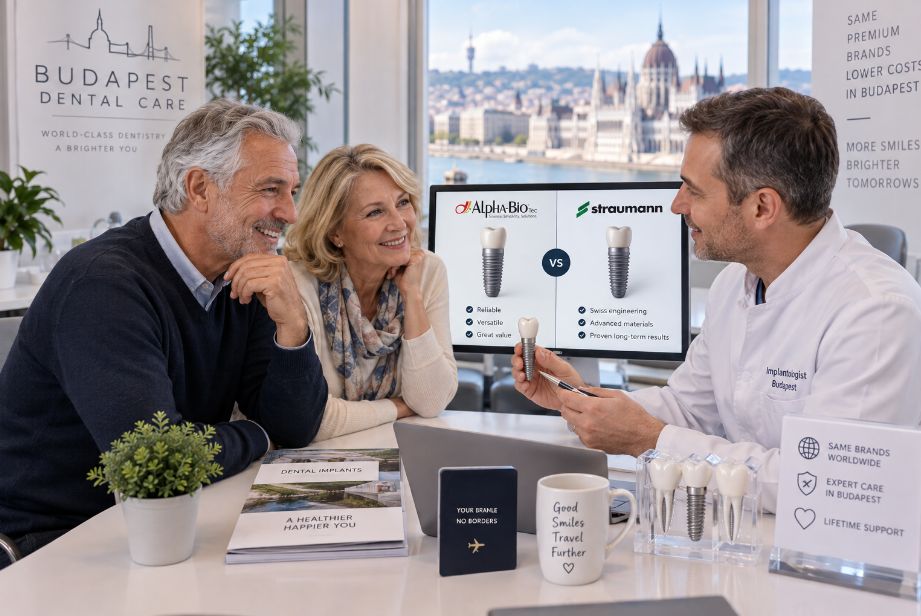
Two implant systems frequently discussed by patients are Straumann and Alpha-Bio Tec. Both are established international dental implant manufacturers, and both offer implant systems supported by clinical research and broad distribution networks.
The important point, however, is that brand selection should follow the clinical situation rather than the other way around.
Straumann is generally positioned as a premium implant system, with technologies such as Roxolid titanium-zirconium alloy and the hydrophilic SLActive surface. Alpha-Bio Tec offers a broad range of implant designs, including its long-established SPIRAL system, and is part of the Envista dental group alongside major international brands including Nobel Biocare.
For many straightforward implant cases, either system can be an appropriate choice. In more demanding cases—such as limited bone volume, narrow spaces, immediate implant placement or situations where primary stability is particularly important—the specific implant design and surface may become more relevant.
So, which should you choose for dental implants in Budapest?
The answer depends on your bone, anatomy, treatment plan and expectations.
Dental implants in Budapest: does lower cost mean lower quality?
Patients from London, Dublin, New York, Boston and other Western cities are often surprised by the difference between dental implant prices in Budapest and those in their home countries.
However, it is important not to assume that the difference automatically represents a difference in implant quality.
The overall cost of implant treatment includes much more than the implant itself. It includes clinical staff, premises, laboratory work, sterilisation, equipment, diagnostic imaging, laboratory technicians, administrative costs and local operating expenses.
Budapest has a different cost structure from London, Dublin or major US metropolitan areas. That can allow an established clinic to provide internationally manufactured implant systems at a lower overall treatment price.
But there is an important qualification:
A lower price is not proof of equivalent quality, and a higher price is not proof of better treatment.
The correct question is:
What exactly is included in the treatment, which implant and prosthetic components are being used, who is performing the surgery, and what happens if you need assistance after returning home?
That is the level of transparency I recommend to every international patient.
It is also worth distinguishing between regulatory approval and clinical suitability. Straumann products, for example, appear in the US FDA 510(k) database, including Roxolid and SLActive implant systems.
A clinic should be able to tell you the exact implant system and model, rather than simply saying that you are receiving a “premium implant”.
Straumann dental implants: Swiss engineering and premium implant technology
Straumann Group is one of the best-known names in implant dentistry.
Straumann’s implant portfolio includes conventional titanium implants as well as its proprietary Roxolid® titanium-zirconium alloy and SLActive® surface technology.
What is Roxolid?
Roxolid is not zirconia.
This distinction is important.
Roxolid is a titanium-zirconium alloy, and Straumann developed it particularly for situations where the mechanical properties of the implant material are important. FDA documentation identifies Roxolid implants as titanium-13 zirconium alloy.
Titanium-zirconium alloys have demonstrated high tensile strength, and clinical research has evaluated their use particularly in narrow-diameter implants. A systematic review of titanium-zirconium narrow implants reported short-term survival and success rates comparable with conventional-diameter titanium implants, although the authors also noted the need for longer-term evidence.
Why does that matter to a patient?
Because sometimes the ideal treatment is not to place a large implant and remove additional bone to accommodate it. A mechanically strong narrow implant may allow the surgeon to work within the available anatomy.
That does not mean Roxolid eliminates the need for bone grafting in every patient. It does not.
The decision still depends on the width and height of your bone, implant position, bite forces, aesthetic requirements and the amount of available soft tissue.
What is SLActive?
SLActive is a specially modified implant surface designed to encourage favourable early biological interaction between the implant and surrounding tissues.
In simple terms, osseointegration is the process through which living bone becomes firmly integrated with the implant surface.
Straumann describes SLActive as a hydrophilic surface with micro- and nano-scale characteristics. Its published technical information reports increased surface area and research demonstrating early osseointegration effects.
There is also clinical literature examining SLA and SLActive implants in immediate and early loading protocols. A systematic review found positive results but also highlighted limitations in the available evidence, including heterogeneity between studies and relatively limited randomised evidence specifically for SLActive.
That distinction matters.
SLActive does not mean that every Straumann implant can be loaded immediately.
Immediate loading is a clinical protocol, not simply a property of an implant brand.
Primary stability, bone quality, implant position, occlusion, infection control and the design of the temporary restoration all matter.
When might Straumann make particular clinical sense?
In my experience, the premium characteristics of a Straumann system can be particularly relevant when we are dealing with a more demanding clinical situation.
Examples may include:
- limited available bone width;
- narrow spaces between adjacent roots;
- certain immediate implant situations;
- cases where high primary stability is important;
- complex restorative requirements;
- situations where a narrow-diameter implant may be considered;
- patients with anatomical limitations where implant dimensions need to be selected carefully.
The evidence does not justify saying that Straumann is automatically “better” for every patient.
Instead, its material options and surface technologies give the implantologist additional tools when planning a case.
That is a more clinically useful way of looking at premium implant systems.
Alpha-Bio Tec: a versatile, established implant system
Alpha-Bio Tec is another established name in implant dentistry.
Today Alpha-Bio Tec sits within the Envista dental portfolio, alongside brands including Nobel Biocare and other major dental companies. Envista describes Alpha-Bio Tec as a company founded in 1988, focused on cost-effective implant solutions, clinical research, training and education.
This corporate relationship is sometimes misunderstood.
Alpha-Bio Tec is not simply another Nobel Biocare implant. It is its own implant brand with its own product portfolio.
What patients can reasonably take from the relationship is that Alpha-Bio Tec operates within a large international dental technology group with extensive global distribution and infrastructure.
Alpha-Bio Tec itself reports a broad international distribution network, including distributors across Europe and other regions.
The Alpha-Bio SPIRAL implant: why the design matters
The SPIRAL™ implant is one of Alpha-Bio Tec’s long-established implant systems.
Its design incorporates a tapered body, variable/double threading and relatively aggressive apical threads intended to help achieve primary stability and controlled insertion.
Alpha-Bio Tec describes the SPIRAL as an active tapered implant with an internal hex connection and a design intended to provide high primary stability and bone-to-implant contact.
The spiral concept also has an interesting history.
Alpha-Bio Tec’s founder, Dr Ophir Fromovich, has described the development of the original SPI Spiral implant as an attempt to improve fixation in softer bone by changing the thread geometry.
From a clinical perspective, the important concept is not the marketing story but the biomechanics.
An implant has to achieve sufficient primary stability—the mechanical stability immediately after placement—to allow the bone healing process to proceed without excessive micromovement.
This is particularly important if immediate or early loading is being considered.
What about Alpha-Bio’s implant surface?
Alpha-Bio Tec offers different surface technologies across its implant portfolio.
Its NanoTec surface is produced using mechanical and chemical surface modification, including sandblasting and acid etching. The company describes the resulting microporous surface as being designed to increase surface area and bone-to-implant contact.
Its newer NiNA surface technology adds hydrophilic and nanoscale characteristics.
This is another reason why patients should avoid asking only:
“Do you use Alpha-Bio?”
The more useful question is:
“Which Alpha-Bio implant model and surface are you planning to use?”
Different implant models within the same manufacturer’s portfolio can have different designs, dimensions, connections and intended clinical applications.
Alpha-Bio vs. Straumann: direct comparison
Here is the comparison I would give to a patient considering treatment in Budapest.
| Feature | Straumann | Alpha-Bio Tec |
|---|---|---|
| Origin | Switzerland; Straumann Group | Founded in Israel; international Envista dental portfolio |
| Material | Titanium and, in selected systems, Roxolid® titanium-zirconium alloy | Titanium implant systems; specific alloy depends on the product |
| Surface technology | SLA® and SLActive® among its established surface technologies | NanoTec™, NiNA™ and other product-specific surface technologies |
| Osseointegration time | No universal time; SLActive is designed to support early biological integration, but loading depends on clinical stability | No universal time; depends on implant model, surface, bone quality and stability |
| Best clinical use | Broad range; particularly attractive where premium material/surface options or narrow-diameter solutions are clinically useful | Broad range; versatile option for routine and appropriately selected immediate/early-loading cases |
| Primary stability | Highly dependent on implant design, dimensions and bone | SPIRAL and other designs are engineered to support primary stability |
| Relative price tier | Generally premium | Generally lower/mid-market compared with premium systems |
| International availability | Extensive international presence | Broad international distribution network |
| Long-term maintenance | Replacement components and prosthetic support available internationally, subject to local availability | International distribution supports access to components, subject to local availability |
One important correction about “healing time”
There is no medically responsible way to say:
“Straumann takes X weeks and Alpha-Bio takes Y weeks.”
Osseointegration is biological. It depends on bone quality, implant stability, surgical technique, implant position, systemic and local factors, loading conditions and the specific implant surface.
The manufacturer’s surface technology can influence the early biological response, but it does not override the patient’s biology.
For some cases, loading may be possible immediately or early. For others, the implant should remain unloaded for a longer healing period.
So, which implant is better?
I would not give every patient the same answer.
If you have excellent bone volume, a straightforward missing tooth and conventional loading is planned, an Alpha-Bio Tec implant may provide a very sensible balance between established implant technology and treatment cost.
If you have a narrow ridge, limited available bone, challenging anatomy or a treatment plan in which a particular Straumann material or surface technology provides a clinical advantage, Straumann may be considered.
But the surgeon, treatment planning and restoration are at least as important as the logo on the implant.
An excellent implant placed in the wrong three-dimensional position is not an excellent treatment.
Likewise, an appropriately selected, well-positioned implant from a less expensive system can provide a successful long-term restoration.
The implant brand is one part of the treatment equation—not the entire equation.
What international patients should check before travelling to Budapest
If you are travelling from the UK, US or Ireland, I recommend asking your Budapest clinic these questions before booking flights.
1. Which exact implant will you use?
Ask for:
- manufacturer;
- implant family/model;
- diameter;
- length;
- implant material;
- surface treatment;
- abutment system.
You should be able to receive this information in writing.
2. Is the implant included in the quoted price?
An advertised “implant price” may not include:
- abutment;
- temporary crown;
- permanent crown;
- CBCT;
- extraction;
- bone grafting;
- sinus augmentation;
- sedation;
- laboratory fees;
- follow-up appointments.
Compare complete treatment plans, not individual implant prices.
3. Who performs the surgery?
Ask about the implantologist’s qualifications and experience with the proposed system.
4. What happens if bone grafting is required?
A CBCT scan is often essential when bone volume, sinus anatomy, nerve position or complex implant placement needs to be assessed.
5. What happens after you return home?
This is particularly important for dental tourism.
Ask whether you will receive:
- the implant passport or implant identification information;
- implant model and dimensions;
- abutment information;
- radiographs;
- surgical records;
- prosthetic records;
- laboratory details;
- written aftercare instructions.
Keep these documents permanently.
Cross-border peace of mind: what happens if you need a dentist at home?
One of the legitimate advantages of using an established international implant manufacturer is the potential availability of components and professional familiarity beyond Budapest.
Straumann has an extensive international presence, while Alpha-Bio Tec reports a global partner and distribution network.
This can be helpful if a patient needs maintenance after returning to the UK, Ireland, the US or another country.
However, I would not promise that every dental practice will stock every component.
That would be unrealistic.
A local dentist may need to identify the exact implant and obtain the appropriate prosthetic component from the manufacturer or distributor.
This is why your implant documentation matters so much.
Your dentist back home should not have to guess whether you received a Straumann BLX, Bone Level, Alpha-Bio SPIRAL, MultiNeO or another system.
Is Straumann worth paying more for?
This is ultimately a clinical and financial decision.
Straumann’s Roxolid and SLActive technologies are genuine engineering and surface-technology features, and there is published clinical evidence supporting the use of titanium-zirconium implants.
But premium does not automatically mean necessary.
If a patient has a straightforward case with favourable bone dimensions, paying substantially more for an implant system may not provide a meaningful clinical advantage for that particular treatment.
Conversely, if the anatomy is challenging, the additional implant options available within a premium system may be useful.
The correct question is therefore not:
“Is Straumann better?”
It is:
“Does the additional technology offered by this particular implant provide a meaningful benefit in my particular anatomy?”
That is a much more useful question for a patient.
What I would want to see before recommending an implant brand
If you contacted my Budapest clinic and asked me to choose between Alpha-Bio and Straumann without seeing your X-ray, I would not make a definitive recommendation.
I would first want to assess:
- bone height;
- bone width;
- bone density;
- proximity to the inferior alveolar nerve;
- maxillary sinus anatomy;
- adjacent tooth roots;
- available prosthetic space;
- gum and soft-tissue condition;
- bite and occlusal forces;
- infection or periodontal disease;
- aesthetic requirements;
- whether immediate placement is appropriate;
- whether immediate loading is appropriate;
- whether bone regeneration is necessary.
Only then does implant selection become meaningful.
The most important factor is not the implant brand
A successful implant treatment is a chain of decisions:
Diagnosis → treatment planning → implant selection → surgical positioning → healing → prosthetic design → maintenance.
If one link is weak, the brand cannot compensate for it.
This is particularly important for patients travelling abroad.
Do not choose a Budapest dental clinic simply because it advertises “Straumann implants” or because an Alpha-Bio implant is offered at a lower price.
Look at the complete treatment plan.
Ask who will perform the surgery.
Ask what happens if the anatomy is different from what was expected.
Ask which laboratory makes your crown or bridge.
Ask for your implant identification documents.
And ask what support is available after you fly home.
Those questions tell you much more about the quality of care than a brand name alone.
Alpha-Bio or Straumann: what would I recommend for you?
For a patient with good bone density and a relatively straightforward implant site, Alpha-Bio Tec can be a very reasonable option when the implant is correctly selected and the treatment is planned and executed properly.
For a patient with more demanding anatomy, limited space or a case where particular material and surface characteristics are clinically useful, a Straumann system may offer additional options worth considering.
There is no universal winner.
The best implant is the one that is appropriate for your anatomy, professionally placed, correctly restored and properly maintained.
That is also why comparing Budapest implant prices without comparing the actual treatment specification can be misleading.
Thinking about dental implants in Budapest?
If you are travelling from the UK, Ireland or USA to Budapest for dental implants, you do not have to decide between Alpha-Bio and Straumann based on advertising alone.
Send us your panoramic X-ray (OPG) or, where available, your CBCT scan.
We can assess the available bone, implant site, anatomical limitations and overall treatment requirements and explain which implant system may be appropriate for your case—and why.
We can also explain the difference between the implant itself and the abutment, temporary restoration and final crown, so you know exactly what you are paying for before travelling.
For international patients, transparency should come before the sales pitch.
Your treatment plan should be based on your mouth—not on a brand name.
Clinical note: Dental implant treatment is individual. This article provides general educational information and should not replace an examination, diagnostic imaging or a personalised treatment plan by a qualified dental professional.
Frequently Asked Questions: Alpha-Bio vs. Straumann Dental Implants in Budapest
1. Is Straumann better than Alpha-Bio for dental implants?
Not necessarily. Both are established implant systems, but the appropriate choice depends on your bone volume, bone quality, implant position, restorative requirements and overall treatment plan. Straumann offers premium technologies such as Roxolid® and SLActive®, while Alpha-Bio Tec provides a range of versatile implant designs. Your implantologist should select the system based on your individual clinical needs rather than brand reputation alone.
2. Are Alpha-Bio implants good quality?
Alpha-Bio Tec is an established international dental implant manufacturer with a broad implant portfolio and global distribution. Its systems include different implant designs and surface technologies. For appropriately selected cases, an Alpha-Bio implant can be a suitable treatment option. The quality of the final result also depends heavily on diagnosis, surgical technique, implant positioning and the quality of the final restoration.
3. Why are Straumann implants more expensive?
Straumann is generally positioned in the premium segment of the dental implant market. Its portfolio includes proprietary technologies such as Roxolid® titanium-zirconium alloy and SLActive® surface treatment. However, the price of an implant treatment also includes surgery, diagnostics, laboratory work, abutments and the final crown or bridge. A higher implant price does not automatically mean that it is clinically necessary for every patient.
4. What is Roxolid®?
Roxolid® is a titanium-zirconium alloy developed by Straumann for dental implant applications. Compared with commercially pure titanium, the alloy has high mechanical strength and is used in selected Straumann implant designs, including narrow-diameter implants. Whether this provides an advantage depends on the patient’s anatomy and treatment plan.
5. What is SLActive®?
SLActive® is a Straumann implant surface technology designed to provide a hydrophilic surface and support early biological interaction between the implant and surrounding tissues. It is associated with research into early osseointegration, but it does not mean that every Straumann implant can or should be loaded immediately.
6. How long does an Alpha-Bio implant take to heal?
There is no single healing time that applies to every Alpha-Bio implant. Osseointegration depends on factors such as bone quality, implant stability, implant position, surgical technique and the patient’s individual healing response. Some appropriately selected cases may use immediate or early loading protocols, while others require a longer healing period.
7. How long does a Straumann implant take to heal?
The healing period varies from patient to patient and from one clinical situation to another. Straumann’s SLActive® surface is designed to support early osseointegration, but the decision about when to load an implant depends on clinical stability and other factors. Your implantologist should determine the appropriate loading protocol after assessing your bone and implant stability.
8. Can I get Alpha-Bio or Straumann implants in Budapest?
Yes. Both manufacturers have international distribution networks, although the exact implant models and components available vary between clinics and countries. If you are travelling to Budapest, ask the clinic for the exact implant manufacturer, model, dimensions and prosthetic components included in your treatment.
9. Are Budapest dental implants the same brands used in the UK, US and Ireland?
Budapest clinics can use internationally established implant brands that are also available in Western markets. However, patients should verify the exact manufacturer and implant model rather than assuming that every clinic uses the same products or regulatory configuration. A reputable clinic should be transparent about the implant system being proposed.
10. Why are dental implants cheaper in Budapest?
Dental treatment costs can be lower in Budapest because operating expenses—including salaries, premises, laboratory costs and other overheads—differ from those in cities such as London, Dublin or New York. Lower treatment costs should not, however, be taken as proof of either higher or lower clinical quality. Patients should compare the qualifications of the dental team, treatment plan, materials, laboratory work, aftercare and total price.
11. Can a UK, US or Irish dentist maintain my Budapest dental implant?
In many cases, a dentist in your home country can provide routine examinations and maintenance, but they will need to know exactly which implant system and prosthetic components were used. Specific components may need to be sourced through the manufacturer’s local distribution network. This is why you should keep your implant passport, treatment records and radiographs after returning home.
12. What information should I request before travelling to Budapest for implants?
Ask the clinic for a written treatment plan specifying:
- Implant manufacturer and exact model
- Implant dimensions
- Implant material and surface
- Abutment type
- Temporary restoration
- Final crown or bridge
- Laboratory used
- CBCT or other diagnostic requirements
- Any proposed bone grafting or sinus augmentation
- Number of visits required
- Total treatment cost
- Warranty and aftercare arrangements
13. Is Alpha-Bio cheaper than Straumann?
Alpha-Bio Tec is generally positioned at a lower price tier than Straumann. However, the total cost depends on the clinic, treatment complexity, laboratory work and the components included. When comparing Budapest dental implant prices, compare the complete treatment package rather than the price of the implant fixture alone.
14. Can I get immediate-load implants with Alpha-Bio or Straumann?
Immediate loading may be possible with appropriately selected cases using either implant system, but the brand alone does not determine whether immediate loading is safe. Primary stability, bone quality, implant position, occlusion and the design of the temporary restoration all need to be considered. Your implantologist should make this decision after clinical examination and imaging.
15. Which implant is best for patients with limited bone?
There is no single implant that is automatically best for patients with limited bone. Depending on the anatomy, treatment may involve a narrow implant, bone augmentation, sinus elevation or a different surgical approach. Straumann’s Roxolid® portfolio can provide additional options in selected narrow-ridge situations, but whether it is appropriate can only be determined from your clinical assessment and imaging.
16. Should I choose my Budapest dental clinic based on the implant brand?
The implant brand is important, but it should not be the only factor. Look at the implantologist’s experience, diagnostic process, treatment planning, surgical facilities, laboratory quality, restoration design, documentation and aftercare arrangements. A well-planned treatment using an appropriate implant is more important than simply choosing the most expensive brand.
17. Can you tell which implant I need from a panoramic X-ray?
A panoramic X-ray can provide useful initial information, but it may not show bone dimensions and anatomical structures with the same three-dimensional detail as a CBCT. For many implant cases, particularly complex ones, a CBCT may be recommended before final treatment planning.
18. Can I send my X-ray or CBCT before travelling to Budapest?
Yes. Sending your panoramic X-ray or CBCT to an experienced implantologist can allow the dental team to make an initial assessment of your implant sites and discuss potential treatment options before you travel. A remote assessment does not replace an in-person examination, but it can help you understand the likely treatment approach, number of implants and possible additional procedures.
19. What should I do if I need implant maintenance after returning to the UK, US or Ireland?
Keep all of your dental records, including the implant brand, model, dimensions, abutment information, radiographs and laboratory details. When possible, arrange routine implant maintenance with a dentist familiar with implant dentistry. If a component needs replacement, the exact implant system can then be identified and the appropriate part sourced.
20. How do I choose between Alpha-Bio and Straumann for my Budapest implant treatment?
Start with your clinical situation rather than the brand. Your implantologist should assess your CBCT or other diagnostic imaging, bone volume and quality, implant position, bite, aesthetic requirements and restoration. You can then compare the clinical rationale and total cost of Alpha-Bio and Straumann options and make an informed decision about your treatment.
Considering dental implants in Budapest? Send your panoramic X-ray or CBCT scan for an initial expert assessment of your implant sites, treatment options and the implant system that may be appropriate for your anatomy and budget.
Sources and Further Reading
- Straumann – Roxolid® titanium-zirconium implant material — Manufacturer information on Roxolid, its material characteristics and clinical applications.
- Straumann – SLActive® surface technology — Technical information on SLActive surface characteristics and early osseointegration research.
- U.S. FDA – Straumann Roxolid® dental implant 510(k) record — U.S. regulatory documentation.
- U.S. FDA – Straumann SLActive® labeling / 510(k) documentation — FDA documentation covering Straumann SLActive and Roxolid implant configurations.
- Alpha-Bio Tec – SPIRAL™ implant system — Manufacturer information on the SPIRAL implant design, dimensions and clinical features.
- Alpha-Bio Tec – Implant surface technology — Manufacturer information on NanoTec™ and NiNA™ surfaces.
- Envista – Specialty Products & Technologies — Corporate information on Alpha-Bio Tec and the wider Envista dental portfolio.
- PubMed – Clinical evidence on titanium-zirconium dental implants: systematic review and meta-analysis — Peer-reviewed evidence concerning titanium-zirconium narrow-diameter implants.
- PubMed – SLA and SLActive implants in immediate/early loading protocols — Systematic review of prospective clinical evidence.
- PubMed – Clinical performance of titanium, titanium-zirconium and zirconia implants — Systematic review of randomised controlled trials.