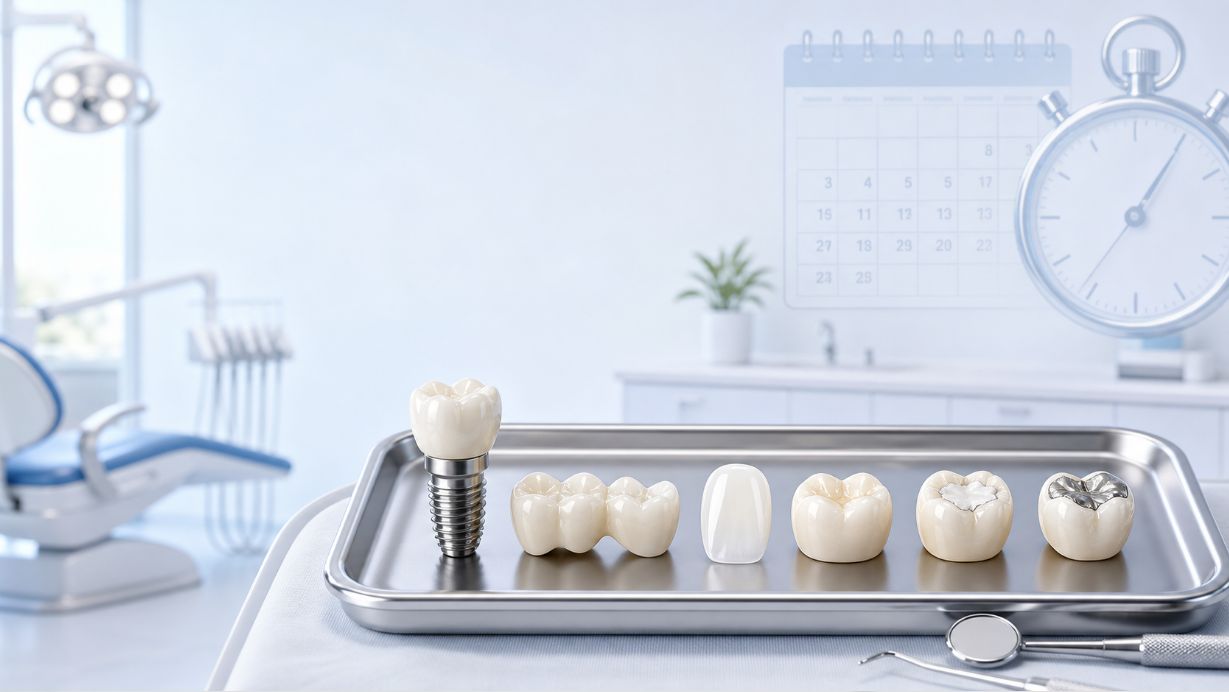
The lifespan of dental work: what lasts, what fails, and what to expect
When people travel for dental treatment, they usually want two things: a smile that looks good and results that last. The real value of any dental restoration is not just how it looks on day one, but how long it performs before repair or replacement becomes necessary. In a dental tourism context, this matters even more because patients often compare treatment cost against long-term durability rather than the lowest upfront price.
Dental work is not built to last forever, even when it is done well. Some treatments can survive for decades with proper care, while others are more maintenance-heavy and may need replacement much sooner. If you are planning treatment abroad or comparing UK clinics, understanding lifespan is essential before choosing implants, bridges, veneers, crowns, composite fillings, or amalgam fillings.
Dental implant lifespan
Dental implants are usually the most durable option for replacing missing teeth. The implant fixture itself can often last many years and, in many cases, a lifetime, provided the patient maintains excellent oral hygiene and attends regular reviews. What usually wears out first is the visible crown on top of the implant, not the titanium post in the jaw.
A practical way to think about implants is that they are a long-term investment rather than a disposable restoration. They are especially attractive for dental tourism patients who want stability, chewing function, and a result that feels close to a natural tooth. However, implants still depend on healthy gums, controlled bite forces, and avoidance of smoking-related complications, so “lifetime” should be treated as a goal rather than a guarantee.
For UK patients, implants often compare well against bridges because they do not rely on grinding down adjacent teeth. That said, the initial cost is usually higher, and maintenance still matters. A well-maintained implant can be one of the best value-for-money treatments in restorative dentistry when measured across many years of use.
Bridge lifespan
Traditional dental bridges usually last less time than implants, but they remain a popular option because they are fixed, fast, and often more affordable upfront. UK patient guidance commonly describes crown and bridgework as lasting around five to ten years on average, though some patients keep them for 20 or 30 years with excellent care. Other UK and private-clinic sources place bridges closer to 7 to 15 years, depending on the design and oral condition.
The main weakness of a bridge is that it depends on the teeth supporting it. If those anchor teeth decay, crack, or suffer gum disease, the bridge may fail even if the bridge itself is intact. This is why bridges are often considered a compromise solution: they restore function well, but they create extra responsibility for cleaning around the supporting teeth and under the bridge.
For dental tourists, bridges can still be a smart choice when the surrounding teeth already need crowns or when implant surgery is not ideal. The key is to accept that a bridge is usually not a “fit and forget” solution. It is a maintenance-dependent restoration that can perform well for many years if the patient keeps the area clean and attends follow-up care.
Veneer lifespan
Veneers are usually chosen for cosmetic improvement rather than strength, and their lifespan reflects that. NHS guidance and UK clinic literature make it clear that veneers do not last a lifetime and may need to be replaced several times over a patient’s life. In practical terms, many veneers last around 10 to 15 years, while some survive much longer when the patient avoids heavy biting, nail-biting, grinding, and poor oral hygiene.
Porcelain veneers generally hold up better than direct cosmetic bonding, but they are still thin restorations and can chip, debond, or stain at the edges. The long-term follow-up of crown and veneer cases in a London dental practice showed very strong survival when cases were maintained regularly and oral hygiene was good, with some restorations lasting decades. That kind of result is impressive, but it is not the average patient experience and should not be sold as a promise.
For a UK-facing dental tourism audience, veneers are best described as a medium-to-long-term cosmetic treatment. They are excellent for smile design, but they are not the same as a structural solution for badly broken teeth. Patients should choose veneers when the goal is appearance and minor correction, not when the tooth needs major reinforcement.
Crown lifespan
Crowns are one of the most common and most reliable restorative treatments in dentistry. UK sources commonly place the average lifespan of a dental crown around 10 to 15 years, with many lasting longer if they are well made and well maintained. Strong long-term clinical evidence from a London practice found that metal-ceramic crowns can survive for decades under regular recall and good oral hygiene.
A crown fails for several familiar reasons: decay developing at the margin, fracture of the tooth underneath, loosening of the cement, gum recession, or bite stress from clenching and grinding. This means that crown longevity is not only about material quality; it is also about how the tooth is prepared, how the crown fits, and how the patient looks after it afterward. In other words, a crown is only as good as the tooth and gum health around it.
Crowns are often used in dental tourism because they solve a wide range of problems: cracked teeth, heavily filled teeth, root-treated teeth, and teeth that need both strength and appearance. For many patients, crowns hit the right balance between longevity, cost, and aesthetics. If you want a treatment that is generally more durable than veneers and more conservative than extracting and replacing a tooth, crowns often sit in the middle ground.
Composite filling lifespan
Composite fillings are popular because they match tooth color and can be placed conservatively. The trade-off is longevity: composite usually does not last as long as amalgam in high-load back teeth, and UK literature repeatedly shows shorter survival compared with amalgam restorations. Typical real-world estimates often fall around 5 to 7 years, though many can last longer depending on cavity size, tooth location, and patient habits.
Composite is especially vulnerable in larger restorations and in teeth exposed to heavy chewing forces. It can wear, chip, stain, or lose its seal at the margins over time, and once microleakage starts, secondary decay can follow. That said, composite remains very useful because it is tooth-coloured, versatile, and often preferred in visible areas or when a conservative approach is needed.
For review-style content, the balanced view is simple: composite fillings are aesthetically excellent, but they usually need replacement sooner than more durable indirect restorations. They are a strong everyday option for many patients, especially in the front teeth and in smaller cavities, but they are not the longest-lasting material in the dentistry toolkit.
Amalgam filling lifespan
Amalgam fillings have a strong reputation for durability, especially in posterior teeth that take a lot of chewing pressure. UK data from England and Wales found that single-surface amalgam restorations had the longest survival at ten years in the large NHS dataset examined, and they outperformed composite in many situations. In practical terms, amalgam often lasts around 10 to 15 years or more, and smaller fillings can last even longer.
The main reason amalgam has remained relevant in longevity discussions is simple: it is tough. It resists wear well and often performs better than composite in load-bearing areas, particularly where the cavity is large or the patient bites hard. However, longevity is not the only issue patients care about, because appearance matters too, and many people now prefer tooth-coloured materials.
In a dental tourism review, amalgam is best described as a durable but less cosmetic option. It may still be a sensible choice in specific clinical situations, but many patients now choose composite for aesthetics despite the shorter expected lifespan. If your main priority is survival under pressure, amalgam still has a strong track record in the literature.
Which lasts longest
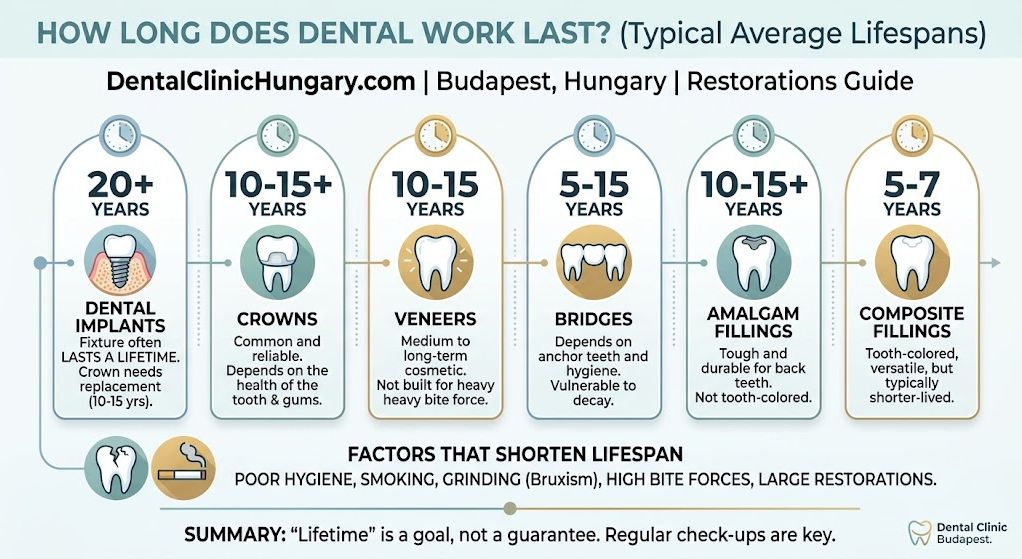
If the question is purely about lifespan, implants generally win at the top end, followed by well-made crowns and bridges, then veneers and fillings depending on the case. But the answer is not as simple as “longest is best,” because the right choice depends on the tooth’s condition, the number of missing teeth, the bite, the patient’s budget, and how much maintenance they are willing to accept. A treatment that lasts 20 years but is over-invasive may not be better than a simpler option that is easier to repair.
Here is the practical hierarchy for many patients:
-
Dental implants: often the best long-term option for missing teeth, with the post potentially lasting a lifetime.
-
Crowns: often 10 to 15 years or more, with long survival possible under regular care.
-
Bridges: commonly around 5 to 15 years, depending on support teeth and hygiene.
-
Veneers: often 10 to 15 years, though maintenance and bite habits matter a lot.
-
Amalgam fillings: often outlast composites in back teeth, especially under load.
-
Composite fillings: usually shorter-lived than amalgam, but excellent aesthetically.
What shortens lifespan
Most dental restorations fail for predictable reasons. Poor hygiene, smoking, grinding, high bite forces, large restorations, and untreated gum disease all reduce lifespan. Even the best material can fail early if plaque control is poor or if the restoration is overloaded.
Another major factor is the size and location of the restoration. Smaller fillings typically survive better than large multi-surface fillings, and anterior cosmetic work usually faces different stresses than posterior chewing teeth. The quality of the dentist’s work also matters, because fit, seal, and margin design influence how quickly decay or leakage develops.
For medical tourism and dental tourism patients, aftercare is often the hidden variable. A restoration placed abroad may be excellent, but if the patient does not continue with check-ups at home, the lifespan will usually drop. The cheapest treatment is rarely the cheapest over 10 years if maintenance is ignored.
Maintenance tips
The simplest way to extend the lifespan of dental work is to protect the margins and control plaque. Brush twice a day, clean between teeth daily, and attend regular dental check-ups and hygiene visits. For implants and bridges, cleaning access is especially important because bacteria often collect around the structure even when the restoration itself still looks fine.
If you grind your teeth, ask about a night guard. Bruxism can shorten the life of crowns, veneers, bridges, and fillings because it increases fracture risk and wear. Also, try to avoid using teeth as tools, biting hard objects, or repeatedly loading one side of the mouth.
A good rule for dental tourists is to plan for maintenance before choosing the treatment. If you want the longest life, choose a durable material, but also commit to the habits that make that material last. In dentistry, longevity is partly built in the lab or clinic and partly built at home.
UK patient view
For UK-facing readers, it is worth noting that NHS guidance and NHS-adjacent patient information consistently stress that crowns, bridges, veneers, fillings, and other restorations do not last forever. The 12-month NHS guarantee on certain items is a short-term safety net, not a statement of long-term durability. That distinction matters in dental tourism because many patients confuse warranty-style language with real lifespan.
The strongest positioning is honest and practical: implants can be the longest-lasting option, crowns and bridges often offer strong medium-to-long-term value, veneers are mainly cosmetic, amalgam remains durable, and composite offers aesthetics with shorter survival in many cases. That is the message UK patients usually need before making a decision.
FAQs
1. How long does dental work usually last?
Dental work can last anywhere from a few years to several decades, depending on the treatment, the materials used, and how well it is maintained. Implants and well-made crowns often last the longest, while fillings and veneers usually need replacement sooner.
2. Do dental implants last a lifetime?
Dental implants can last a very long time, and the implant post itself may last for life in many cases. The crown on top of the implant may still need replacement after years of wear.
3. How long do dental crowns last?
Dental crowns often last around 10 to 15 years, but many last much longer with good oral hygiene and regular check-ups. Their lifespan depends on bite pressure, tooth condition, and daily care.
4. Are bridges better than implants for longevity?
Implants usually last longer because they do not rely on nearby teeth for support. Bridges can still be a good option, but they often need replacement sooner than implants.
5. How long do veneers last?
Veneers often last about 10 to 15 years, although some last longer. Their lifespan depends on bite habits, grinding, oral hygiene, and the quality of the placement.
6. Do composite fillings last as long as amalgam fillings?
No, amalgam fillings usually last longer than composite fillings, especially in back teeth. Composite fillings look more natural, but they may wear down or fail sooner under heavy chewing pressure.
7. What makes dental work wear out faster?
Poor oral hygiene, gum disease, teeth grinding, smoking, and biting hard objects can shorten the lifespan of dental work. Large restorations and heavy chewing forces can also cause earlier failure.
8. How can I make dental work last longer?
Brush twice a day, clean between your teeth daily, and attend regular dental check-ups. If you grind your teeth, a night guard can help protect crowns, veneers, bridges, and fillings.
9. Is dental work in the UK designed to be permanent?
No, most dental restorations are not permanent. Even high-quality treatment will eventually need review, repair, or replacement.
10. Which dental treatment offers the best long-term value?
For missing teeth, implants often offer the strongest long-term value. For damaged teeth, crowns usually provide a good balance of durability, function, and appearance.
Sources
-
NHS dental treatments: https://www.nhs.uk/live-well/healthy-teeth-and-gums/dental-treatments/
-
Manchester University NHS Foundation Trust leaflet on crowns, veneers and bridges: https://mft.nhs.uk/app/uploads/sites/3/2018/09/UDH-124.pdf
-
NHSBSA guidance on guaranteed items: https://faq.nhsbsa.nhs.uk/knowledgebase/article/KA-04756/en-us
-
PubMed: How long do direct restorations placed within the general dental services in England and Wales survive?: https://pubmed.ncbi.nlm.nih.gov/19057561/
-
PubMed: An up to 50-year follow-up of crown and veneer survival in a dental practice: https://pubmed.ncbi.nlm.nih.gov/28969914/
-
British Dental Journal / Nature: How long do routine dental restorations last? A systematic review: https://www.nature.com/articles/4800298a1
-
British Dental Journal / Nature: Resin composite restorations longevity article: https://www.nature.com/articles/sj.bdj.2018.443
-
British Dental Journal / Nature: Restoration longevity in England and Wales, key findings: https://www.nature.com/articles/sj.bdj.2018.1029