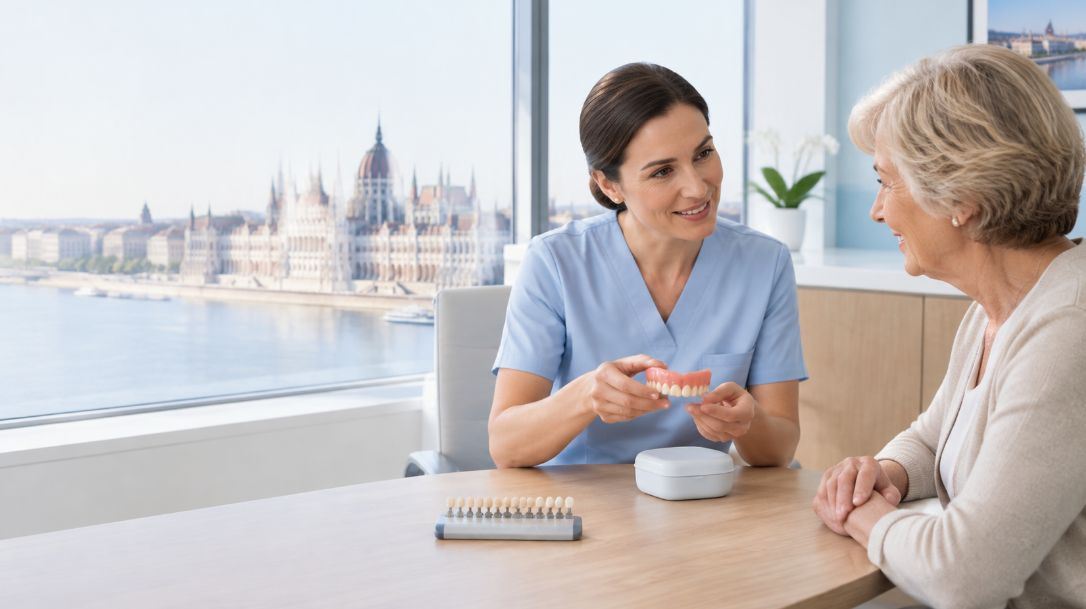
- BPS dentures use a coordinated clinical and laboratory workflow developed by Ivoclar. They are individually made – not a prefabricated product or simply a premium set of denture teeth.
- Detailed impressions, jaw registration and personalised tooth arrangement aim to improve fit, function and appearance. Results still depend on your anatomy and the treating team.
- Better stability is possible, but guaranteed suction and adhesive-free wear are not realistic promises. Lower dentures can remain challenging, particularly with severe bone loss.
- Natural-looking teeth and appropriate lip support can improve confidence. Dentures cannot stop jawbone changes, eliminate ageing or fully reproduce natural-tooth chewing ability.
- Budapest may offer lower treatment fees, but compare equivalent quotations. Confirm whether the price covers one jaw or both, the complete BPS workflow, adjustments and aftercare.
- Include flights, accommodation and possible follow-up costs when calculating savings. For US patients, long-haul travel may outweigh the saving on a single denture.
- One planned trip may be sufficient, but it is not guaranteed. A five-to-seven-working-day schedule depends on oral health, laboratory availability and whether changes are needed.
- Leave time after fitting for adjustments. Agree in advance who will help if pressure areas or fit problems develop after you return home.
- Future conversion to an implant-retained overdenture may be possible, but some dentures need substantial modification or replacement.
- Daily cleaning and regular reviews remain essential. Request a personalised treatment plan and written warranty terms before booking travel.
When Your Dentures Affect More Than Your Smile
A denture that moves while you speak can make a conversation uncomfortable. Clicking teeth, sore gums and food trapped beneath the base can turn everyday activities into sources of anxiety.
Some people gradually stop eating certain foods. Others avoid restaurants or cover their mouths when laughing. After several disappointing adjustments, it is understandable to wonder whether removable dentures can ever feel dependable.
BPS dentures offer a structured approach to making personalised replacement teeth. BPS stands for Biofunctional Prosthetic System, a coordinated clinical and laboratory workflow developed by Ivoclar, previously widely known as Ivoclar Vivadent.
Sometimes described in advertising as the “Rolls-Royce of dentures”, BPS is better understood through its process than its luxury label. It combines detailed impressions, jaw-relation records, coordinated materials and close cooperation between the clinician and dental technician.
There is also a geographical detail worth clarifying. Ivoclar is headquartered in Schaan, Liechtenstein. Describing every BPS denture as a finished “Swiss-made” product is misleading: the denture is manufactured by the laboratory providing your treatment, using the specified workflow and materials.
For UK and US patients, Budapest can offer another place to investigate this premium approach. The city has an established international dental sector, including providers advertising BPS treatment and English-language patient support.
However, lower prices do not automatically establish equivalent treatment. The important questions concern the clinician’s experience, laboratory procedures, materials, appointments and aftercare.
BPS dentures also remain removable prostheses. They cannot stop natural changes in the jaw, guarantee unlimited chewing ability or reproduce every sensation of natural teeth.
Their potential value lies in careful personalisation.
For someone disappointed by previous dentures, that can be a meaningful improvement – provided the treatment starts with a realistic assessment rather than a promise of perfection.
What Makes BPS Dentures “Biofunctional”?
The word biofunctional describes the intention to make the denture work with the patient’s oral anatomy and functional movements.
A BPS denture is not a prefabricated plate selected from a shelf. The teeth, base, fit and bite are developed through a coordinated sequence of clinical and laboratory procedures.
Conventional dentures should also be individually made. BPS distinguishes itself through its defined workflow, matched products and communication between the dental practice and laboratory.
Detailed impressions and functional borders
The dentist first examines the mouth, remaining teeth, supporting tissues and existing dentures.
Preliminary impressions help create models and plan subsequent records. Custom trays can then be used for more detailed impressions.
Functional impression-taking records the supporting tissues while accounting for the surrounding muscles and movements.
A process sometimes called muscle trimming or border moulding helps establish the denture’s edges. The aim is to extend the base appropriately without making its borders interfere with the lips, cheeks or tongue.
Too little extension may reduce support and retention. Too much can cause displacement or soreness.
Precision therefore matters more than simply making a denture fit tightly.
Jaw registration: more than asking you to bite
The clinician must determine how the upper and lower jaws should meet, including the height at which the teeth contact.
Ivoclar’s Gnathometer M is an intraoral registration device – not an impression tray. It can help record jaw relationships using a tracing procedure known as Gothic arch tracing.
An articulator allows the technician to position models and assess aspects of the planned bite outside the mouth.
These records help guide tooth arrangement. They do not mean every possible jaw movement is perfectly duplicated or that adjustment becomes unnecessary.
The exact workflow may be conventional, digital or a combination.
Teeth, base materials and personal appearance
BPS uses coordinated products rather than one universal tooth or denture-base material.
Depending on the prescribed system, the laboratory may use suitable Ivoclar denture teeth and processing materials selected for appearance, handling and mechanical properties.
Ask for the actual product names. “Premium acrylic” alone does not identify what you are buying.
The technician can personalise tooth size, colour, arrangement and gum appearance. Small variations may look more convincing than perfectly uniform, brilliant-white teeth.
Gum characterisation can add natural-looking contour and colour where appropriate.
The goal is a believable result – not a guarantee that nobody will ever recognise a denture.
What Benefits Can Patients Realistically Expect?
Better fit and stability
A well-made denture distributes pressure appropriately and works with the supporting tissues.
Upper complete dentures can benefit from a peripheral seal and the relationship between the base, saliva and palate. This is often loosely described as suction.
Lower dentures usually present a greater challenge because the tongue moves within the arch and the available supporting area is smaller.
BPS cannot create an effective seal in every mouth. Severe ridge loss, dry mouth and tissue conditions can limit retention despite careful manufacture.
Some patients may need less adhesive. Others may still find appropriate adhesive helpful.
More comfortable eating and clearer speech
An accurate bite and well-positioned teeth can improve practical function.
A 2023 randomised trial found better measured chewing efficiency with BPS dentures than with the conventional comparison dentures. However, it did not find significant differences in overall patient satisfaction or the number of post-insertion adjustments.
That distinction matters. Promising clinical results do not mean every patient experiences a dramatic improvement.
Start with manageable foods and follow the clinician’s advice. Cut firmer foods into smaller pieces and avoid judging the result by immediately biting into a whole apple.
Steak and other demanding foods may remain difficult. Removable dentures do not necessarily restore natural-tooth chewing performance.
Speech can also require practice as the tongue and lips adapt.
Facial support without “anti-ageing” promises
Tooth loss and poorly designed dentures can affect lip support and the distance between the jaws when the teeth meet.
Appropriate restoration of this vertical dimension may improve facial proportions and reduce an overclosed appearance.
However, increasing the bite excessively can cause discomfort and other problems. The dentist must assess speech, appearance, comfort and function together.
Dentures are not a facelift. They cannot eliminate normal ageing, restore lost bone or guarantee a particular cosmetic transformation.
Durability and appearance over time
Quality materials and accurate processing can support wear resistance, surface finish and repairability.
Nevertheless, acrylic dentures can break if dropped. Teeth can wear, staining can develop and the mouth beneath the denture can change.
Plaque resistance is not plaque immunity.
The long-term result depends on daily cleaning, handling, clinical reviews and timely relining or replacement when appropriate.
Are BPS Dentures Suitable for Complete and Partial Tooth Loss?
BPS is particularly associated with complete dentures, but patients with remaining teeth need a separate assessment rather than an automatic complete-denture plan.
A partial denture must account for the condition and position of the natural teeth, available support, clasp design and gum health.
Ask exactly which parts of the proposed treatment follow the BPS workflow and how the partial denture will be supported.
Healthy, maintainable teeth should not be removed merely to simplify manufacture.
Patients with severe lower-denture instability should also discuss implant-retained alternatives where medically and financially appropriate. A premium conventional denture and an implant-retained overdenture solve different mechanical problems.
BPS Denture Costs: Budapest Compared With the UK and US
The most common pricing mistake is confusing one denture with a complete upper-and-lower set.
“One jaw”, “one arch” and “one plate” commonly refer to either the upper or lower denture. A “full set” may mean both, but terminology must be confirmed.
The following examples are published prices or broader cost benchmarks – not equivalent packages or national BPS averages.
| Location and treatment | Published price | What the figure means |
|---|---|---|
| UK: Denturecare UK, Ivoclar BPS | £1,500 | Single denture; guide price |
| UK: Denturecare UK, Ivoclar BPS | £2,545 | Full set; guide price |
| Budapest: Smile Expert, BPS removable denture | HUF 298,000 | Listed per jaw; current inclusions require confirmation |
| US: CareCredit traditional full removable dentures benchmark | $2,022 average | Not BPS-specific; confirm whether your quotation covers one or both arches |
| US: CareCredit premium removable dentures benchmark | $6,703 average | Broad premium category, not a verified BPS package |
These examples show why the requested ranges of £1,500–£2,500, $2,000–$4,000 and €600–€1,000 should not be presented as directly comparable BPS averages.
Budapest providers may quote in Hungarian forints or euros. Request a written quotation in your preferred currency and confirm exchange-rate and payment arrangements.
Why might Budapest cost less?
Differences in staffing, premises, laboratory fees and business models can contribute to price differences.
However, the provider should explain its actual quotation. Lower local costs do not prove that every material, appointment or adjustment matches a more expensive package elsewhere.
Confirm:
-
The precise denture and tooth materials.
-
Whether both jaws are included.
-
Functional impressions and jaw registration.
-
Try-in appointments and permitted changes.
-
Additional extractions or treatment.
-
Post-fitting adjustments.
-
Relines, repairs and warranty conditions.
Using Ivoclar teeth alone does not establish that the complete BPS workflow has been followed.
Check funding before paying privately
NHS dentures are available where clinically appropriate, subject to access, eligibility and applicable charges. They should not be dismissed simply because a patient wants a premium private alternative.
In the US, insurance coverage varies. Some plans contribute towards removable dentures, with exclusions, replacement intervals or limits.
Do not assume that all premium treatment is uninsured – or that overseas treatment will be reimbursed.
Can a Budapest Denture Trip Really Save Money?
It can, but calculate the complete journey.
Suppose a hypothetical domestic quotation is £2,500. A comparable Budapest quotation is £1,300, while travel, accommodation and other expenses total £850.
The overall difference is £350, not £1,200.
A later adjustment trip could reduce or remove that saving.
For US patients, long-haul travel makes this calculation particularly important. One denture may not justify the journey, even when the clinical fee is lower.
Compare value across the full treatment period, not only the initial invoice.
The Budapest Patient Journey
A removable denture does not require implant surgery or osseointegration. This may allow manufacture within one planned trip when the mouth is healthy and the laboratory schedule permits.
However, one trip is not guaranteed.
Recent extractions, changing tissues, difficult records or a necessary remake can alter the timetable. Immediate dentures fitted around extractions commonly require subsequent adjustments and sometimes replacement.
Before travelling
Send photographs, details of your current dentures and relevant dental records. Explain what you dislike: movement, pain, appearance, speech or chewing.
A remote review helps plan appointments but cannot replace examination.
Confirm that the dentist and laboratory have relevant BPS training. Ask how they document materials and quality control.
If ISO certification is advertised, request its scope and validity. A laboratory certificate does not guarantee the outcome for an individual patient, and not every Hungarian laboratory holds the same certification.
An illustrative seven-working-day schedule
| Stage | Possible timing | Main purpose |
|---|---|---|
| Examination and preliminary records | Day 1 | Assess tissues, expectations and treatment suitability |
| Functional impressions and jaw registration | Around Day 3 | Establish support, borders and jaw relationships |
| Trial arrangement where indicated | Around Day 5 | Check appearance, speech and bite |
| Delivery and initial adjustments | Around Day 7 | Assess the completed denture and provide instructions |
This is a planning example, not an Ivoclar requirement or universal clinic promise.
Some workflows combine appointments or use different verification stages. Seven working days may also require a stay longer than one calendar week.
Make room for adjustments
Do not schedule the final fitting immediately before departure.
New pressure areas may appear only after eating and speaking. Allow time for review, and agree on what happens if further adjustment is needed at home.
English-speaking coordination can help, but confirm who explains the clinical decisions.
Flights also need checking. Do not assume a year-round nonstop New York–Budapest service. Travel from London and other airports depends on the actual schedule and treatment dates.
Choose convenient accommodation and a flexible itinerary rather than treating the visit as an unrestricted holiday.
Frequently Asked Questions
What are BPS dentures, and how do they differ from conventional dentures?
BPS dentures are made using Ivoclar’s Biofunctional Prosthetic System, a coordinated workflow covering impressions, jaw registration, tooth arrangement, laboratory manufacture and fitting. Conventional dentures are also individually made, but BPS follows defined clinical and technical protocols with coordinated materials and instruments. Using Ivoclar teeth alone does not mean the complete BPS workflow has been followed.
Will BPS dentures stay in place without adhesive?
They may offer improved retention, but adhesive-free wear cannot be guaranteed. Stability depends on the shape of your jaw, saliva, muscle activity and the condition of the supporting tissues. Lower dentures can be particularly challenging. A clinical assessment should establish what is realistically achievable and whether an implant-retained alternative deserves consideration.
Can BPS dentures improve eating, speech and appearance?
Careful impressions, bite records and tooth arrangement aim to improve function and create a natural appearance. A clinical trial found better measured chewing efficiency with BPS dentures than with the comparison dentures, but no significant difference in overall satisfaction. Adaptation is still necessary, and removable dentures do not fully reproduce natural-tooth function.
How long should I stay in Budapest for BPS denture treatment?
Ask the clinic for a personalised schedule before booking. Treatment involves several clinical and laboratory stages, and some patients need additional appointments or changes. A proposed five-to-seven-working-day schedule is not a universal BPS requirement or guarantee. Leave time after delivery for adjustments, and confirm what happens if the denture cannot be completed within your planned stay.
How long do BPS dentures last, and how should I clean them?
There is no guaranteed lifespan. Wear, accidental damage and changes in your gums and jaw can make adjustment, relining or replacement necessary. Clean dentures daily using the method recommended for their materials, avoid hot water and abrasive products, and remove them overnight unless advised otherwise. Attend reviews even when the dentures appear intact.
Can BPS dentures be attached to dental implants later?
Possibly, but conversion is not automatic. The dentist must assess the implant positions, attachment space, denture structure and bite. Some dentures can be modified or reinforced; others need replacing with a purpose-designed overdenture. If future implants are part of your plans, discuss this before the denture is manufactured.
What happens if I need an adjustment after returning home?
Agree on aftercare before travelling. Ask which adjustments are included, whether a local clinician can provide them and who pays. Obtain written warranty conditions covering repairs, relines and remakes, along with your treatment records. Do not assume that a guarantee includes return flights, accommodation or every change caused by normal healing and tissue changes.
Choose a Personalised Process, Not Just a Premium Label
The strongest reason to consider BPS dentures in Budapest is the opportunity for carefully coordinated, personalised care at a price that may be manageable.
Request an itemised plan, confirm the complete workflow and arrange aftercare before travelling. A trustworthy provider should explain both what may improve and what removable dentures cannot promise.
Sources
- Ivoclar: BPS workflow, coordinated materials, clinical stages and training
- Ivoclar: Gnathometer M, jaw registration and removable prosthetic workflows
- Ivoclar: Company headquarters in Schaan, Liechtenstein
- Randomised clinical trial: BPS chewing efficiency, patient satisfaction and adjustment outcomes
- Denturecare UK: Published single-denture and full-set BPS guide prices
- Smile Expert Budapest: Published BPS removable denture price per jaw
- CareCredit: US removable denture cost categories and pricing benchmarks
- NHS: Denture care, adaptation, cleaning and adjustments
- Kent Community Health NHS Foundation Trust: New-denture adjustment and maintenance advice
- General Dental Council: Choosing treatment abroad, aftercare and guarantees