In a Nutshell
Severe jawbone loss does not necessarily rule out fixed dental implants or a full-arch restoration. A detailed CBCT scan and specialist treatment plan can identify whether grafting, sinus augmentation or advanced implant techniques can create a stable foundation for new teeth.
- Sinus lifts create more bone height in the upper back jaw where the sinus sits too close to the implant site.
- Direct (lateral-window) sinus lifts are generally used for more substantial upper-jaw bone loss and may require a longer healing period.
- Indirect (transcrestal) sinus lifts are less invasive and can be suitable when enough natural bone remains for implant stability.
- Bone grafting can rebuild deficient areas before implants using your own bone, synthetic material or a carefully selected combination.
- Short implants may avoid the need for major grafting or sinus surgery in selected cases with limited bone height.
- Pterygoid implants can provide rear support for a full upper bridge without a sinus lift in suitable patients.
- Zygomatic implants anchor into the cheekbone and may be an option for extreme upper-jaw bone loss when conventional implants and grafting are not suitable.
- The right option depends on your scan and overall health. Ask for a written, staged plan that includes the proposed surgery, healing timeline, temporary teeth, final bridge design, costs, implant records and long-term aftercare.
Jawbone Regeneration and Pre-Implant Surgery: Options for Severe Bone Loss Before Full-Arch Dental Implants
For patients considering full-arch dental implants, being told that there is “not enough bone” can feel like the end of the road. It usually is not. Modern implant dentistry offers several ways to manage jawbone loss, from sinus-lift surgery and guided bone regeneration to short implants, pterygoid implants and zygomatic implants in carefully selected upper-jaw cases.
Important: This article is provided for general information only and does not replace a personal consultation, clinical examination, X-rays or CBCT scan. Bone grafting, sinus lifts and advanced implant procedures are not suitable for every patient; the safest option depends on your anatomy, gum health, medical history, bite and treatment goals. Always seek an individual assessment and written treatment plan from a qualified dental professional before making a decision.
The right treatment is not automatically the most complex treatment. It is the approach that provides a stable, cleanable and long-lasting foundation for teeth while keeping surgery proportionate to the patient’s anatomy, medical health and goals. For UK and Irish patients travelling to Budapest for full-mouth reconstruction, this should begin with detailed CBCT imaging, periodontal assessment and a written staged plan—not a generic promise that every patient can have teeth in a day.
Why Jawbone Regeneration May Be Needed
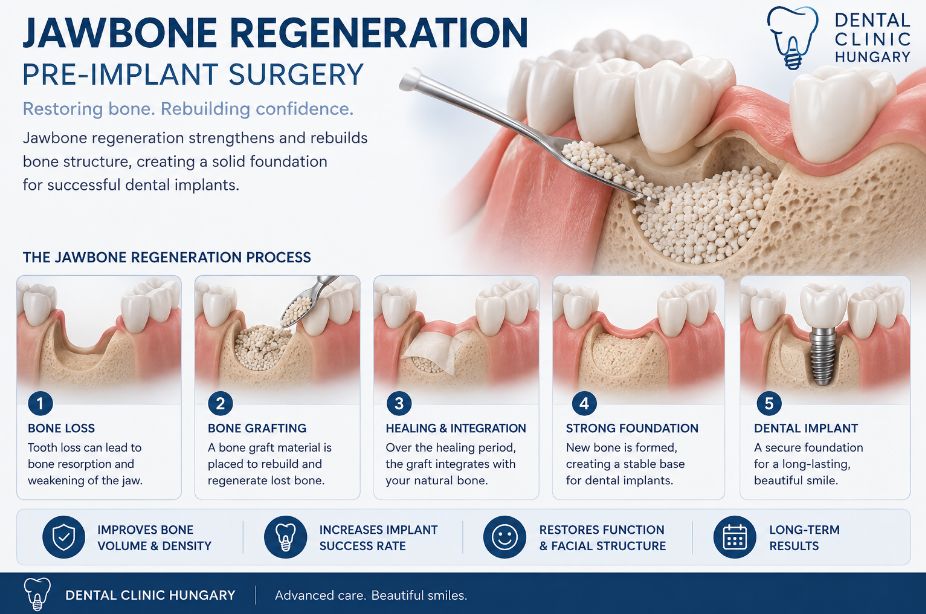
Jawbone is not static. After a tooth is removed, the bone that once held it gradually changes shape and volume because it no longer receives the same chewing forces. Bone loss can accelerate where teeth have been missing for many years, where dentures have pressed on the gums, after infection, trauma, cysts, advanced gum disease or unsuccessful previous implant treatment.
In the upper back jaw, there is an additional challenge: the maxillary sinus. This air-filled space sits above the roots of the premolars and molars. Following tooth loss, the sinus can expand downwards while the jawbone reduces in height, leaving limited space for conventional implants.
For a single missing tooth, the solution may be modest. For a full upper bridge or a full-mouth restoration, the challenge can be more significant. A clinician must consider not only whether an implant can be placed, but whether its position supports a bridge with a natural bite, good appearance and enough space for reliable daily cleaning.
Severe bone loss does not always require extensive grafting. Sometimes grafting is the best solution; sometimes graft-free techniques provide a more efficient and equally appropriate route. The decision should follow clinical diagnosis, not a clinic’s preferred package.
The Starting Point: CBCT and Full-Arch Planning
A panoramic X-ray can provide a useful overview, but advanced implant cases commonly need cone beam CT, known as CBCT. This three-dimensional scan allows the surgeon to evaluate:
- Remaining bone height, width and density
- The shape of the sinus and nasal cavity
- Nerve position in the lower jaw
- Previous implants, grafts or areas of infection
- Whether teeth are suitable to retain
- Implant position in relation to the planned final bridge
- Whether bone grafting, short implants or angled implants are possible
- Soft-tissue and smile-line considerations
Full-arch rehabilitation should be planned from the final teeth backwards. In other words, the team should first consider where the bridge needs to sit for speech, smile, lip support and bite, then determine where implants can safely support it. This restorative-led approach helps prevent implants being placed merely where bone happens to be available.
Before bone augmentation or implant placement, active gum disease and oral infection should be controlled. Bone grafting is not a substitute for periodontal treatment. A graft or implant placed into an unhealthy environment is more vulnerable to poor healing, inflammation and long-term bone loss.
Sinus Lift Surgery for Upper-Jaw Implants
A sinus lift, also called sinus-floor elevation or sinus augmentation, is a procedure that increases available bone height in the posterior upper jaw. It is most commonly considered when upper premolars or molars have been missing and the sinus sits too close to the ridge for a conventional implant of suitable length.
The surgeon gently lifts the Schneiderian membrane, which lines the sinus, to create a space beneath it. Graft material may then be placed to support new bone formation. Depending on the amount of residual bone, implants may be inserted at the same appointment or after a healing period.
A sinus lift is a well-established procedure, but it should not be treated as routine in the sense of casual. It requires careful scan-based planning, appropriate surgical technique and assessment of sinus health.
Direct sinus lift: the lateral-window approach
A direct sinus lift is commonly referred to as a lateral-window sinus lift. The surgeon creates a small access window in the side wall of the upper jaw, gently elevates the sinus membrane and places graft material into the newly created space.
This approach is often considered when the available bone height is very limited, when a larger volume of augmentation is required or when the surgical team needs broad visibility and access.
The procedure may be staged, with graft healing first and implant placement later. In selected cases with enough native bone to stabilise the implant, an implant may be placed at the same time.
A lateral sinus lift is generally more extensive than an indirect procedure. Swelling, facial bruising, pressure in the cheek region and temporary sinus-related symptoms can occur after surgery. Patients are normally advised to avoid nose blowing, forceful sneezing with a closed mouth, strenuous exercise and other actions that increase sinus pressure during early healing.
Indirect sinus lift: the transcrestal approach
An indirect sinus lift is also called a transcrestal or crestal sinus lift. Rather than creating a window through the side wall of the jaw, the clinician works through the implant site from the top of the ridge.
This technique is typically used when a smaller lift is needed and there is enough existing bone to gain initial stability for an implant. The sinus membrane is elevated carefully through the implant preparation site, and an implant may often be placed during the same procedure.
Indirect sinus elevation can be less invasive, with a smaller surgical area and potentially easier recovery. However, it is not simply a “better” version of a direct sinus lift. It is suitable only for certain anatomy and degrees of bone loss.
Direct vs Indirect Sinus Lift
A systematic review of sinus-floor elevation complications found that lateral procedures had more membrane perforations and sinusitis cases than transcrestal procedures, while each approach has its own pattern of risks. The most common complications requiring intervention after lateral sinus lift included membrane perforation, wound opening, graft exposure or graft failure and sinusitis.
This is not an argument against direct sinus surgery. It simply illustrates why technique selection must match the anatomy. A patient with substantial bone loss may require a lateral approach because a small transcrestal lift would not create enough safe, stable support.
What to Expect After a Sinus Lift
Most patients manage recovery with prescribed or recommended pain relief, careful home care and a short period of reduced activity. The first few days are usually the most noticeable for swelling and pressure. Bruising may develop around the cheek or under the eye, particularly after a lateral approach.
Common temporary experiences include:
- Mild-to-moderate swelling and cheek tenderness
- Bruising
- A feeling of sinus pressure or fullness
- Light nasal spotting in some cases
- Temporary discomfort when chewing
- Reduced ability to wear a removable denture over the surgical area
Patients should contact their surgeon promptly if they experience persistent or worsening facial pain, fever, foul-smelling nasal discharge, heavy bleeding, uncontrolled swelling, fluid passing between the mouth and nose or signs of infection.
Healing time varies. If a grafted sinus requires maturation before implant placement, the interval can be several months. If implants are placed at the same appointment, the final bridge may still require a healing and review period before definitive loading. The correct timeline is biological, not determined by flight dates.
Severe Jawbone Resorption: You May Still Have Options
Severe jawbone resorption means that the ridge has lost significant height, width or both. This can make conventional vertical implants difficult or unsafe to place without reconstruction.
It is particularly common in people who have worn dentures for many years, lost teeth long ago, had repeated infection or periodontal disease, or have undergone unsuccessful implant treatment. Patients may be told that they have “no bone for implants” after a quick consultation. That phrase often means “not enough bone for standard implants in a conventional position,” rather than “no implant solution exists.”
For severe upper-jaw resorption, the main options may include:
- Extensive bone grafting and staged implant placement
- Short or tilted implants where residual bone permits
- Pterygoid implants to support the back of a full upper bridge
- Zygomatic implants anchored in the cheekbone
- A hybrid plan using conventional, pterygoid and zygomatic implants
- Removable implant-retained dentures when fixed teeth are not the right choice
There is no one-size-fits-all hierarchy. A patient with enough bone in the front jaw but not at the back may be suitable for a graftless tilted or pterygoid implant approach. Another patient may require bone reconstruction to support implants in an ideal position. A patient with extreme upper-jaw atrophy may be a candidate for zygomatic implants, but these are advanced procedures requiring specialist training and appropriate facilities.
Extensive Bone Grafting
Extensive bone grafting rebuilds the jaw to create enough volume for conventional implants. It may use autogenous bone, bone substitutes, donor-derived materials, animal-derived mineral scaffolds or combinations of these, usually alongside barrier membranes and fixation devices.
Autogenous bone is harvested from the patient, often from inside the mouth for smaller procedures. It has long been valued for its biological activity and can be used as particles or blocks. For very large reconstructive cases, bone may be taken from outside the mouth, such as the hip, though this increases surgical burden and recovery.
Synthetic grafts commonly use calcium phosphate-based materials. They act mainly as scaffolds for the patient’s own bone formation and avoid a second donor-site operation. For many localised bone deficiencies, they can be a predictable choice.
The decision between autogenous and synthetic grafting should be based on defect size, shape, location, blood supply, soft-tissue condition, planned implant position and patient priorities. It should not be reduced to the misleading claim that one material is always superior.
Research comparing autogenous bone and biomaterials for posterior mandibular reconstruction found no statistically significant difference in bone gain, complication rate or implant survival. Both approaches can be appropriate when matched carefully to the case.
Advantages of grafting
- Can restore bone in a position that supports ideal implant placement
- May improve lip support and facial contour in selected full-arch cases
- Allows use of conventional implants where grafting is successful
- Can be combined with soft-tissue grafting for better aesthetics and hygiene
- May provide a useful option where graft-free implants are not appropriate
Limitations of grafting
- May require more than one surgical stage
- Can lengthen the overall treatment timeline
- Carries risks of infection, graft exposure, partial resorption and graft failure
- Larger autogenous grafts can create donor-site discomfort or complications
- May not be the most efficient solution for every severe atrophy case
For patients travelling from the UK or Ireland, staged grafting needs realistic travel planning. A clinic should never guarantee that a complex graft will be ready for implant loading at a set date without reviewing the healing response.
Zygomatic Implants: A Graft-Free Option for Extreme Upper-Jaw Bone Loss
Zygomatic implants are long implants anchored in the zygomatic bone, commonly called the cheekbone. They are used primarily for severe upper-jaw atrophy, where conventional implants would require extensive grafting or where little usable maxillary bone remains.
These implants are generally part of a full-arch reconstruction. Depending on the remaining bone, a plan may use two zygomatic implants with conventional implants at the front of the jaw, or four zygomatic implants in a quad-zygoma approach when anterior bone is also severely limited.
One major advantage is that zygomatic implants can avoid extensive jawbone grafting and may permit immediate fixed provisional teeth in selected patients. However, the procedure is technically demanding and should be performed by clinicians with specific experience in zygomatic surgery and management of its complications.
Systematic-review evidence reports high survival figures in selected severe maxillary atrophy cases, but patients should not confuse high survival with a risk-free procedure. One review reported cumulative success rates of 98.5% before one year, 97.5% between one and three years, 96.8% between three and five years and 96.1% beyond five years.
Potential complications include sinusitis, soft-tissue problems, nerve-related symptoms, prosthetic complications and difficulties if an implant later fails. In a long-term retrospective cohort, sinusitis was the most frequently reported infectious complication.
Zygomatic implants can be an excellent option for the right patient, but they should not be sold as a shortcut for patients who have enough bone for a less invasive conventional or short-implant plan.
Pterygoid Implants: Reaching the Back of the Upper Jaw
Pterygoid implants are placed towards the back of the upper jaw, extending into dense bone in the pterygoid region behind the maxillary sinus. They can help support the rear of a full upper bridge without a sinus lift or distal cantilever.
They are usually used as part of a comprehensive full-arch strategy rather than as a routine single-tooth solution. They can be particularly valuable where the posterior maxilla is severely resorbed but a graftless full-arch design remains feasible.
Pterygoid implant placement is technique-sensitive because of the anatomy and posterior location. It requires a clinician who is familiar with three-dimensional planning, angulated implant placement and prosthetic design.
A systematic review involving 634 patients and 1,893 pterygoid implants reported a mean implant survival rate of 94.87%. This is encouraging evidence, but the patient’s anatomy, the operator’s experience, the bridge design and long-term maintenance remain central to the prognosis.
Short Implants: Sometimes Less Surgery Is Better
Short implants are designed to work in areas with limited vertical bone height. They can offer an alternative to sinus grafting in the posterior upper jaw or major bone augmentation in selected lower-jaw cases.
The idea is not that shorter is universally better. An implant must still have appropriate width, primary stability, bone support and a carefully designed restoration. But where suitable bone exists, short implants can reduce surgical complexity, treatment time and post-operative morbidity.
Evidence comparing short implants with longer implants placed after sinus augmentation shows broadly similar survival outcomes in selected posterior upper-jaw cases. A 2025 systematic review and meta-analysis of randomised controlled trials found no statistically significant difference in implant success and survival between short implants and longer implants combined with sinus augmentation after at least five years of loading.
Another meta-analysis found short implants were associated with fewer biological complications and less marginal bone loss, while implant survival was similar between the two strategies.
Short implants can therefore be a sensible option for some patients—but not for all. They may be unsuitable where bone is extremely thin, where the bite forces are excessive, where a large fixed bridge requires different biomechanics, or where the final tooth position would be poorly supported.
Choosing Between Grafting and Graft-Free Solutions
The choice is not simply between “more treatment” and “less treatment.” It is a decision between different ways of creating stable support for the final teeth.
A specialist implant clinic should discuss at least two clinically reasonable pathways when appropriate. For example, a patient may have a choice between a staged sinus-grafting approach with conventional implants and a graftless plan using short or tilted implants. Another may need a clear explanation of why zygomatic implants are safer or more predictable than attempting large grafts.
Full-Arch Treatment in Budapest: What a Responsible Plan Looks Like
Budapest is a popular destination for UK and Irish patients seeking implant dentistry, often because private treatment costs can be lower than at home. However, complex surgical preparation should never be selected on headline price alone.
A responsible full-arch plan should include:
- A comprehensive clinical assessment and periodontal evaluation
- CBCT imaging and restorative-led implant planning
- Review of medical history, smoking and diabetes status
- Explanation of teeth that may be retained versus extracted
- A discussion of grafting, sinus lift, short implants or advanced alternatives
- A realistic number of treatment stages and expected healing intervals
- A provisional-teeth plan during healing
- Clear information about the implant system and restorative materials
- Written costs for grafts, membranes, scans, temporary bridges and final bridges
- Implant passports, scan copies and clinical records for aftercare
- A maintenance plan after the final bridge is fitted
Ask whether the surgeon completing advanced procedures is a specialist oral surgeon, periodontist or implant clinician with demonstrable experience in that particular technique. It is reasonable to ask how many sinus lifts, pterygoid implants or zygomatic cases they perform and how they manage complications.
A well-designed bridge must be accessible for cleaning. Fixed full-arch teeth can feel like natural teeth, but they still need meticulous care around the implant-gum junction. Water flossers, interdental brushes and specialist maintenance visits may be recommended.
Frequently Asked Questions
Can I get implants if I have been told I have no jawbone?
Often, yes. “No jawbone” usually means that standard implants cannot be placed in the usual position without additional planning. Possible options include bone grafting, sinus lift surgery, short implants, pterygoid implants or zygomatic implants depending on the jaw and severity of bone loss.
Is sinus lift surgery painful?
It is performed under local anaesthetic, with sedation available in some cases. Swelling, pressure and soreness are expected after surgery, particularly with a lateral-window approach. Most patients manage recovery with appropriate medication and instructions.
How long after a sinus lift can I have implants?
It depends on the amount of residual bone, the size of the augmentation, whether implants were placed at the same time and how the graft heals. Some cases allow simultaneous placement; others need several months before implants can be inserted safely.
Are zygomatic implants safe?
They can be a reliable option in appropriately selected cases of severe upper-jaw atrophy when performed by experienced clinicians. They are advanced implants, however, and carry risks including sinus-related complications, soft-tissue problems and more complex management if complications occur.
Are short implants as good as sinus lifts?
For selected posterior upper-jaw cases, research suggests short implants can have comparable survival outcomes and may involve fewer biological complications. They are not suitable for every patient or every full-arch design.
Do I always need bone grafting for All-on-4 treatment?
No. All-on-4-style treatment uses angled posterior implants to make use of existing bone and may reduce the need for grafting. However, severe bone loss can still require grafting, zygomatic implants, pterygoid implants or an alternative restorative plan.
Can I travel back to Ireland or the UK straight after surgery?
This depends on the procedure and your clinician’s advice. Complex grafting, sinus surgery and full-arch implant treatment may require short-term review before travelling. You should plan for the possibility of additional appointments if swelling, wound concerns or bite adjustments occur.
The Clinical Bottom Line
Jawbone regeneration and pre-implant surgery are not signs that implant treatment has failed before it begins. They are tools used to make implant treatment possible, safer and more predictable when bone loss has changed the anatomy of the jaw.
For posterior upper teeth, a direct or indirect sinus lift can create the foundation needed for implants. For more severe jawbone resorption, extensive grafting, short implants, pterygoid implants and zygomatic implants may provide different routes to fixed teeth. Each has benefits, limitations and specific indications.
The best pathway is based on your scan, your health, the final bridge design and the experience of the treating team. For UK and Irish patients considering full-arch treatment in Budapest, choose a clinic that explains every option clearly, provides a staged written plan and makes long-term function and maintenance – not speed – the priority.
Sources
- Systematic Review: Complications of Sinus Floor Elevation Procedures and Management Strategies
- Systematic Review and Meta-Analysis: Long-Term Outcomes of Short Implants Versus Long Implants with Sinus Lift
- Systematic Review and Meta-Analysis: Short Versus Standard Implants at Sinus-Augmented Sites
- Systematic Review and Meta-Analysis: Short Implants Versus Longer Implants with Sinus Floor Elevation
- Systematic Review: Success Rates of Zygomatic Implants for Severe Maxillary Atrophy
- Long-Term Cohort Study: Survival and Complications of Zygomatic Implants
- Systematic Review and Meta-Analysis: Clinical Outcomes of Pterygoid Implants
- Systematic Review and Meta-Analysis: Autogenous Bone Versus Biomaterial for Posterior Mandibular Augmentation