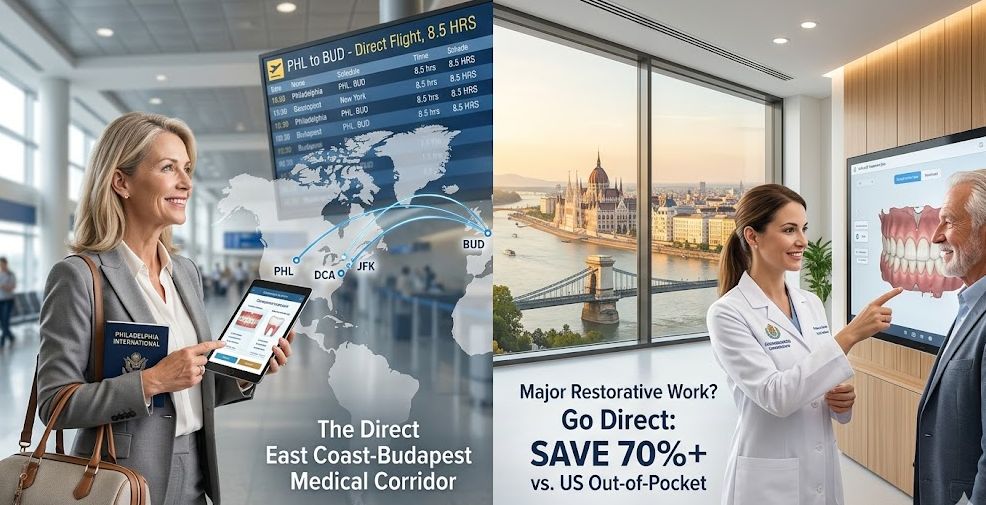
For the millions of Americans living in the “Acela Corridor”—stretching from Washington D.C. through Philadelphia and up to Boston—the cost of dental care has reached a breaking point. While the East Coast boasts some of the world’s finest dental schools and specialists, the price of a single dental implant or a full-arch restoration has outpaced inflation, leaving even well-insured patients in a financial lurch.
In 2026, a “New Era” of dental consumerism has emerged. Patients are no longer choosing between “standard care” and “no care.” Instead, they are navigating a complex matrix of domestic insurance, local financing, and the burgeoning “Medical Corridor” created by direct international flights.
In this expert analysis, we will break down the true costs of major dental work and compare the four most viable paths for East Coast patients: US Dental Insurance, Mexico, Turkey, and the sophisticated “Direct Flight” model of Budapest, Hungary.
1. The Financial Reality of Restorative Care in the US
Before looking abroad, we must understand why the domestic model is failing the average patient.
The Insurance “Safety Net” is Frayed
Most major US carriers (Delta, MetLife, Cigna, Aetna) have maintained annual maximums between $1,500 and $2,000 for decades. In 2026, these limits cover little more than two cleanings and a single crown.
-
The Implants Problem: Most US plans cover only 50% of an implant, but the “cap” is hit almost instantly.
-
The “All-on-4” Reality: A full-arch restoration in a city like Philadelphia or New York averages $25,000 to $35,000 per arch. Insurance, at best, contributes 5% of the total cost.
Types of Treatments in Focus
-
Dental Implants: The gold standard for tooth replacement. Requires surgical placement into the jawbone.
-
Full Arch (All-on-4/6): A permanent bridge fixed to four or six implants, replacing an entire set of teeth.
-
Modern Dentures: Often implant-supported (Snap-on) to prevent the “slipping” associated with traditional acrylic dentures.
2. Option 1: The “Stay at Home” Strategy
For some, the convenience of staying local outweighs the cost.
-
Pros: Post-operative care is only a 20-minute drive away. No language barriers. US legal recourse.
-
Cons: Massive out-of-pocket costs. Long wait times for top-tier specialists.
-
Expert Tip: If staying in the US, look for University Dental Schools (like UPenn or NYU). They offer discounted rates for work performed by residents, though the process takes 3x longer than a private clinic.
3. Option 2: The Mexico Border (The Traditional Choice)
For decades, Los Algodones and Cancun have been the go-to for Americans.
-
The Appeal: Proximity (especially for those with Southwest flight points) and rock-bottom prices.
-
The Reality for East Coasters: For a patient in Philadelphia, Mexico is not “close.” It requires a 5-hour flight plus a border crossing or a long shuttle.
-
The Verdict: Mexico is excellent for simple crowns or single implants, but the “assembly line” nature of many border clinics can be a risk for complex, full-arch reconstructions.
4. Option 3: The Turkey “All-Inclusive” Allure
Turkey has marketed itself aggressively to the US market in recent years.
-
The Appeal: “Instagram-ready” smiles and all-inclusive packages (hotel, transport, and teeth).
-
The Red Flags: Turkey is often criticized for “over-preparation”—shaving down healthy natural teeth into “pegs” for veneers rather than focusing on long-term biological health.
-
The Verdict: Great for aesthetics, but the clinical standard for heavy-duty oral surgery (implants and bone grafting) can vary wildly.
5. Option 4: The Budapest “Direct Flight” Corridor
In 2026, Budapest, Hungary, has emerged as the clear winner for the East Coast demographic. The reason is logistical: Direct flights from Philadelphia (PHL) and New York (JFK) to Budapest (BUD).
Why Budapest is the “Dental Capital of the World”
While Mexico offers “value” and Turkey offers “glamour,” Budapest offers Clinical Mastery.
-
Education: Hungarian dentists graduate from Semmelweis University, a world-leading institution. The standards for surgery are among the highest in the EU.
-
Volume: Budapest clinics serve the entire European continent. Their surgeons often place 50x more implants per year than the average US suburban dentist.
The Math for the East Coast Patient
Let’s look at a “Full Arch” (All-on-4) scenario:
-
US East Coast Cost: $30,000 (Insurance covers $1,500). Patient Pays: $28,500.
-
Budapest Cost: $9,000 (Includes premium Straumann implants). Patient Pays: $9,000.
-
The “Net” Saving: Even after spending $1,500 on a direct flight from PHL and $2,000 on a 5-star hotel, the patient saves $16,000.
6. Technical Standards: Straumann, Zirconia, and CAD/CAM
One of the greatest myths is that dental tourism uses “cheap” materials. In top-tier Budapest clinics, the technology is often ahead of the US.
-
Implant Brands: Clinics utilize Straumann (Switzerland) or Nobel Biocare (Sweden). These are the exact same parts used by high-end US prosthodontists.
-
Digital Workflow: 3D CT scans and intraoral scanners are used to create “Guided Surgery” templates, ensuring the implants are placed with sub-millimeter precision.
-
Materials: “Prettau Zirconia” is the standard for bridges in Budapest—a material so strong it is virtually unbreakable, providing a natural look that acrylic dentures cannot match.
7. The Experience: Recovery in the City of Spas
A unique factor for the Budapest corridor is the post-operative recovery. Budapest is world-famous for its Thermal Baths (Széchenyi and Gellért).
-
Healing Benefits: The mineral-rich waters and the stress-free environment of a “Dental Vacation” have been shown to lower cortisol, which aids in faster surgical healing.
-
Accessibility: For a patient from Philly or DC, the 8.5-hour direct flight is manageable. You leave at 7 PM and wake up in Europe, ready for your consultation.
8. Summary: How to Choose Your Path
To find the most affordable dental treatment in 2026, you must categorize your needs:
-
Maintenance (Cleanings/Fillings): Stay in the US. Use your Delta or MetLife insurance to its full extent.
-
Single Implant/Crown: If you are on the East Coast, it may be worth staying local if your insurance covers a portion.
-
Major Restorative (All-on-4, Full Mouth): Book the direct flight to Budapest. The clinical expertise, the massive cost savings, and the high-tech European materials make it the only logical choice for high-value surgery.
Conclusion: Your Smile, Your Passport
The US dental crisis is real, but you are not trapped by it. Whether you utilize your Cigna benefits for the basics or use your passport for an All-on-4 in Hungary, the key is to act before bone loss makes treatment more difficult.
In 2026, the best “dental network” for an East Coaster isn’t an insurance list—it’s the direct flight path from PHL to BUD.