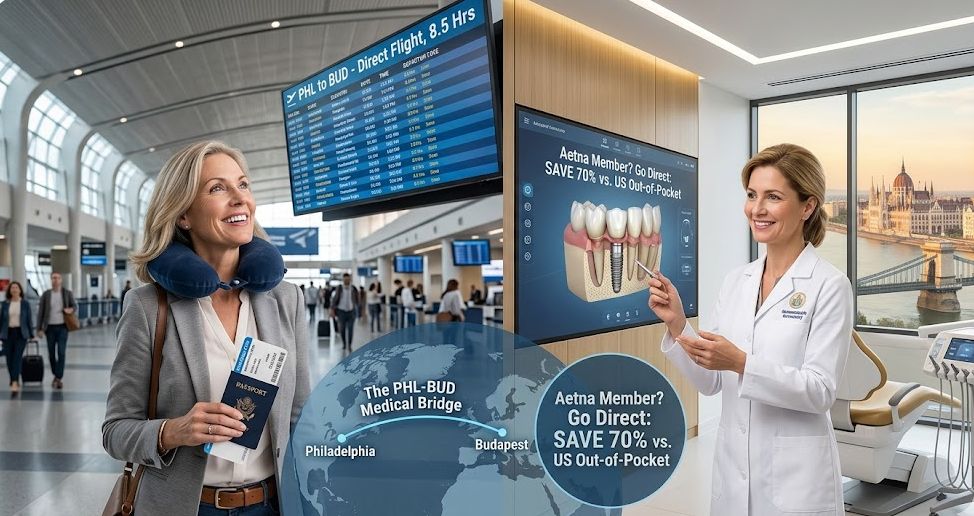
In the hierarchy of American healthcare, Aetna (a CVS Health company) represents one of the most sophisticated dental networks available to the modern consumer. As of 2026, Aetna has successfully integrated pharmacy perks, teledentistry, and a massive “Preferred Patient” network into a cohesive package.
However, for the resident of the American Northeast—from the Philadelphia suburbs to the DC corridor—a critical question remains: Is an Aetna plan sufficient for major restorative needs, or is it merely a preventative safety net?
In this comprehensive expert review, we will analyze the Aetna Dental DMO and PPO structures, the reality of their 2026 “Annual Maximums,” and why the most innovative Aetna members are looking toward Budapest, Hungary, to solve their high-cost dental dilemmas.
1. The Aetna Dental Infrastructure: PPO vs. DMO
Aetna’s primary strength is choice. In 2026, they offer two distinct paths for dental care, each with a different financial outcome for the patient.
The Aetna DMO (Dental Maintenance Organization)
The DMO functions like a traditional HMO. You must select a primary care dentist, and your costs are fixed (co-pays). While this is the most “predictable” financial model, it lacks flexibility. For patients who value specialized care or specific clinical expertise, the DMO can feel restrictive.
The Aetna PPO (Preferred Provider Organization)
The Aetna PPO is the “gold standard” for those who want access to a wider array of specialists. In 2026, Aetna’s PPO network includes over 120,000 unique dental providers. The key advantage here is the “Negotiated Fee Schedule.” Even if you have a deductible to meet, an Aetna PPO member pays significantly less than an uninsured patient simply by walking into an in-network office.
2. The 2026 Benefit Review: Wellness and Innovation
Aetna has pioneered several “Total Health” initiatives that set it apart from carriers like MetLife or Delta Dental.
-
Oral Health Integration: Aetna’s 2026 plans explicitly link dental health to chronic conditions. Members with heart disease or rheumatoid arthritis often qualify for extra cleanings and gum disease treatments at no additional cost.
-
CVS Health Synergy: As part of the CVS Health family, Aetna members now receive discounts on oral health products (electric toothbrushes, specialized rinses) at CVS locations, merging retail convenience with medical coverage.
-
Virtual Care: Aetna has expanded its 24/7 teledentistry portal, allowing members to consult with a dentist via smartphone for emergencies, potentially saving an expensive trip to the ER.
3. The “Restorative Reality” and the $1,500 Ceiling
Despite Aetna’s industry-leading wellness perks, the “Major Work” category remains a challenge. In 2026, the standard Aetna PPO plan carries an Annual Maximum of $1,500 to $2,000.
While this sounds substantial, let’s look at the actual clinical costs in the U.S. Northeast:
-
Single Molar Root Canal: $1,200 – $1,600
-
Zirconia Crown: $1,500 – $2,000
-
Dental Implant (Surgery Only): $2,500
If a patient needs a single root canal and a crown, they have likely exhausted 100% of their Aetna benefits for the entire year. If they need multiple implants or a full-mouth restoration, they are facing an out-of-pocket bill that can reach $30,000 to $50,000.
4. The Budapest Bridge: Expanding the Definition of “In-Network”
For Aetna members in Philadelphia, New Jersey, and Delaware, the 2026 launch of daily direct flights from Philadelphia (PHL) to Budapest (BUD) has changed the dental landscape.
Budapest is not just a destination for “budget dentistry”; it is the European capital of high-tech prosthodontics. For an Aetna member, the logic of flying to Hungary for major work is no longer based on “saving a few dollars”—it is based on receiving elite care for a fraction of the U.S. specialist price.
Why Budapest for Aetna Members?
-
Volume-Based Expertise: Top clinics in Budapest place thousands of tooth implants annually. The surgical expertise in these “all-in-one” centers often exceeds that of a general U.S. practitioner.
-
Technology Standards: Many Budapest clinics are equipped with CAD/CAM digital milling, 3D Cone Beam CT scans, and AI-assisted planning as standard equipment, whereas these are often “premium” upgrades in domestic offices.
-
The “Total Cost” Win: In Budapest, a high-end dental implant (using premium Swiss materials like Straumann) costs approximately $1,100 to $1,300. In Philadelphia, that same implant is often $4,500+.
5. Strategic Comparison: Philadelphia vs. Budapest
| Service | U.S. Northeast (with Aetna PPO) | Budapest (Out-of-Pocket) |
| All-on-4 Full Arch | $25,000+ (After Cap) | $8,500 – $10,500 |
| Full Mouth Reconstruction | $45,000+ | $14,000 – $18,000 |
| Zirconia Bridge (3 Units) | $4,500 ($3,000 After Cap) | $1,400 |
For a patient requiring an “All-on-4” reconstruction, the savings on the procedure alone pay for a 9-hour direct flight from PHL, a luxury hotel in Budapest’s District V, and a week of world-class dining, while still leaving $10,000 to $15,000 in the patient’s savings account.
6. How to Coordinate Aetna Benefits with Overseas Care
Can an Aetna member actually use their plan for work done in Budapest?
-
Out-of-Network Reimbursement: Most Aetna PPO plans allow for “Out-of-Network” claims. While you pay the Budapest clinic directly, you can submit your English-language, itemized invoice to Aetna. If the work is “covered,” Aetna may reimburse you based on their “Reasonable and Customary” fee schedule.
-
Diagnostic Synergy: Use your Aetna plan at home for your annual cleanings, X-rays, and initial consultations. Once you have a U.S. diagnosis, send your digital X-rays to a Budapest clinic for a remote second opinion and a fixed-price quote.
-
HSA/FSA Advantage: Aetna members with Health Savings Accounts (HSA) can use those pre-tax funds for dental work in Hungary. The IRS recognizes dental care in Budapest as a qualified medical expense, effectively giving the patient another 20-30% discount through tax savings.
7. Quality Control: The “Semmelweis” Factor
Patients often ask: “Is the work in Budapest as good as my Aetna dentist’s work?”
In Hungary, the dental profession is governed by the Semmelweis University standard—one of the oldest and most prestigious medical schools in the world. Hungarian dentists must undergo rigorous training that is recognized throughout the European Union. Furthermore, the top-tier clinics catering to American tourists utilize the exact same hardware (Straumann, Nobel Biocare, Zimmer Biomet) that the most expensive U.S. prosthodontists use.
8. The Experience: Healing in the City of Spas
A unique advantage of the Budapest dental corridor is the environment of recovery. Instead of navigating Philadelphia traffic after a surgery, patients in Budapest recover in a city famous for its thermal springs and medicinal baths.
The Széchenyi or Gellért baths offer a stress-reducing atmosphere that is scientifically proven to lower cortisol—a major factor in post-operative healing. For many Aetna members, this turns a stressful medical necessity into a life-changing “Wellness Vacation.”
9. Final Verdict: The 2026 Aetna Strategy
Aetna Dental is a premier insurance product for maintenance, prevention, and basic restorative care. Its integration with CVS Health and its focus on whole-body wellness make it a leader in the American market.
However, Aetna members must recognize the “Restorative Ceiling.” If your treatment plan involves implants, bone grafting, or a full-mouth smile makeover, your insurance is a drop in the bucket.
With the new direct flight link from Philadelphia, Budapest has become the “logical expansion” of the Aetna network. By using Aetna for preventative care at home and Budapest for the “heavy lifting” restorative work, U.S. patients can finally access the elite dental care they deserve at a price they can actually afford.
The Expert Recommendation: Keep your Aetna plan for the basics. Use your passport for the rest. Budapest is no longer just a city in Europe—it’s the answer to the U.S. dental crisis a real dental tourism hub in the heart of Europe.