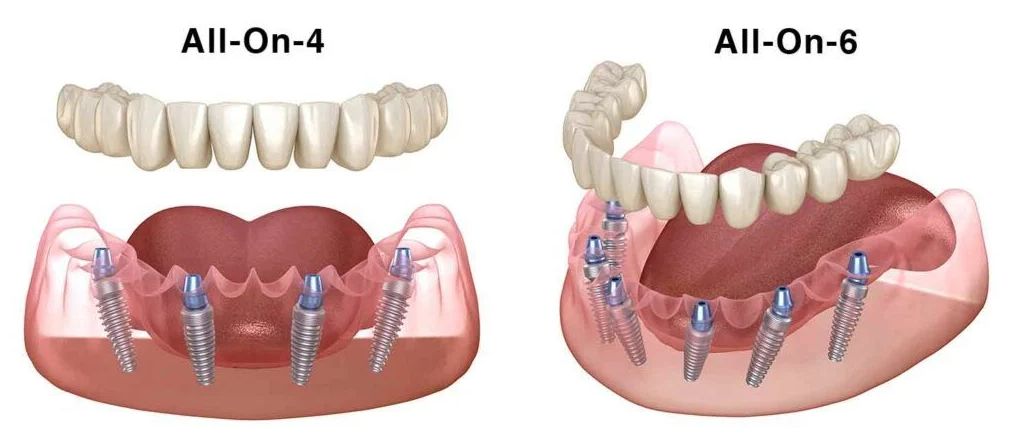
All-on-4 and All-on-6 full‑arch implants both provide fixed teeth on implants in one jaw, but they differ in how many implants are placed, how much bone they need, how stable they feel, and how much they cost. Understanding these differences helps you and your implant team choose a solution that matches your oral health, budget, and long‑term expectations.
What All-on-4 and All-on-6 Actually Are
All‑on treatments replace a full arch of missing teeth (upper or lower) with a bridge that is permanently fixed to a small number of dental implants. Instead of placing 8–10 implants, the dentist places fewer, carefully positioned fixtures that support a full row of teeth.
-
All‑on‑4: four implants per jaw, two near the front placed straight and two further back placed at an angle of around 30–45 degrees.
-
All‑on‑6: six implants per jaw, usually placed more vertically and spread along the arch to share chewing forces across a wider base.
-
Fixed bridge: in both systems, a custom bridge (often acrylic on a titanium bar, or full zirconia) is screwed onto the implants and can only be removed by the dentist.
-
One‑arch or both: treatment is possible on just one jaw or both, depending on how many natural teeth remain and how healthy they are.
In everyday life, both options aim to feel and look like a solid set of natural teeth, allowing normal eating, speaking, and smiling once healing is complete.
Key Differences Between All-on-4 and All-on-6
Although the concept is similar, several practical differences influence which option suits you best.
Number and Position of Implants
The first and most obvious difference is in the number of implants.
-
All‑on‑4: uses four implants to hold the bridge.
-
All‑on‑6: uses six implants, adding two extra fixtures for greater support.
In All‑on‑4, the two back implants are tilted, which allows the dentist to “reach” further back in the jaw and create a longer bridge without touching sinuses in the upper jaw or nerve areas in the lower jaw. In All‑on‑6, implants tend to be placed more vertically, with additional fixtures to better distribute chewing forces.
Bone Requirements and Need for Grafting
Because of the angulated placement in All‑on‑4, this approach is often suitable even when bone volume is reduced in the back of the jaw.
-
All‑on‑4: can often avoid bone grafting and sinus lifts, because implants are placed in the front where bone is usually thicker.
-
All‑on‑6: usually needs more bone volume and may require grafts or sinus lifts, especially in the upper jaw, because more implants are placed and often in straighter positions.
For patients with severe bone loss who want to avoid complex grafting procedures, the All‑on‑4 concept can be a practical, less invasive option.
Stability, Chewing Comfort and Redundancy
Adding more implants increases the “scaffolding” that supports the bridge.
-
All‑on‑6: the two additional implants spread chewing forces across a broader base, which can improve stability and feel more solid for heavy biters or patients who grind their teeth.
-
All‑on‑4: still offers very high stability when correctly planned, but all forces are shared between four fixtures.
If one implant fails in an All‑on‑6 case, the remaining five may still support the bridge temporarily while the dentist plans a repair. With All‑on‑4, losing one fixture can put more stress on the others and may require a more urgent intervention.
Treatment Time and Healing
Both concepts are often marketed as “teeth in a day” because a temporary bridge can frequently be attached shortly after implant placement.
-
All‑on‑4: in many suitable cases, an immediate temporary bridge can be fixed on the same day or within 24 hours, giving patients instant teeth while the implants heal.
-
All‑on‑6: immediate loading is also possible in many protocols, but because there are more implants and sometimes bone grafts, some cases require a conventional 4–6 month healing period before the final bridge.
Your surgeon will decide whether immediate loading is safe based on bone quality, implant stability at placement, and your bite forces.
Longevity and Success Rates
Both approaches have been studied for many years and show excellent long‑term outcomes when performed by experienced teams and maintained properly.
-
All‑on‑4 success: clinical studies report long‑term implant survival rates consistently above 95%, with some large cohorts showing around 99.2% prosthesis survival at 10 years and about 94.8% implant survival over similar periods.
-
Prosthesis survival: even when an individual implant fails, the full‑arch bridge itself remains in function in the vast majority of cases once corrective treatment is performed.
-
All‑on‑6 success: while fewer headline figures are published than for the branded All‑on‑4 concept, six‑implant full‑arch restorations generally show comparable high survival rates, with the extra fixtures serving to share loads and reduce individual stress on each implant.
Long‑term success does not depend only on the number of implants: it also requires good planning, correct occlusion (bite), high‑quality materials, meticulous surgery, and regular maintenance visits.
Maintenance and Daily Care
Whether you choose All‑on‑4 or All‑on‑6, everyday care is similar and critical.
-
Daily cleaning with special floss, interdental brushes, and sometimes water irrigators to remove plaque under the bridge.
-
Professional implant maintenance visits every 6–12 months, including cleaning around the implants, checking the screws, and monitoring bone levels.
-
Night guard use for patients who grind their teeth to protect both the bridge and the implants from overload.
With this routine, many patients enjoy stable, comfortable function for a decade or more and expect the bridge to last significantly longer with occasional refurbishments.
Costs: Local vs. Dental Tourism
Cost is one of the biggest deciding factors, and here the gap between home treatment and dental tourism can be substantial.
Typical Price Ranges by Country
Prices vary between clinics, but published ranges give a realistic overview of what patients can expect.
-
In England, typical prices per arch are roughly £12,000–£15,000 for All‑on‑4 and £14,000–£18,000 for All‑on‑6, reflecting the extra implants and often longer chair time.
-
In the UK more broadly, full‑arch All‑on‑4 or similar concepts often sit in the £20,000–£30,000 per arch range based on some international comparisons.
-
In the USA, full‑arch All‑on‑4 may cost around 20,000–40,000 USD per arch, while All‑on‑6 ranges roughly 25,000–45,000 USD.
-
In Australia, published pricing bands are similar to UK and US, often in the 20,000–30,000 USD equivalent range for All‑on‑4 and 25,000–35,000 USD equivalent for All‑on‑6.
Dental tourism destinations can reduce these figures significantly for comparable materials and experienced surgeons.
-
Turkey: some guides list All‑on‑4 packages from about £3,000–£6,000 per arch, with All‑on‑6 between £4,000 and £7,000, depending on the case and materials.
-
Hungary: full‑arch All‑on‑4 packages are often advertised in the £4,000–£7,000 range per arch in Budapest, while All‑on‑6 typically runs from about £5,000 to £8,000.
-
Other European hubs such as Croatia and Poland usually sit in a similar mid‑range between local Western European prices and the most competitive Turkish offers.
For a patient needing both jaws restored, the total savings when travelling abroad can reach many thousands of pounds or dollars even after flights and accommodation.
Why All-on-6 Costs More
All‑on‑6 is almost always more expensive than All‑on‑4 within the same clinic.
-
Two extra implants add to the cost of components and surgical time.
-
More complex bone work and grafting are more common with All‑on‑6 and increase total treatment fees.
-
The final bridge often has to be engineered to connect to six fixtures rather than four, which can increase laboratory costs.
In practice, the difference may be modest compared to the overall investment, but it is an important consideration when budgeting or comparing quotes from different providers.
Which Option Do Patients Prefer?
Preferences are rarely about the label “All‑on‑4” or “All‑on‑6” alone. They are usually shaped by lifestyle, medical factors, and how each option feels in the mouth once treatment is complete.
When All-on-4 Is Often Preferred
All‑on‑4 can be especially attractive in the following situations:
-
Limited bone in the back of the jaw: patients who would otherwise need sinus lifts or extensive bone grafting can often avoid them with angled All‑on‑4 placement.
-
Desire for a less invasive, faster journey: fewer implants, shorter surgery, and a good chance of immediate temporary teeth appeals to many who want a quicker transformation.
-
Budget constraints: in almost every country, All‑on‑4 tends to be the lower‑cost full‑arch fixed option compared with All‑on‑6.
For many medical tourism patients, those three factors—less bone surgery, shorter stays abroad, and lower package cost—make All‑on‑4 the first proposal they receive.
When All-on-6 May Be the Better Choice
Some patients accept a higher upfront investment for extra implants and potentially even stronger support.
-
Strong bite or bruxism: people who clench or grind heavily often benefit from the greater stability and load distribution of six implants.
-
Younger patients: those expecting their bridge to serve them for many decades sometimes choose All‑on‑6 to maximise support and redundancy.
-
Good bone volume: when sufficient bone is available, placing six fixtures can be straightforward and provide a reassuringly solid base for the bridge.
Psychologically, some patients also feel more comfortable knowing they have six supports rather than four, even if clinical success rates for both options are excellent.
A Simple Example Scenario
Imagine a 65‑year‑old patient with long‑standing denture wear and moderate bone loss who wants a fixed solution.
-
If bone is thin at the back and the patient wishes to avoid sinus surgery, All‑on‑4 with angled implants at the front may provide a stable solution without grafting and with lower cost.
-
If a younger, strong‑bited patient in their early 50s has good bone and a history of grinding, the dentist may recommend All‑on‑6 to add stability and reduce the risk of overload on any single implant.
In both situations, the final smile can look equally natural; the engineering underneath is what differs.
Choosing Between All-on-4 and All-on-6 as a Medical Tourist
When you are planning treatment abroad, the decision involves more than just clinical details and price tags.
Questions to Ask the Clinic
Before committing, it is wise to ask your clinic clear, practical questions such as:
-
Why are you recommending All‑on‑4 vs All‑on‑6 in my case, and what are the alternatives?
-
What implant brand and materials do you use for the bridge (for example, acrylic over titanium bar or full zirconia)?
-
What are the estimated success and complication rates in your own practice, and how do they compare with the published data of above‑95% long‑term survival?
-
How many similar full‑arch cases does your team complete each year?
-
What aftercare and warranty are included, and what happens if an implant fails after I return home?
Reliable clinics will be comfortable answering these questions in detail and will provide a written treatment plan before you travel.
Planning Travel and Follow‑Up
All‑on treatments usually involve at least two stages: initial surgery with a temporary bridge, followed by a second visit for the final bridge once healing is complete.
-
In many centres, the first visit lasts 3–7 days to allow for diagnostics, surgery, and fitting of the temporary bridge.
-
The second visit typically takes place 4–6 months later and may require several days for impressions, fittings, and delivery of the final prosthesis.
-
Annual reviews can often be combined with a short city break if you are travelling to a popular tourism destination.
Consistent follow‑up—whether abroad or with a trusted local dentist—is a key part of protecting your investment, regardless of whether you choose All‑on‑4 or All‑on‑6.
For most patients, both All‑on‑4 and All‑on‑6 offer the chance to move from loose dentures or failing teeth to a stable, confident bite that looks and feels natural for many years. The best choice is not automatically the one with more implants or the lowest price, but the one that fits your bone, bite, lifestyle, and long‑term plan after a thorough discussion with your implant team.